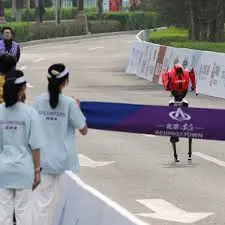
robot is now part of a race that was supposed to belong to people alone. In China, a humanoid machine completed a 21-kilometer half marathon in 50 minutes and 26 seconds, marking an unusual benchmark that turns a sports result into a signal about how quickly machine performance is changing.
What Happens When a Machine Crosses a Human Benchmark?
The result matters because it is not just about one finish line. It shows a robot moving through a task that combines endurance, balance, and speed over a long distance. The winning unit came from Honor, a Chinese smartphone maker, and finished the race at the Beijing E-Town event in Beijing, where the run began.
That 50-minute-and-26-second time is the clearest fact in the moment: a machine completed the distance in a way that immediately invites comparison with human performance. The context is narrow, but the message is broad. When a robot can complete a half marathon, the boundary between demonstration and practical capability begins to look thinner.
What Is the Current State of Play?
The available record points to a single race, a single winner, and a single verified time. The event took place in Beijing E-Town, and the result was posted by the Beijing Economic-Technological Development Area. Those details matter because they ground the story in a formal setting rather than a staged showcase without measured outcomes.
This is also why the development should be read carefully. It does not mean robots have broadly surpassed humans in every athletic or real-world setting. It does show that a robot can now sustain movement across a long route well enough to produce a result that is easy to understand and hard to ignore.
| Element | What the context shows |
|---|---|
| Event | Half marathon in Beijing E-Town |
| Distance | 21 kilometers, or 13 miles |
| Winning time | 50 minutes and 26 seconds |
| Winning maker | Honor, a Chinese smartphone maker |
What Forces Are Reshaping the Robot Race?
The first force is technical progress. A humanoid machine that can complete a half marathon signals progress in motion control, endurance management, and system reliability. Even without additional specifications, the race result suggests that the robot category is moving from isolated display toward repeatable performance under conditions that test stability.
The second force is competition through public benchmarks. A race gives the public an easy way to measure progress, and that can accelerate attention from companies, institutions, and investors. Once a robot is shown in a timed event, the comparison standard is no longer abstract. It becomes visible, immediate, and easy to repeat.
The third force is narrative power. This result lands because it is simple to explain: a machine finished a half marathon faster than any human ever in that setting. Simple milestones travel fast, and they shape expectations even when the broader implications are still uncertain.
What If This Becomes a Pattern?
Three scenarios stand out from the available evidence:
- Best case: robot performance keeps improving in public tests, helping establish clearer benchmarks for endurance, balance, and practical mobility.
- Most likely: the result remains an important proof point, but one that highlights how uneven progress can be across different machine tasks and environments.
- Most challenging: the headline result creates inflated expectations, while real-world use still depends on conditions that a race cannot fully capture.
Each path is consistent with the current facts. The race is a milestone, but it is not a complete answer. The uncertainty is not whether the event happened; it is what kind of progress it truly represents beyond the course in Beijing.
Who Wins, and Who Has More to Prove?
The immediate winner is the maker behind the machine, because the result places its robot in a global conversation about capability and speed. More broadly, the robotics field wins attention, because the public now has a concrete benchmark to discuss.
Humans, in a sense, are not losing a race so much as watching the category expand. That matters for firms building advanced machines, for organizers who may use similar events to test systems, and for observers trying to understand how fast machine performance is changing. Still, the burden of proof remains high. A single robot finishing a half marathon is notable; proving versatility across many tasks is a different challenge.
What Should Readers Take From This Moment?
The main lesson is that robot progress is no longer confined to laboratory claims or vague promise. It is entering public view through measurable events that create clear reference points. That does not settle the larger debate over where machine capability goes next, but it does raise the floor of what counts as possible.
Readers should watch for whether this becomes a repeatable trend or remains a headline-grabbing one-off. The difference will matter. If more machines can perform under similar conditions, the benchmark will shift from novelty to expectation. If not, this result will still stand as an important signpost of how far the field has come. For now, the clearest takeaway is that robot performance has reached a new and highly visible stage.