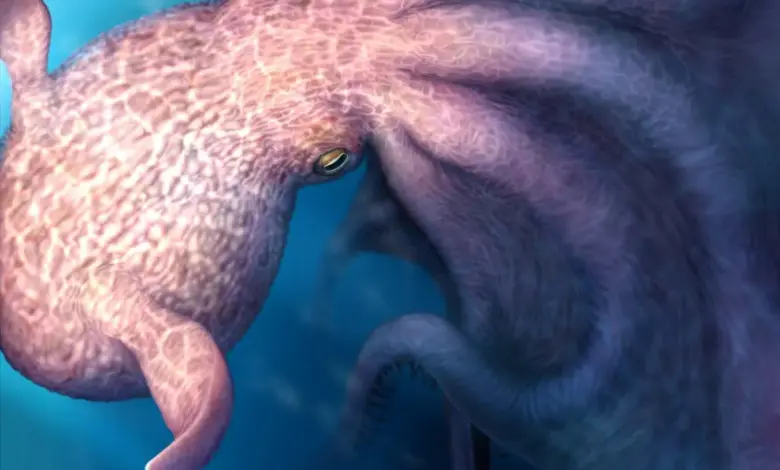
In rocks collected from Japan and Vancouver Island, a story about nanaimoteuthis has emerged from what was once hidden in stone: a predatory octopus that may have lived as an open-water hunter in the Cretaceous seas and grown to extraordinary size.
The fossil evidence points to an animal that was not just large, but active, powerful, and built for predation. Researchers identified 27 fossilized octopus jaws dating between 100 million and 72 million years ago, and from that material they concluded that only two species are currently confirmed: Nanaimoteuthis jeletzkyi and N. haggarti.
What makes Nanaimoteuthis important to scientists?
The significance of nanaimoteuthis lies in what it changes about the scale of Cretaceous oceans. Yasuhiro Iba of Hokkaido University in Japan said these octopuses “could be thought of as the orcas or great white sharks of the invertebrate world” because they were large, intelligent, and highly effective apex predators. He described them as animals over 10 meters long, with long arms and powerful jaws capable of crushing hard structures.
That image is not built on a full skeleton. In soft-bodied animals, the jaw or beak is often the only part that survives as a fossil because it is made primarily of durable chitin. In this case, a dozen of the jaws were new to science and were still locked inside rock until high-tech scanning equipment and digital fossil mining, combined with artificial intelligence, allowed researchers to image the remains in detail.
How large could Nanaimoteuthis haggarti have been?
The largest estimates come from the jaw-to-body relationship used by the team. Iba said the analysis suggests Nanaimoteuthis haggarti may have reached about 6. 6 to 18. 6 meters in total length. That would place it among the largest invertebrates in Earth’s history. The jaws of N. haggarti stood out even against large modern cephalopods, and the team said the full scale only became clear after they compared jaw size with the mantle length of modern, long-bodied finned octopuses.
For the broader Cretaceous seascape, the finding adds another layer to a period already known for giant animals. John Long of Flinders University in Australia said he was not surprised that many creatures of that time went through gigantism, naming sharks, marine reptiles, and ammonites as examples. Still, he called the discovery “gob-smacking” and said the oceans were full of food for large predators.
What did these ancient octopuses look like in the water?
Although they superficially resembled today’s giant squid, the ancient octopuses were different animals. The comparison matters because giant squid are open-water swimmers, and these octopuses were too. But Iba said squids typically have eight arms plus two long tentacles for prey capture, while octopuses rely heavily on all eight arms to capture prey. That difference helps frame Nanaimoteuthis as a hunter with its own set of tools, not simply a larger version of a modern squid.
The overall picture is one of a sea with room for formidable predators. The fossil jaws suggest that nanaimoteuthis was not an oddity at the edge of the food web, but a central predator in it, one that may have used size, strength, and possibly advanced behavior to dominate its environment.
What does this discovery mean for the Cretaceous seas?
The new fossil work narrows the list of confirmed Cretaceous octopuses to two species and gives scientists a sharper view of how marine life evolved under conditions that supported gigantism. It also shows how much can remain hidden in plain sight until new imaging methods reveal what old rocks contain. In that sense, nanaimoteuthis is more than a name from the fossil record. It is evidence that the Cretaceous seas may have held predators as formidable as any on land, even if their bodies were mostly soft, their jaws were small, and their scale was only just beginning to be understood.