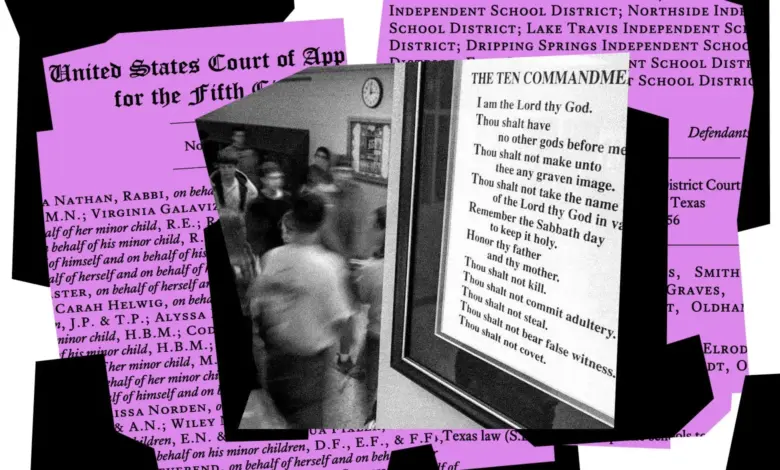
The Ten Commandments have become a turning point in the fight over what public schools may display, and the Texas ruling has pushed that fight into a sharper phase. On Tuesday, the 5th U. S. Circuit Court of Appeals allowed the state to move ahead with a classroom mandate that had been blocked in part by lower courts, setting up a direct clash over how far states can go in putting religion in front of students.
The immediate issue is narrow, but the implications are not. Texas, Louisiana, Arkansas, and now Alabama have all moved toward classroom displays, while Republican lawmakers in other states are pressing similar measures. The result is a fast-moving test of whether school walls can become a venue for religious messaging in ways that earlier courts said crossed a constitutional line.
What Happens When Court Rulings Meet Classroom Displays?
The current state of play centers on Texas, where the law requiring the Ten Commandments in every public school classroom took effect in September. The 5th U. S. Circuit Court of Appeals in New Orleans reversed a lower-court ruling that had blocked about a dozen Texas districts from hanging the posters. In a 9-8 vote, the court said the requirement does not violate students’ or parents’ rights.
Supporters see the ruling as part of a broader effort to expand the role of religion in classrooms. Critics see it as a step toward state endorsement of religious doctrine in a setting where children are a captive audience. The dispute has already produced practical consequences: school board meetings have become flashpoints, teachers have received guidance on what to say when students ask questions, and some teachers have resigned rather than post the displays.
The legal fight is not isolated. Louisiana became the first state to pass a requirement in 2024, followed by Arkansas and Texas. Alabama has since joined the list, with Republican Gov. Kay Ivey signing a law this month requiring displays in 5th through 12th grade classrooms where U. S. history is routinely taught, along with common areas such as cafeterias and school libraries.
What If the Trend Spreads Beyond Texas?
The broader trend is visible in the legislative pipeline. An analysis of state legislation compiled by the bill-tracking software Plural found at least 30 measures introduced in current sessions that would require display of the document in schools. Nearly all were introduced by Republican lawmakers, and almost all were in GOP-controlled states.
That matters because the Texas case is no longer just about one state’s policy. It is now a signal to lawmakers elsewhere about how far they may be able to push classroom religion mandates before courts stop them. It also gives school districts a preview of the operational strain that comes with such laws: whether posters are donated, who installs them, what teachers say when students ask about them, and how families respond when a state-ordered religious text appears in a public classroom.
The key legal and political pressure points are clear:
- States are testing whether a new court climate will permit religious displays in public schools.
- Districts face administrative and staff-level friction when a law reaches the classroom.
- Families of other faiths may view the requirement as government preference for one tradition over another.
- Lawmakers are using school policy to force a broader constitutional review.
What Happens When The Ten Commandments Become a National Test?
The most consequential force is the court system itself. The Texas ruling reversed a lower-court block, but the issue remains unsettled. The 5th Circuit’s decision is important not only because it advances the state law, but because it invites further review of how much weight older precedent still carries in school-religion cases.
That creates three possible futures. In the best case for supporters, more states follow Texas and the display rules remain intact. In the most likely case, the issue keeps moving through the courts, producing uneven enforcement and continued conflict inside school districts. In the most challenging case, the dispute escalates into a broader constitutional fight that forces schools, parents, and lawmakers to live with years of uncertainty.
What makes the moment especially important is that this is not happening in a vacuum. The push is advancing alongside efforts to expand Bible stories in classrooms and to normalize public-school exposure to religious material. That broader pattern suggests the Texas ruling is less an endpoint than a marker of a larger campaign.
What Should Readers Watch Next?
Readers should watch for two things in the coming months. First, whether more states turn classroom display laws into active policy rather than proposals. Second, whether courts treat the Texas ruling as an isolated decision or as the start of a wider shift in how schools may handle religion.
The immediate stakes are practical, but the larger stakes are institutional. Public schools are where the tension between state power, family belief, and constitutional limits becomes visible. If the current trend continues, districts will need to manage not only legal compliance but also community conflict and staff uncertainty.
For now, the best reading is cautious: the movement is real, the resistance is real, and the final shape of the law is not settled. The Ten Commandments will remain a test of how far states can go in redrawing the line between education and religion, and how much lower courts can diverge before a higher court steps in. Ten Commandments