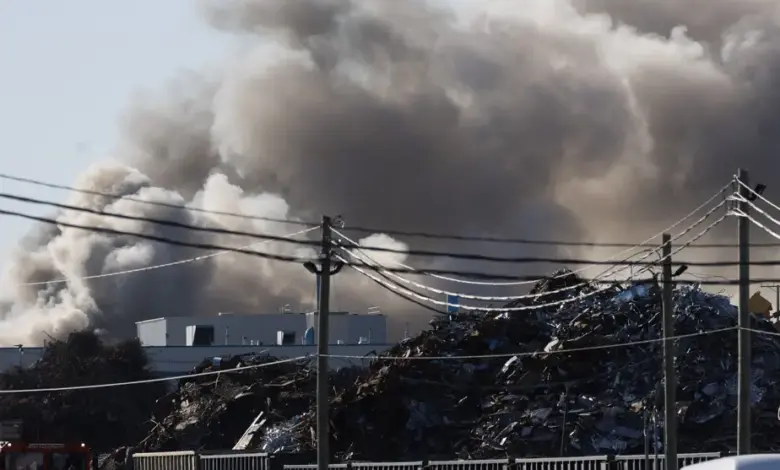
Fumée from Thursday morning’s fire in eastern Montreal has become more than a visible plume; it is now the clearest marker of a city weighing immediate air-quality concerns against a longer regulatory battle over a recycling site that has been under pressure for years.
What Happens When a Fire Becomes a Regulatory Turning Point?
The fire at the metal-recycling site in Montréal-Est did not cause injuries, but it quickly moved the issue from environmental enforcement into public view. The Service de sécurité incendie de Montréal was alerted at about 5: 20 a. m. ET, and around 50 firefighters were mobilized to battle flames involving waste and vehicles.
Within hours, the City of Montreal revoked all operating permits for American Iron & Metal. The city said repeated demands to bring the site into compliance had not been met, and that ongoing exceedances of particles and metals were still being measured at the property line. The city also said the fire was not the reason for the revocation; the decision had already been prepared for release later in the day.
The timing matters because it shows how quickly one industrial incident can sharpen a broader policy dispute. The site has faced repeated interventions in recent years, including a suspension in October 2024 of a particle-emitting piece of equipment, a move that is already the subject of a legal challenge by the company. A new metropolitan regulation on atmospheric pollutant releases is also being contested by the company, which says it is discriminatory, abusive and unreasonable.
What Happens When the Smoke Moves Across the City?
Public-health messaging has focused on caution rather than alarm. The Santé publique warned that air quality could be affected in several parts of the metropolitan area. Dr. David Kaiser, deputy medical director at Montreal’s regional public health authority, said smoke should be avoided, especially by people with respiratory or heart conditions, young children, pregnant women, older adults and outdoor workers.
Normand Voyer, full professor of chemistry at Université Laval, said the black plume contains particulate matter that can enter the lungs and cannot be filtered by the nose. He advised people in the path of the smoke to avoid outdoor exercise, wear a mask if they must go outside, or stay indoors as much as possible.
The environmental picture remained mixed but not fully resolved. In the early afternoon, the ministry responsible for the environment confirmed that no toxic particles had been detected in the air. Dr. Kaiser also said that no particularly worrisome substance had been identified at that stage. Even so, officials stressed that the situation was evolving quickly and that improvement was expected as the plume rose during the day.
What Should Readers Watch Next?
| Possible development | What it would mean |
|---|---|
| Permit dispute escalates | More legal action between the city and the company |
| Air quality improves during the day | Shorter-lived public-health impact, but continued scrutiny |
| Further contamination concerns emerge | Stronger pressure on regulators and the operator |
Who gains from this moment is the regulatory system, if enforcement now carries clearer consequences. The city has already signaled that repeated non-compliance will not be treated as routine. Public-health authorities also gain credibility when they communicate practical advice without overstating the danger.
The losers are more complicated. The company faces mounting legal, operational and reputational pressure. Nearby residents face uncertainty whenever smoke drifts across the east end of the island. Workers outdoors and people with existing health conditions remain the most exposed when the air turns visibly worse, even if toxic particles are not immediately detected.
At the same time, the case shows the limits of certainty. No one can yet draw a final conclusion from one fire alone. What is clear is that fumée has become the signal connecting public health, environmental enforcement and industrial accountability in Montreal, and the next steps will likely shape how that balance is handled well beyond this incident.