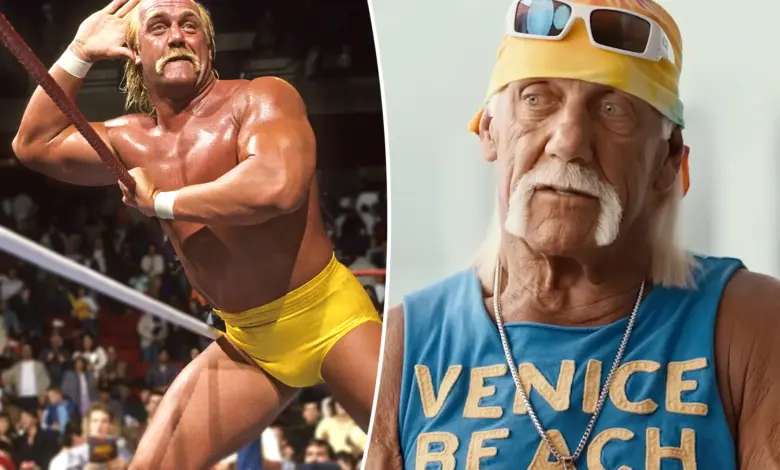
hulk hogan’s final interview in Netflix’s Hulk Hogan: Real American lands with an unusual force: it is both a personal farewell and a curated public reckoning. Filmed in early and mid-2025, the documentary captures the WWE icon months before his death at 71 in July, when health limitations were already visible on screen. The result is less a victory lap than a portrait of decline, legacy, and the way fame can outlive the body that built it.
Hulk Hogan’s Final On-Screen Years
The most revealing thread in the series is not spectacle but fragility. hulk hogan appears working out in his home gym, using a cane, and describing pain that had become part of daily life after years of surgeries and the toll of a wrestling career. He says he feels “okay but it’s a pain, ” and adds that he needs his son Nick to open water bottles for him. The admission is small, but it says more than any highlight reel: the body that once defined an era had become a source of dependence and embarrassment.
That physical decline gives the documentary its strongest emotional frame. Because the interviews were completed only months before his death, the footage now functions as a final public record. It is not simply retrospective; it is terminally retrospective, which changes how every pause, gesture, and confession reads.
Family, Memory, and the Burden of the Past
The series also turns inward, tracing hulk hogan’s childhood in South Tampa, Florida, where he describes “broke” parents and a hard father he remembers as rough and emotionally distant. He says his older brother was the favorite and that repeated comparisons left him with a “big chip on my shoulder. ” Those details matter because they frame the ambition that followed. The documentary suggests that what looked like swagger in public may have been an answer to insecurity in private.
That interpretation extends into his family life. Linda Hogan, his first wife, offers a far more vivid account of their early relationship than he does, underlining the gap between self-mythology and memory. Their marriage, which lasted from 1983 until their 2009 divorce, produced two children, Nick and Brooke. Brooke does not appear in the documentary, and that absence itself becomes part of the story. The film shows a family system still shaped by distance, even as it tries to present a full accounting.
The Career That Built the Brand
The documentary revisits the mechanics of the Hogan persona, including how Vince McMahon Sr. gave him the stage name that became a global brand. Hogan acknowledges confusion over the name at first, noting that he was Italian, not Irish. That exchange may seem minor, but it illustrates how much of his public life depended on reinvention. His breakout in Rocky III in 1982 pushed him beyond wrestling and into broader pop culture, expanding his fame while reinforcing the larger-than-life image that the documentary keeps circling.
Yet the film does not treat that rise as uncomplicated. It places his career inside a pattern of injuries, image management, and ego-driven mythmaking. One interviewee describes him as “being a mark for your own gimmick, ” a line that captures the tension at the core of the project: Hogan was both performer and product, and eventually the product became harder to separate from the person.
Trump’s Presence and the Politics of Spectacle
Donald Trump’s appearance adds another layer to the documentary’s meaning. Their friendship predates Hogan’s 2024 political endorsement, and Trump’s interview was filmed in the Oval Office. He calls Hogan a “showman” and a “good man, ” while Hogan later plays a voicemail in which Trump thanks him for the endorsement and calls him a “winner. ” The exchange is revealing not only because of the friendship, but because it shows how both men relied on spectacle as political and cultural language.
hulk hogan says the turning point in his support came after the assassination attempt on Trump during the summer of 2024. He describes earlier votes for Trump as cowardly because he had not publicly displayed his support. That framing turns the endorsement into a story of personal transformation, but the documentary also makes room for irony. Trump, who appears in multiple episodes, offers little reciprocal warmth and comes across as highly self-focused, even when asked to imitate Hogan’s finger wag.
Why the Docuseries Matters Beyond Wrestling
The broader significance of the series lies in how it compresses American celebrity culture into one narrative: fame, reinvention, scandal, politics, and mortality. It acknowledges past controversies, including the 2012 publication of stolen intimate footage and the racial slur that later reshaped public perception of him. It also notes the consequences, from contract termination to removal from the Hall of Fame, and then the later reinstatement. Those facts do not sit comfortably beside the nostalgia, and that discomfort is exactly why the documentary matters.
For viewers, the final impression is not of triumph but of unresolved contradiction. hulk hogan is presented as a man who built an enduring character, survived public disgrace, and returned to the spotlight one last time only to reveal how much the body and the legacy had both frayed. The open question is whether the documentary closes the book on Hogan’s image, or simply proves that in American culture, even the final interview can still be another act in the performance.