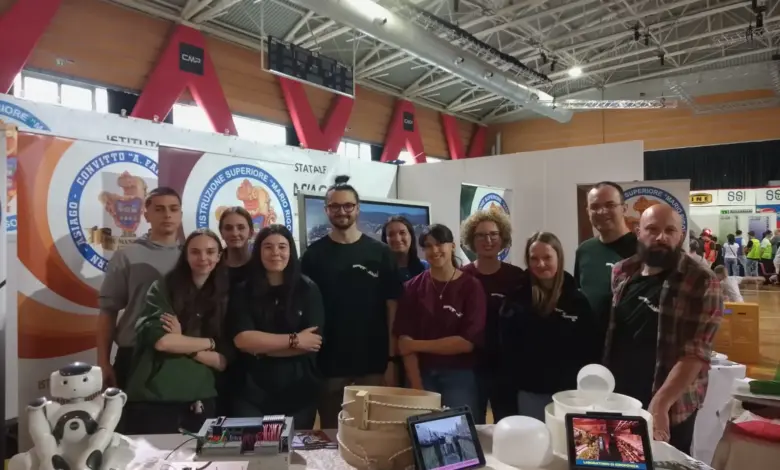
Asiago is appearing this week in a surprisingly practical role: not as a destination, but as a school brand trying to meet families where their decisions begin. The IIS Mario Rigoni Stern used BassanOrienta and the M. I. Th. in Thiene to present its full offer, and the timing matters. With orientation season underway, the school is turning two local fairs into a wider campaign to explain its identity, its paths, and the Convitto “College A. Farina” to second-year middle school students and parents.
A broader presence beyond one fair
The school’s participation was not limited to Bassano del Grappa. It appeared at BassanOrienta at the CMP Arena and, on Saturday, also at the M. I. Th. in Thiene. That double presence gives Asiago a wider territorial reach at a moment when families are looking for clear signals, not abstract promises. In both settings, the institution presented a structured offer that includes the Liceo Scientifico with Scienze Applicate and Sportivo, the ITE with Amministrazione, Finanza e Marketing and Turismo, and the Ipsia with Enogastronomia e Ospitalità Alberghiera, Automazione e Robotica, and Agricoltura e Sviluppo Rurale.
That breadth is the core of the school’s message. Rather than narrowing its public image to a single path, Asiago is presenting itself as a multi-track institution with options that speak to different interests and aptitudes. The inclusion of the Convitto “College A. Farina” reinforces that identity, suggesting that the offer is not only academic, but also tied to a fuller student experience. In the context of school choice, that matters because families often weigh not just subjects, but environment, support, and continuity.
Why the timing matters for Asiago
The fairs were designed for students in second grade of lower secondary school and their families, meaning the audience is at the stage where decisions are still open but becoming more concrete. In that sense, Asiago is using orientation as an early trust-building exercise. The school is not waiting for enrollment conversations to begin in a classroom setting; it is meeting potential students in public spaces where questions can be asked directly and comparisons can be made on the spot.
The response appears to have been strong. The stands drew a very positive reaction from middle-school students and their families, with questions, requests for information, and curiosity shaping the exchanges. That detail is important because it shows orientation working as intended: not as a one-way presentation, but as a dialogue. For a school that wants to be understood through its range of programs and territorial roots, those interactions are the first layer of recruitment and reputation-building.
What the school is really signaling
Behind the event presence, Asiago is signaling something more strategic than simple visibility. By appearing at BassanOrienta, the M. I. Th., and earlier at SchiOrienta, the school is building continuity across several orientation moments. That continuity helps create recognition, especially for families comparing multiple institutions. It also suggests an effort to make the Mario Rigoni Stern name familiar before the enrollment stage becomes urgent.
This is where the school’s message becomes more than a list of courses. The repeated emphasis on plurality of paths, territorial rootedness, and the ability to form different profiles points to a school that wants to be seen as adaptable. In the current orientation cycle, Asiago is using these fairs to say that its identity is not confined to one specialization. Instead, it is framing itself as a place where academic, technical, and professional tracks coexist under one structure.
Impact on families and the wider region
The broader effect reaches beyond the school itself. For families in the Bassano, Thiene, and Schio areas, the fairs reduce the distance between curiosity and decision. They allow parents and students to compare offers in a single setting and to ask direct questions about study paths, student life, and practical outcomes. For the region, that kind of outreach strengthens the role of orientation as a public service rather than a private choice made in isolation.
For Asiago, the current round of appearances also creates useful contact ahead of orientation for 2026-2027. That forward-looking layer is significant: the school is not only presenting what it already has, but also laying groundwork for future conversations with students and parents. In that sense, Asiago is treating the fairs as both a showcase and a listening exercise, one that may shape how its offer is perceived when the next enrollment season opens.
For a school with a wide educational portfolio, the challenge is not simply to be present, but to be remembered. If the interest shown in Bassano and Thiene continues, Asiago may have found in orientation events the most direct route to making its identity visible well before choices are made. The question now is whether that early visibility will translate into lasting preference when families move from curiosity to commitment about Asiago.