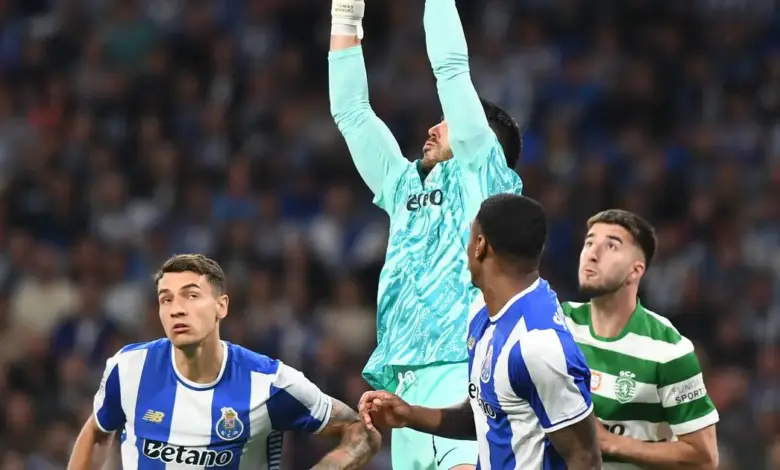
The night at the Dragão felt tight from the first whistle, and porto vs sporting quickly became more than a semifinal second leg. It was a match loaded with noise from the stands, tension near the benches, and the weight of a tie that still had to be turned around by FC Porto.
What makes Porto Vs Sporting so tense at the Dragão?
FC Porto entered the match needing a victory by two goals to move on to the final of the Taça de Portugal. Sporting arrived with the advantage from the first leg, having won 1-0 in Alvalade, and could afford the draw that would keep them on course for Jamor.
That balance of risk and protection shaped everything. A single goal for Porto could change the mood without fully changing the math. A narrow home win would push the match into extra time, and if needed, penalties. So every duel, every clearance, and every stoppage carried extra meaning. The crowd sensed that from the opening moments, especially as the home side tried to impose itself while the visitors managed the game with the cushion they had earned earlier in the tie.
The opening scene was not calm. The supporters displayed messages that framed the occasion as a test of resilience, while the match itself was already creating small flashes of friction. William Gomes caused danger on the right, Rui Silva responded with a strong palm, and the moment offered a glimpse of how little margin either side had. Later, Farioli was shown a yellow card for protests, and the benches became part of the story when another yellow was shown after Porto appealed for a penalty on William Gomes. The emotional temperature rose fast, and the Dragão answered in kind.
How does this semifinal reflect the wider Taça de Portugal picture?
The tie is also part of a broader Cup landscape. The winner of porto vs sporting will face the team that advances from Torreense and Fafe, two sides that sit outside the traditional heavyweight frame of the competition. That contrast gives the semifinal extra value: one side of the bracket is defined by a classic, while the other offers a path shaped by underdog ambition.
For Porto, the match also sits inside a season where the club has regained some league comfort. The context around the team suggests a different kind of pressure than Sporting’s. FC Porto lost in Europe in Nottingham last Thursday, but the gap it now holds over Sporting in the league gives Farioli room to think about a possible double, four years after that achievement was last completed at the club. For Sporting, the week has been harder, with the team eliminated from the Champions League by Arsenal and then beaten by Benfica, a sequence that sharpened the stakes in this semifinal.
There is also a historical edge. Farioli is trying to do something in his first season at the Dragão that only André Villas-Boas had done before: overturn a Taça de Portugal semifinal played over two legs. That memory gives the night a second layer, because the task is not only about one result but about joining a very small set of successful comebacks.
Who changed the game plans and what does that tell us?
The lineups tell their own story. Rui Borges changed only in attack, bringing in Quenda, who returned to the starting XI for the first time after injury and had not started for nearly five months. On Porto’s side, Farioli made four changes, introducing Thiago Silva, Pablo Rosario, Gabri Veiga, and William Gomes, while Martim Fernandes was not even on the bench.
Those choices show two different responses to the same problem. Sporting aimed for control with a single attacking adjustment. Porto looked for energy and variation across the team, trying to find enough movement to break down a side that had already protected a first-leg lead. That contrast is part tactical, part psychological: one team defending a margin, the other trying to create belief through selection.
Among the named figures in the night, Rui Silva again stood out in the early exchanges by stopping the cross from William Gomes, while Gonçalo Inácio had to leave after struggling following a previous collision in the match. The benches, the officials, and the medical staff all became part of the same unfolding pressure.
What does the Dragão need now?
At this stage, Porto need clarity as much as urgency. The equation remains simple: score enough, while avoiding the kind of lapse that would make Sporting’s first-leg edge decisive. Sporting, for their part, need composure and discipline, because every minute they absorb without conceding makes the path to Jamor shorter.
That is why porto vs sporting feels larger than one semifinal. It is a match about control, memory, and the strain of staying sharp when the margin is thin. Back in the stands and beside the benches, the emotion has already risen. On the pitch, the next touch may decide whether the Dragão is remembered as the place where a comeback began, or where the first-leg advantage finally held.