Kalashnikov’s Unmanned Aerial Vehicle Pitch to Asia-Pacific Buyers Reveals a Narrower Export Story

The most revealing detail in the current unmanned aerial vehicle push at Defence Services Asia 2026 is not range or payload, but simplicity: one soldier can fire the system, run the fire-control equipment, and manage the related components. That design choice frames Russia’s export message in Kuala Lumpur as much as any technical specification.
What is Russia actually offering in Kuala Lumpur?
Verified fact: Kalashnikov’s Rus-PE containerised loitering munition is being displayed at Defence Services Asia 2026 in Kuala Lumpur, held from 20 to 23 April. A representative for Rosoboronexport said the system is being offered to export customers in the Asia-Pacific region. The munition is described as manportable, with day-and-night cameras, a dual guidance system, and a warhead of up to 2 kg.
Verified fact: The same representative said Rus-PE has an endurance of 30 minutes and a maximum cruise speed of 140 km/h. The maximum range was not disclosed. That absence matters because the export pitch gives buyers enough to evaluate portability and basic performance, but not enough to fully measure reach.
Analysis: In an exhibition environment built around institutional and government buyers, the omission leaves the system positioned as a compact battlefield tool rather than a fully transparent long-range option. The practical appeal is obvious; the operational envelope is still partially withheld.
Why does the one-soldier feature matter?
The representative said one soldier can launch the munition and operate the fire-control system and other related components. The representative added: “A crucial thing about this type of system is that it is easily operated by one person. ” That statement is central to understanding the export strategy.
Verified fact: The emphasis is on reduced manpower and rapid deployment. The system’s containerised format and manportable design suggest a product aimed at customers seeking field usability without a large support footprint. For Asia-Pacific buyers, that makes the system less about complex integration and more about immediate tactical utility.
Analysis: This also signals a broader commercial logic. A system that can be run by one operator lowers the threshold for adoption, especially where training time, transport, and crew availability are constrained. The appeal is not only technical; it is organizational.
How does this fit the wider Russian export message?
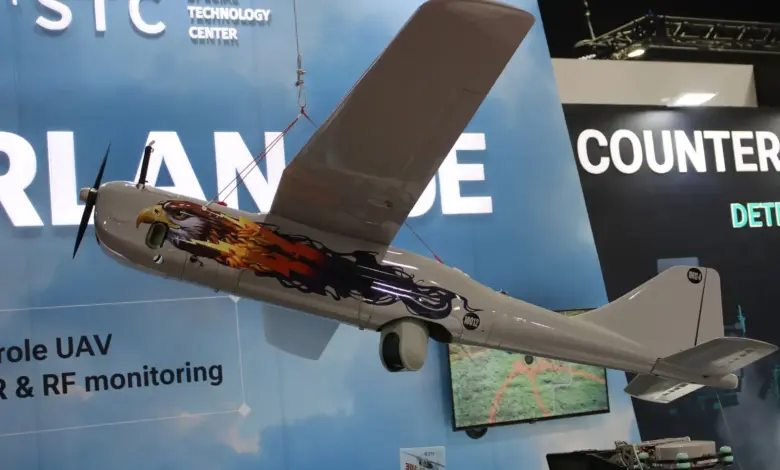
Rus-PE is not being shown in isolation. At the same exhibition, Rosoboronexport is also presenting other Russian systems, including the Lancet-E family of unmanned aerial vehicle platforms and the Orlan-10E reconnaissance drone. Together, these displays suggest a layered export narrative: one system for loitering strikes, another for reconnaissance, and another for artillery correction and surveillance.
Verified fact: The Lancet-E family was described as having upgrades intended to improve range, endurance, and precision, with the Z-16E reconnaissance UAV receiving artificial intelligence-based tracking and detection mechanisms. The Orlan-10E was presented as an export-ready reconnaissance drone with combat use in Russian service and a role in artillery correction. In that context, Rus-PE sits alongside a broader portfolio of battlefield systems built for export customers in the Asia-Pacific region.
Analysis: The common thread is not just aircraft design. It is the packaging of combat-relevant capability into exportable forms that can be displayed, explained, and sold within a regional market. The presentation in Kuala Lumpur suggests Russia is trying to convert battlefield reputation into procurement interest.
What remains unknown, and why does it matter?
Verified fact: Rosoboronexport did not disclose the maximum range of Rus-PE. The representative did provide endurance, speed, payload, and operating features, but not the full extent of the munition’s reach. That gap is not a minor omission; it is a key variable for any buyer assessing how the system fits into operational planning.
Analysis: When a manufacturer highlights one-person operation, day-and-night cameras, and a dual guidance system but leaves out maximum range, the message becomes selective. The export pitch is built to emphasize usability and tactical flexibility while keeping the most sensitive performance detail off the table. That is a familiar structure in defense marketing, but it is especially important here because the system is being offered to foreign customers.
The question for buyers is therefore not whether the system is compact or easy to use. It is whether the disclosed performance is enough to judge its place within a wider force structure. Without the missing range figure, the picture remains incomplete.
Who benefits from this positioning?
Verified fact: The display is aimed at export customers in the Asia-Pacific region, and the system is being shown in a unified Russian pavilion at DSA 2026. Rosoboronexport serves as the state export channel, while Kalashnikov is the company presenting the Rus-PE.
Analysis: The immediate beneficiaries are the manufacturer and the export agency, both of which gain visibility in front of institutional buyers. For potential customers, the benefit is access to a manportable munition with a relatively small warhead, dual guidance, and short-duration employment. For analysts, the more important takeaway is that the presentation is calibrated to reduce friction in the buying process while leaving some operational questions unanswered.
The broader implication is straightforward: Russia is not only selling equipment. It is selling a model of how compact unmanned aerial vehicle systems can be fielded with minimal manpower, in a format tailored for export conversations rather than full technical disclosure.
That is why the Rus-PE display deserves attention. It shows how a defense exporter can turn a brief product description into a strategic pitch: one person, one containerised system, and one carefully managed set of facts. For any buyer weighing the offer, the missing range figure remains the most important unanswered question about the unmanned aerial vehicle on display.