Thirty-one years on, the bomb that shattered the Alfred P. Murrah Federal Building still forces a hard question: why do the most visible stories of survival sit beside the deepest losses? On April 19, 1995, the Oklahoma City bombing killed 168 people, including 19 children, while six children from America’s Kids Daycare inside the building survived.
What is the central question the anniversary still raises?
The anniversary is not only about remembering the dead. It is also about understanding how a single bomb transformed an ordinary morning into a national trauma in seconds. The blast at 9: 02 a. m. sheared off the building’s north face and collapsed floors within moments, leaving hundreds injured and families, first responders, and survivors carrying the consequences long after the rubble was cleared.
Verified fact: The attack was carried out with a rented Ryder truck packed with explosives outside the Alfred P. Murrah Federal Building. Timothy McVeigh was later convicted in 1997 on multiple federal charges and executed by lethal injection in 2001. Terry Nichols was sentenced to multiple life terms for his role in the attack.
Why does the story of six surviving children matter so much?
Among the most haunting details is that six children from America’s Kids Daycare survived inside the building. One of them, Joe Webber, was only 20 months old at the time. He later described his survival as both a blessing and a hindrance, saying that not remembering the event leaves him without direct images of the horrors, yet still bound to the people who were inside the building and to the city itself.
That detail matters because the bomb did not just take lives; it reshaped identity. For survivors like Webber, the event exists as memory, family history, and civic burden at once. The attack’s scale is measured in deaths and injuries, but its reach extends into lives formed around an absence that never really ended.
How did survivor testimony change the public view of the bombing?
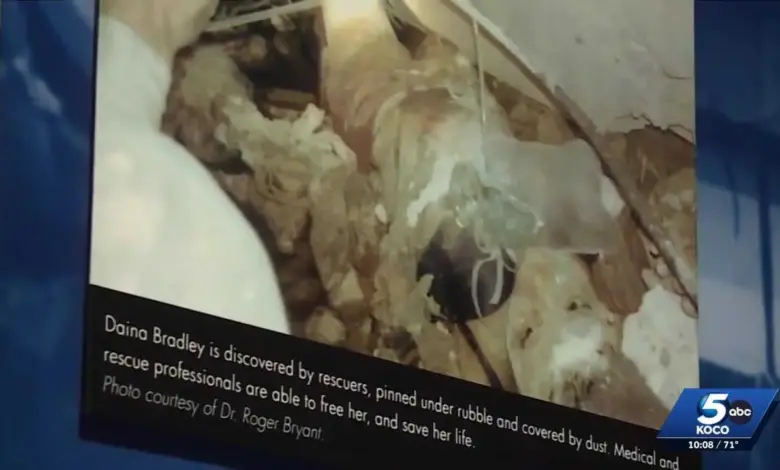
Daina Bradley’s account shows how the bomb’s violence was experienced in real time. She said the room turned red, time seemed to slow, and the clock read 9: 02. She entered the Social Security office with her mother, sister, and two children, then found herself buried alive under rubble with her ankle pinned and rebar through her leg.
Verified fact: Bradley said firefighters found her while she was trapped in water after pipes burst and the cold trapped her arm in ice. She recalled hearing her mother, children, and sister screaming for help. Rescuers told her they would have to remove her leg to save her life, and she chose survival.
Her testimony is important because it reveals the scale of the bomb beyond statistics. The dead are counted at 168, but the living carried permanent damage, fear, and grief. Bradley also said the worst moment was not the loss of her leg; it was hearing the screams of others stop.
Who was implicated, and what does that tell us now?
The attack was tied to Timothy McVeigh, a former U. S. Army soldier who held deep anti-government views, and Terry Nichols, who helped plan and prepare the bombing materials. Authorities later determined that the timing matched the second anniversary of the Waco siege, which fueled McVeigh’s extremist beliefs. McVeigh was arrested just 90 minutes after the bombing during a traffic stop for driving without a license plate.
Informed analysis: The speed of the arrest did not reduce the depth of the damage. It only showed how quickly a domestic terror act can move from execution to evidence trail, while the human consequences remain unresolved for decades. The case became a legal endpoint, but for survivors it became a lifelong starting point.
The Oklahoma City bombing remains the deadliest act of domestic terrorism in U. S. history at the time. That fact explains why the remembrance continues to matter. The public is not only remembering an attack; it is confronting the way ideology, preparation, and access to explosives turned a federal building into a site of mass loss.
What should the public take from this reckoning?
In two days, Oklahoma City will pause again to remember the dead. That pause is more than ritual. It is a measure of whether the public still understands the scale of what happened, the burden carried by survivors, and the warning embedded in the case itself.
The enduring lesson is that the bomb did not end when the smoke cleared. It continued in survivor testimony, in family grief, and in the unfinished work of remembering each person inside the building. If the anniversary is to mean anything, it must preserve the names, the injuries, and the warning that a single act of extremist violence can fracture a city for generations. The public record around the bomb demands transparency, reflection, and sustained accountability.