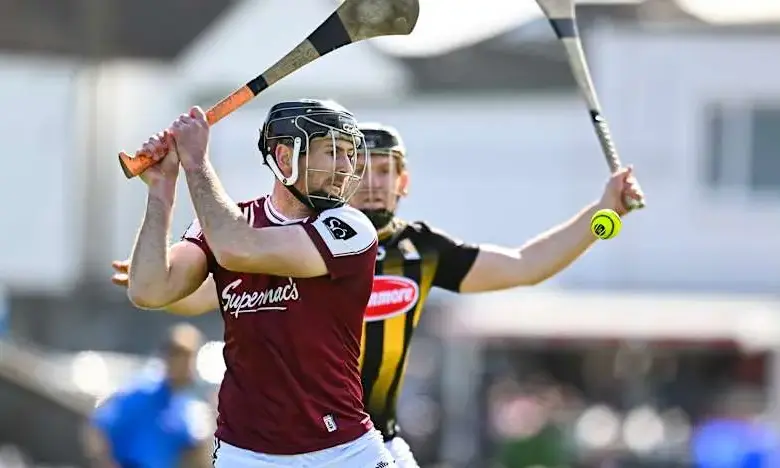
Galway’s senior hurling championship campaign took a decisive turn in Salthill, and the scale of the victory did more than hand over two Leinster SHC points. It also exposed how quickly a match can tilt when one side turns pressure into goals and the other loses discipline at key moments.
Verified fact: Galway led 2-8 to 0-9 at the break after Rory Burke struck twice, then controlled the third quarter and finished with a 3-16 to 1-13 win over Kilkenny. Informed analysis: That margin was not built on a single burst alone; it grew from a pattern of efficient finishing, a slick build-up, and repeated Kilkenny setbacks that altered the contest’s shape.
What did Galway actually do that Kilkenny could not answer?
Galway’s performance was described as a most satisfactory Saturday in Salthill, but the detail matters more than the mood. Kilkenny began more efficiently and edged 0-7 to 0-6 ahead before Galway struck for the first goal in the 25th minute. The move involved Padraic Mannion, Cian Daniels, and Tiernan Killeen, with Rory Burke finishing the play. That sequence matters because it showed a team that was not simply relying on pressure; it was creating and completing chances with clarity.
Burke struck again in the 34th minute after a foul on Aaron Niland, and the home side moved five points clear by halftime. Galway then extended control immediately after the restart, when Kilkenny’s John Donnelly was red carded for a challenge on Darren Morrissey. From there, the match stopped being a contest of small margins and became one of sustained control.
Galway outscored Kilkenny by 1-6 to 0-3 in the third quarter. The second Galway goal came in the 48th minute, when Cathal Mannion and Daniels combined to release Jason Rabbitte. The home side’s scoring depth then became visible, with substitutes Darragh Neary, Conor Cooney, Colm Molloy, Tom Monaghan, and Evan Niland all adding to the total. In a match that began with promise for both sides, the better structure and sharper finishing belonged to Galway.
Where did the contest turn against Kilkenny?
The turning points were not hidden. Kilkenny had a brief early lead and were level again at 1-6 to 0-9 after Liam Moore and TJ Reid, from a free, responded. But Galway answered with 1-2 on the spin, and the balance changed. The 34th-minute goal, coupled with the yellow card for Darragh Corcoran and the black card for Mikey Carey, underlined a period when Kilkenny were trying to keep pace without fully regaining control.
Then came the restart and the red card for Donnelly. That moment mattered because it arrived before Kilkenny could reset. The visitors still had scoring moments later, including a 61st-minute TJ Reid goal after a foul on Eoin Cody, which cut the gap to 3-16 to 1-13. But by then the gap in game management was already clear. Galway had built enough of a cushion, and Kilkenny had already spent too much energy dealing with setbacks.
Verified fact: Conor Whelan was also sent off in the dying embers after a second yellow card offence. Informed analysis: Even that late dismissal did not alter the central pattern of the afternoon: Galway had already done the decisive damage, while Kilkenny had been forced to chase a match that increasingly moved beyond their reach.
What does this mean for both teams in the weeks ahead?
For Galway, the result offers more than relief. The context in Salthill suggests a team with emerging talent and enough balance to absorb pressure before breaking a game open. Micheál Donoghue’s side had encouraging first-half moments, but the stronger point is what followed: the team did not fade after halftime, and its bench contributed meaningfully to the final score. Offaly are next on the agenda for Galway on April 26, which gives them a clear chance to carry momentum forward.
For Kilkenny, the challenge is more complicated. The defeat was not only about missed chances; it was about discipline, timing, and the inability to contain Galway once the home side found rhythm. The next assignment is immediate, with Kilkenny hosting Wexford at UPMC Nowlan Park the previous evening in a schedule where crucial matches are arriving thick and fast. That kind of sequence leaves little room for recovery if the same issues appear again.
Stakeholder positions: Galway will view this as evidence that a new and exciting wave of talent is starting to produce results. Kilkenny will need to reassess how quickly control slipped away once the game turned physical and cards entered the picture. The officials’ decisions are part of the record, but the broader story is that Kilkenny could not recover the contest after Galway’s strongest spell.
What should the public take from the scoreline?
The scoreline is not just a number; it is a signal. Galway’s victory shows a side that can convert good phases into decisive ones, with Rory Burke’s two goals setting the tone and the team’s scoring spread adding depth. Kilkenny’s reply, including TJ Reid’s goal, was real but not sufficient because the game had already been shaped by Galway’s stronger structure and cleaner finishing.
Accountability question: If Kilkenny are to avoid a repeat, the focus must be on discipline, response time, and the ability to stop a match from slipping once momentum changes hands. For Galway, the task is simpler but harder to sustain: keep the same edge, keep the same accuracy, and prove that this senior hurling championship performance was not an isolated peak but a sign of what is being built.