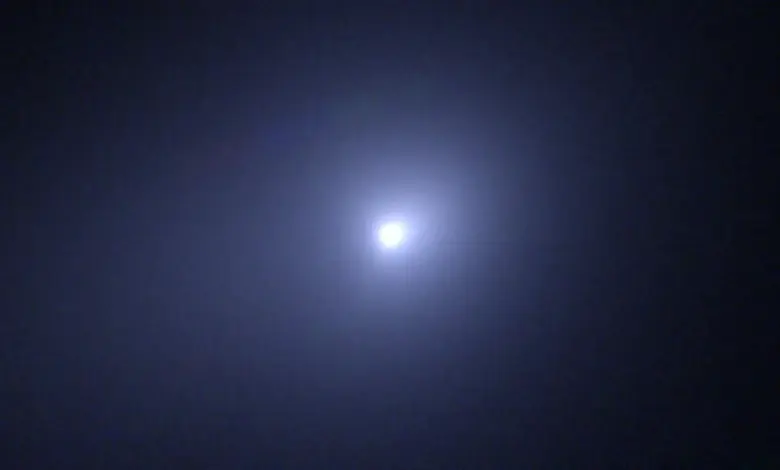
The comet 3I/ATLAS is showing a striking chemical shift as it moves through the solar system, with observations pointing to changes in its coma after its close pass to the Sun. Scientists studying the object say the findings matter because 3I/ATLAS is one of only a few interstellar visitors ever identified, offering a rare look at material formed around another star. The latest observations, tied to work from January 7, 2026 and November 2025 campaigns, are helping researchers compare how an interstellar comet behaves near the Sun in Eastern Time terms for the broader reporting window.
What changed as comet 3I/ATLAS neared the Sun
The key development is a change in the ratio of carbon dioxide to water in the comet’s coma, the cloud of gas surrounding the nucleus. Researchers studying 3I/ATLAS found that the ratio changed after the comet’s close approach to the Sun on Oct. 29, 2025, suggesting that the chemistry visible on the outside is not the same as the material deeper inside.
That distinction matters because a comet’s coma forms when frozen material in the core is heated by solar radiation and turns directly into gas. In this case, the observed shift is being read as evidence that the internal chemistry of 3I/ATLAS differs from its external chemistry. The object was observed with the Subaru Telescope near Maunakea, Hawaii, and the team used the colors of the coma to estimate the gas balance around the comet.
Why scientists are watching the comet so closely
3I/ATLAS stands out because it is only the third object ever found passing through our solar system that originated around another star. It is also on its way out of the solar system, having traveled past the orbit of Jupiter by April after looping around the Sun in October 2025 within 1. 5 AU.
Matthew Belyakov, a graduate student at Caltech and lead author on one of the new papers, said the comet has been traveling through the galaxy for at least a billion years and that its high speed created only a narrow window for study. The work published on the comet uses data from the James Webb Space Telescope to examine infrared signatures from dust, water, organic molecules and carbon dioxide in its coma.
Comet observations and the deep-space value of 3I/ATLAS
In November 2025, the Juice spacecraft also tracked the comet just after its close approach to the Sun. Those observations showed ice turning into water vapor, released at a rate equivalent to 70 Olympic swimming pools a day. Scientists involved in that work say the data help show how deep-space missions can help identify and monitor distant objects that may be too far away to see clearly from Earth.
Yoshiharu Shinnaka, team leader at the Koyama Space Science Institute in Japan, said that by applying techniques developed through studies of solar system comets to interstellar objects, researchers can compare comets from inside and outside the solar system. He said the goal is to deepen understanding of how planetesimals and planets formed in a wide variety of stellar systems, including our own.
What comes next for researchers
The comet will not return, but it is still leaving scientists with a valuable set of measurements from multiple observing campaigns. One paper is set to appear in the Astronomical Journal on April 22, while another appears in The Astrophysical Journal Letters. As more survey telescopes come online, researchers expect more interstellar objects to be found, and comet 3I/ATLAS is likely to remain a reference point for how those future encounters are studied.