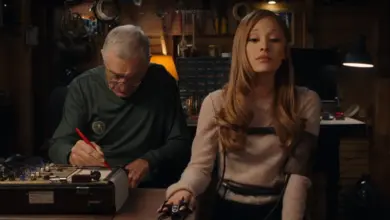
Lee Cronin’s The Mummy opens not with spectacle, but with absence: a family trying to keep going after a daughter vanished years earlier, and then, against everything they feared, came back. In this version of the story, the horror is not a bandaged figure rising from a tomb; it is the unsettling fact that what returns may not be what was lost.
Why does Lee Cronin’s The Mummy feel so unsettling?
The film shifts the old monster template into something more intimate and psychologically tense. Larissa and Charlie Cannon, played by Laia Costa and Jack Reynor, are parents holding together a household that has already been broken once. Their daughter Katie disappeared while the family was in Egypt, and after years of public attention around the missing-person case, she reappears. The reunion should bring relief. Instead, it becomes the beginning of a deeper fear.
That is the central strength of Lee Cronin’s The Mummy: it treats return as a problem rather than a reward. Katie, played by Natalie Grace, is described as changed, distant, and barely human, with signs of trauma that leave her almost catatonic. The film uses that mystery to build dread around the smallest domestic details, turning a home into a place where every silence matters. In the body of the film, the tension comes not from grand action but from watching a family attempt normal life while the ground shifts beneath them.
What story sits underneath the horror?
At its core, Lee Cronin’s The Mummy is about grief and the strain of living with unanswered questions. The Cannons have not only lost a child; they have also had to continue parenting the children who remained, including Sebastian and Maud, while carrying the long shadow of Katie’s disappearance. That emotional pressure gives the film its human weight.
There is also a wider pattern here: a missing-person case that once drew significant attention, a detective in Egypt who never put the files away, and a clue that suggests the official story of Katie’s years away is not complete. May Calamawy’s Dalia Zaki gives that thread a steadying presence, linking the family’s private grief to a broader investigation that never fully closed. The result is a horror story that feels grounded in a search for truth, even as the truth becomes more disturbing than anyone expected.
How does the film turn familiar horror into something new?
Lee Cronin’s The Mummy is built as a pure horror film rather than a playful riff on an old franchise. The tone is dark, the studio interiors are oppressive, and the visual design keeps returning to the body as a site of unease. One of the most memorable details mentioned in coverage is a sequence involving the cutting of Katie’s overgrown nails, a scene that lands because it is physical, intimate, and uncomfortable without needing excess.
The performances carry that tension. Reynor and Costa are presented as parents whose grief feels lived-in rather than staged. Grace, with minimal dialogue, gives Katie a presence that is both tragic and terrifying. The film’s makeup and visual effects work are singled out as especially strong, helping the character feel unsettling in ways that are as emotional as they are visual. Composer Stephen McKeon’s score and the sound design also shape the mood, with the latter often overwhelming the music to intensify the sense of pressure.
What does the film suggest about fear, family, and return?
Lee Cronin’s The Mummy does not offer an easy reunion fantasy. It asks what a family owes to a loved one who comes back altered, and what it means to recognize someone while also sensing that something essential has gone missing. That question is what makes the film more than a retelling of a monster title. It is a study of fear inside the home, where love and dread can exist in the same room.
By the end, the returned child is still at the center of the story, but the meaning of that return has changed. The opening scene of hope becomes one of caution, and the house that should have been a place of healing feels like a place where every familiar detail has been made strange. Lee Cronin’s The Mummy leaves that tension hanging, which may be the most honest ending a story like this could have.