The phrase yellowstone eruption has long carried a familiar image: a giant underground chamber, building pressure until the system fails. But a new three-dimensional model from the Institute of Geology and Geophysics of the Chinese Academy of Sciences suggests that picture may be too simple. The study points instead to a broader, shallower magma system beneath Yellowstone, with implications for how hazard models are built and how volcanic risk is framed.
What is the central question beneath Yellowstone?
Verified fact: Supereruptions are extremely large volcanic eruptions that eject more than 1, 000 cubic kilometers of magma, rock, and ash. They are among the most hazardous geological events on Earth, and the study argues that understanding the subsurface processes behind them is essential for improving volcanic hazard assessments.
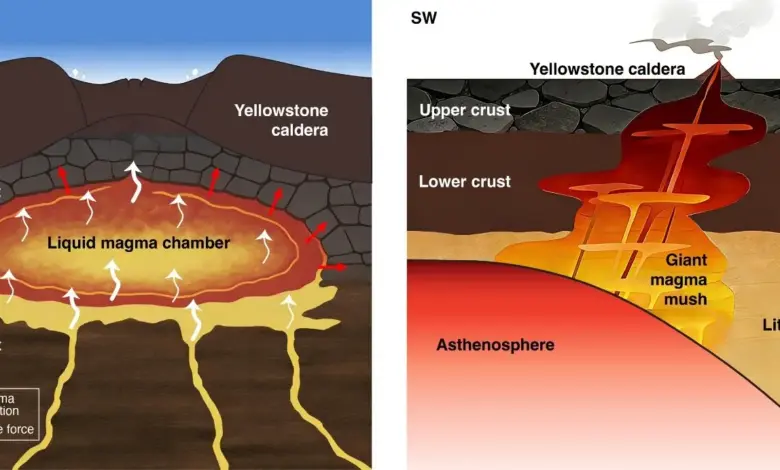
The central question is not whether Yellowstone is active, but what kind of system feeds it. The research team’s model, published in Science on April 9, simulates present-day dynamics of the lithosphere and the underlying convecting mantle beneath western North America. Its aim was to reveal a mechanism for magma generation beneath supervolcanoes. In that framework, the older idea of a single, long-lived liquid-dominated chamber gives way to a different architecture: a translithospheric magma mush system spread through much of Earth’s outer layer.
Analysis: That shift matters because it changes the logic of eruption models. If magma is not stored mainly in one deep reservoir, then pressure buildup may not be the only organizing principle. Instead, distributed partially molten rock could mean a more complex, layered system that behaves differently from the classic chamber-and-collapse picture.
How does the new model change the view of magma below Yellowstone?
Verified fact: The study says magma feeding supervolcanoes originates in the upper asthenosphere, the shallow mantle just beneath the lithosphere. As melt rises into the lithosphere, it interacts with surrounding solid rock and forms a highly viscous magma mush. The effective viscosity of this mush is described as several orders of magnitude higher than liquid magma, which challenges the buoyancy-driven mechanism of the current supereruption model.
Yellowstone is presented as a key natural laboratory because it has produced two supereruptions over the past 2. 1 million years and has extensive geological, geophysical, and petrological constraints. Previous studies indicate that Yellowstone hosts a long-lived, large-scale translithospheric magma mush system with a southwest-dipping geometry. The model expands that idea by linking magma generation to the dynamics of both the lithosphere and the mantle wind moving hot asthenospheric material eastward.
Analysis: The practical takeaway is not a prediction of near-term eruption. It is a warning about model assumptions. If the subsurface is built around a diffuse mush rather than a compact chamber, then hazard estimates based on a simpler structure may miss how heat, melt, and stress are distributed under the caldera.
What do the named institutions and studies actually support?
Verified fact: The research was conducted by a team from the Institute of Geology and Geophysics of the Chinese Academy of Sciences. It appears in Science and is described as a comprehensive three-dimensional geodynamic model of western North America. The study says a shallow, liquid-rich magma body is not the main explanation for Yellowstone’s behavior; instead, the system appears to be replenished through tectonic activity and mantle-driven melt supply.
Two named institutional references frame the broader context. The United States Geological Survey is identified in the context as the source for the statement that Yellowstone has produced three supereruptions in the past 2. 1 million years in one account, while the study itself describes two supereruptions over that same span. The research context here supports only the narrower point: Yellowstone has a long eruption history and remains a crucial site for understanding supervolcano behavior.
Analysis: The difference in eruption counts inside the provided material underscores a larger point: the hazard conversation depends heavily on the dataset and framing used. What the new model clearly challenges is not the existence of risk, but the confidence of older reservoir-based explanations.
Who benefits from the new interpretation, and what remains unresolved?
Verified fact: The study states that recent work suggests persistent liquid-dominated magma chambers are absent beneath active supervolcanoes worldwide. It also says the mechanism by which magma first melts in the upper asthenosphere remains unclear. That unresolved point is important: the model explains a pathway for magma transport and accumulation, but not the full origin of the melt itself.
Who benefits from the new interpretation? Hazard modelers do, because the study offers a more detailed framework for future assessments. Geological researchers do as well, because Yellowstone becomes a test case for comparing chamber-based and mush-based models. What is implicated is the older habit of treating supervolcanoes as if their risk could be mapped from a single deep reservoir. The new evidence suggests the system is more diffuse, more dynamic, and less easily reduced.
Analysis: That does not mean an eruption is imminent. It does mean that a supervolcano can be fed through lithospheric processes alone, without requiring the classic deep-chamber story. For public risk communication, that distinction is crucial: uncertainty should not be mistaken for safety, and complexity should not be mistaken for inevitability.
The accountability question now is straightforward. If Yellowstone’s magma source is closer than thought and more distributed than assumed, then hazard models should reflect that evidence openly and precisely. The most responsible response is not alarm, but transparency: clearer models, clearer limits, and a clearer public explanation of what a yellowstone eruption study can prove—and what it still cannot.