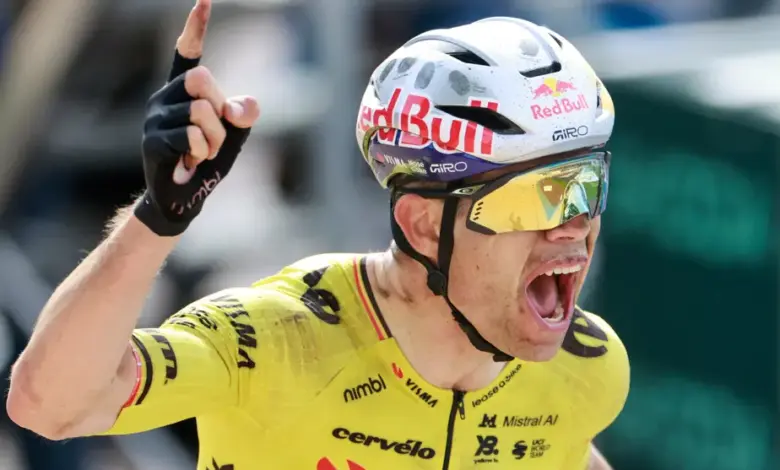
In the dust and roar of the Roubaix velodrome, cyclisme delivered a finish that felt less like routine and more like release. Wout van Aert crossed the line with his finger raised, then broke into tears after winning his first Paris-Roubaix on Sunday, edging Tadej Pogačar in a sprint after more than 50 kilometers away together.
How did Wout van Aert win Paris-Roubaix?
He won it with patience, resilience, and a final burst in the velodrome. Van Aert, the 31-year-old Belgian rider for Visma-Lease a bike, beat Pogačar after a brutally demanding race that repeatedly reshaped itself through mechanical trouble and relentless pressure. The decisive moment came after the two leaders had broken clear in the sector of Auchy-lez-Orchies, 53 kilometers from the finish, and Van Aert made the difference where it mattered most.
For Van Aert, this was not only a victory in a Monument. It was the end of a long run of near misses and setbacks in cyclisme. He had finished second in Paris-Roubaix in 2023, third in 2024, and fourth in 2025, with injuries, crashes, and bad luck repeatedly interrupting his chase of one of the sport’s most feared races.
Why did this race feel so dramatic?
The race changed shape when Mathieu van der Poel, the triple defending champion, suffered two punctures in the Trouée d’Arenberg and lost two minutes. He later fought his way back but could not recover the chance to fight for victory, finishing fourth. Pogačar also had to respond to mechanical trouble, puncturing at 120 kilometers from the finish before returning to the front of the race 98 kilometers from Roubaix.
That chain of events turned a long day over roughly 55 kilometers of pavé into a test of nerve as much as strength. Jasper Stuyven, 13 seconds behind Van Aert, completed the podium, while Christophe Laporte finished fifth. In a race where the stones often decide more than the legs, the riders who stayed composed were the ones who survived to contest the end.
What did the winner and runners-up say after the race?
Van Aert said the victory meant “so much” to him and described it as an objective since 2018, the year he first rode the race. He also connected the day to Michael Goolaerts, his teammate who died after the 2018 edition, saying he had wanted to return and point a finger to the sky.
He added that, on entering the velodrome, he followed his plan and knew exactly what to do in the sprint. Battling Pogačar head-on at the finish, he said, was something “really special. ”
Anthony Turgis, who finished 14th and was the second French rider behind Christophe Laporte, gave a grounded reading of the day’s speed. “The level has really gone up in recent years, ” he said, adding that the race now features “flying speeds” and that he still feels he is in the mix. “I am in my place, ” he said, after also explaining that he was held back by two punctures after the Trouée.
What does this result change in cyclisme?
The result closes one chapter for Van Aert and opens another question for Pogačar, who remains without Paris-Roubaix in his collection. He has now finished second in the race for the second straight year, missing another chance to complete a Grand Slam of the monuments this season.
It also underlined how narrow the margins are at the top of cyclisme. Van Aert’s day was shaped by years of frustration, but also by a strong return to form during the spring classics, while Pogačar again showed that his ambitions extend deep into the hardest one-day races. Van der Poel, meanwhile, saw his bid for a fourth Roubaix title collapse in the stones of Arenberg.
As the dust settled in the velodrome, Van Aert stood where he had dreamed of standing for years. The scene looked simple: a rider, a sprint, a raised finger. But behind it was a long road of setbacks, and a reminder that in cyclisme, the most powerful victories are often the ones that take the longest to arrive.