AUGUSTA, Ga. — The Masters rarely waits for Sunday to deliver its tension, and Mcilroy made sure this one arrived early. What looked like a controlled march toward another title turned into a scramble after a Saturday round that erased a six-shot cushion and left the defending champion tied at 11 under with Cameron Young. The shift was abrupt, but not inexplicable: Augusta has a way of punishing small mistakes, and Mcilroy paid for enough of them to reopen the championship.
How a six-shot edge disappeared
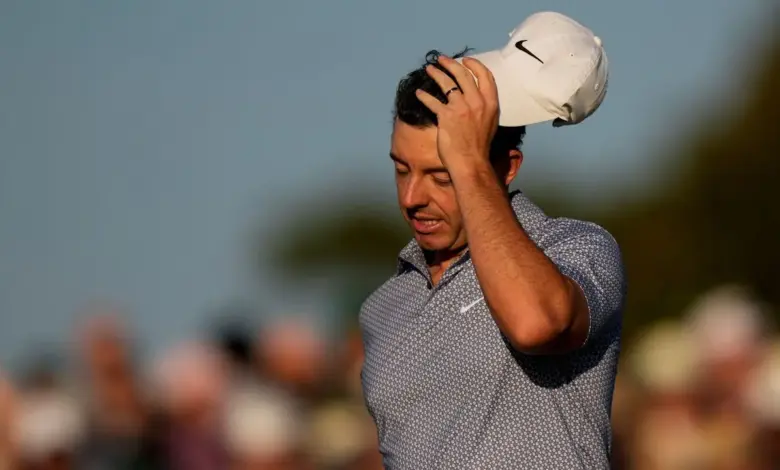
McIlroy began the day with a record advantage through 36 holes, but his 1-over 73 changed the shape of the tournament. A bogey on the opening hole was quickly offset by a birdie at the 3rd after a big drive, and another birdie followed on No. 10. Then came the stretch that changed everything: water at the par-4 11th led to a double bogey, and a miss at No. 12 produced another bogey. By the time he steadied himself with birdies on Nos. 14 and 17, the lead was gone. In a tournament built on patience, McIlroy’s backslide became the day’s defining turn.
Cameron Young’s late surge changes the pairing
Young’s 7-under 65 was the round of the day, and it moved him from chasing position into direct contention alongside McIlroy. That matters because the final pairing now carries both competitive and historical weight: each of the last nine Masters winners entered Sunday from the final group. Young was composed throughout Saturday, making only one bogey, missing just two greens, and producing back-to-back birdies on three separate occasions. His own assessment was revealing. “It started with some really small things, and now I feel just much more comfortable, ” Young said. “It’s hard to say exactly what it is, but I feel like it’s just been very small things over the course of the last year or so that have just built up some steam. ”
What McIlroy’s reset means for Sunday
The practical question is not whether McIlroy has the talent to respond; it is whether he can slow the emotional damage of Saturday long enough to play within the round. He is still tied for the lead, and the scorecard shows he recovered from adversity multiple times. But Augusta has narrowed the margin for error to almost nothing. McIlroy and Young were paired together on Thursday and Friday, and McIlroy said Sunday would be comfortable for both. That comfort will be tested immediately, because the same course that allowed McIlroy to build a record lead also exposed how fast momentum can reverse.
Young’s approach suggests a contrasting strategy. “There’s no reason to take any unnecessary risk when, if you’re hitting it well, you’re going to have opportunities, ” he said. “You just are constantly aware of the fact that this place can bite you. ” That description captures the broader shape of the tournament: one player trying to defend a position that once looked secure, the other trying to turn patience into a first Masters victory.
Why this final round now feels bigger
The headline here is not only that McIlroy surrendered ground; it is that he did so at a moment when the tournament was supposed to be narrowing toward certainty. Instead, Saturday restored doubt and turned Sunday into a direct test of nerve. Young’s recent rise adds another layer, after seven runner-up finishes on the PGA Tour before his first career victory at the 2025 Wyndham Championship, followed by top-10 finishes at signature events in 2026 before his victory at TPC Sawgrass. That arc explains why this pairing feels less accidental than combustible. McIlroy’s backslide has produced a final round that is no longer about protection, but about recovery.
McIlroy and the pressure of the final pairing
For McIlroy, the pressure is not abstract. He began the week with the advantage of a record 36-hole lead, yet the 1-over 73 has taken him from control to collision course. He remains alive, tied with Young, and still in position to win. But the emotional frame has changed. The final pairing now carries the weight of recent history, the memory of last year’s five-shot lead that ended in a playoff, and the reality that Augusta can turn even a dominant start into a fragile finish. If Sunday becomes another battle of small margins, McIlroy’s backslide may be remembered less as a stumble than as the moment the tournament truly opened up. What happens when the leaders know they cannot hide from the course — or from each other?