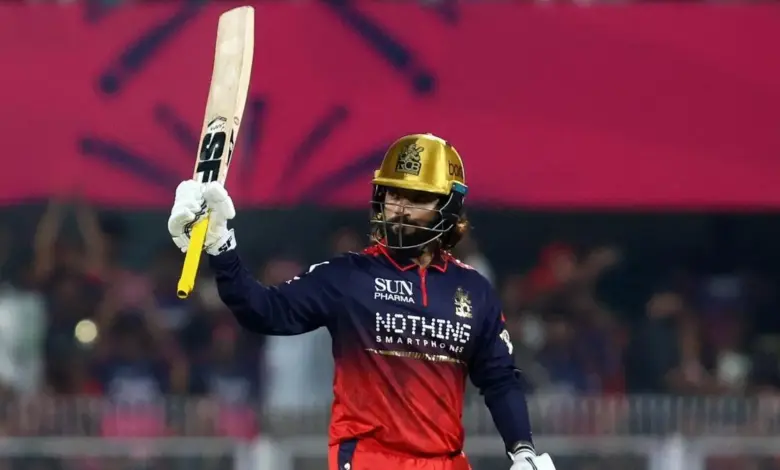
rajat patidar has turned one innings into a clear marker for what Royal Challengers Bengaluru can do when tempo and timing align. At the Wankhede Stadium on Sunday night, he reached his half-century in 17 balls against Mumbai Indians, tying the joint-second fastest fifty by an RCB batter in IPL history and setting the tone for a total that moved past the 240-run mark.
What Happens When A Chase Turns Into A Statement?
The immediate significance is simple: this was not just a fast fifty, but a momentum shift at a decisive stage. Rajat Patidar entered with the game open, attacked from the outset, and briefly looked on course to challenge the franchise record. He was 38 off 10 balls before a slower stretch followed Virat Kohli’s dismissal, yet the damage had already been done.
Patidar finished on 53 from 20 balls before Mitchell Santner dismissed him, but the innings had already reshaped the contest. For RCB, that kind of acceleration matters because it compresses the margin for error and forces the opposition to defend under immediate pressure. In a match where batting intent was visible from the first delivery he faced, the 17-ball milestone is the clearest signal of the evening’s turning point.
What Does The Current Record Picture Show?
The numbers place the innings in a very specific company. Romario Shepherd holds the RCB record for the fastest fifty by a batter for the franchise, with a 14-ball effort against Chennai Super Kings in 2025. Rajat Patidar now shares the second-fastest slot with Chris Gayle, who also took 17 balls for RCB against Pune Warriors India in 2013.
One more detail sharpens the significance: this was Patidar’s fastest IPL fifty overall, and he became the first RCB player to score an IPL fifty in fewer than 20 balls twice for the franchise. That makes the knock more than a one-off burst. It suggests a repeatable ceiling for high-speed scoring in the specific environment RCB was able to create at Wankhede.
| Record context | Detail |
|---|---|
| Fastest RCB fifty | Romario Shepherd, 14 balls vs Chennai Super Kings in 2025 |
| Joint-second fastest RCB fifty | Rajat Patidar, 17 balls vs Mumbai Indians in 2026 |
| Joint-second fastest RCB fifty | Chris Gayle, 17 balls vs Pune Warriors India in 2013 |
| Patidar’s match finish | 53 runs off 20 balls |
What Forces Are Reshaping The Meaning Of This Innings?
Rajat Patidar’s innings matters because it sits at the intersection of three forces: individual acceleration, captaincy responsibility, and a team requirement for fast scoring. The context shows that he is not only producing speed, but doing so while leading the side. That combination raises the value of every scoring burst, because it affects both tactical rhythm and dressing-room confidence.
There is also a comparative layer. The available context notes that Virat Kohli has not scored an RCB fifty in 20 or fewer balls in his franchise career, while Patidar has done it twice. That does not diminish the broader quality of other players; instead, it highlights how rare this particular pace has been for RCB and how unusual Patidar’s present scoring profile is within the team’s recent record set.
What If This Becomes The New RCB Benchmark?
Three paths now stand out for how to read the innings going forward. In the best case, Rajat Patidar’s 17-ball fifty becomes a template for controlled aggression, giving RCB a repeatable way to force totals into uncomfortable territory. In the most likely case, this remains a high-end reference point: not every innings will look like this, but it defines the top of his range and keeps RCB’s batting ceiling visibly high. In the most challenging case, the knock becomes hard to sustain if early wickets or slower phases interrupt the tempo before the middle overs can fully open.
- Best case: Patidar converts fast starts into regular match-defining scores.
- Most likely: The 17-ball fifty stands as a signature innings and a tactical reference point.
- Most challenging: Opposition plans reduce the room for rapid acceleration after early aggression.
Who Wins, Who Loses, And What Should Be Watched Next?
RCB clearly benefits first. A batting performance that drives a total beyond 240 changes the shape of the contest and gives the side a stronger platform, regardless of what follows. Patidar also gains individually: the innings adds another record to his name and reinforces his role as a batter capable of producing elite pace under pressure.
The downside falls on the fielding and bowling side trying to contain such bursts, especially when the innings arrives early enough to alter the rest of the chase plan. Mumbai Indians were forced to absorb a scoreboard surge rather than manage a steady total. For readers watching the wider trend, the key takeaway is not just that Rajat Patidar hit a rapid fifty, but that he did so in a way that may influence how RCB measures batting success from here. If this level of speed appears again, it will no longer read as an outlier. It will read as a standard. rajat patidar