Broc Feeney finished fourth after a race defined by contact, criticism, and a brief electrical scare that nearly changed the outcome before the finish. The same battle that put him against Chaz Mostert also exposed a deeper tension: Triple Eight and Walkinshaw TWG Racing are still pushing each other to the edge, and the margin between hard racing and overreach is getting harder to ignore.
What was really exposed in the fight for third?
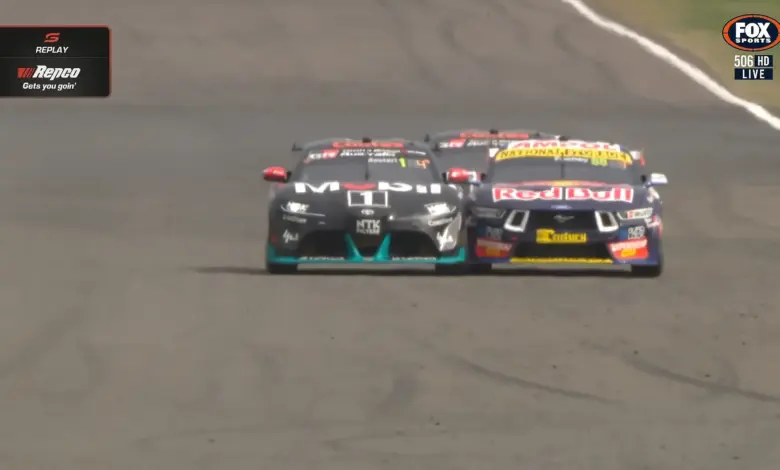
Verified fact: Feeney and Mostert had multiple bouts of side-to-side contact on the back straight while fighting over third in the opening Taupō Super440 race. Feeney eventually won that battle, but the result did not settle the issue. Triple Eight team manager Mark Dutton called Mostert’s driving “out of order” and “a bit silly, a bit uncalled for. ”
Verified fact: Feeney also used team radio to question the incident(s), showing that the conflict was not viewed internally as routine racing. The language from Dutton matters because it came after the race, when the heat of the moment had passed and the team was judging the contact as a matter of conduct, not just outcome. The central question is not only who held position, but what kind of racing this battle is becoming.
Why did Broc Feeney lose more than a podium chance?
Verified fact: Feeney was later powerless to stop Walkinshaw TWG Racing’s Ryan Wood from taking the final podium place. In the same race, Wood then engaged in another Walkinshaw versus Triple Eight battle with Will Brown for second, and Brown held on through robust defence at the Turn 11 hairpin, where there were again multiple bouts of contact.
Analysis: Put together, these moments show a pattern rather than an isolated clash. The issue is not simply that one driver attacked another. It is that the same two teams kept meeting in high-friction situations across the field, with contact appearing in different sections of the race and across multiple battles. For Broc Feeney, that meant his own result was shaped by more than pace. It was shaped by the way the rivalry was being fought.
Verified fact: Feeney ended the race fourth. Mostert finished sixth. That gap is important, but it does not capture the scale of the dispute around the back straight contact or the wider team rivalry that framed it.
What do the team responses reveal?
Verified fact: Brown and Wood brushed off their clash after the race, but Dutton’s response to Mostert was openly critical. He did not describe the contact as part of the normal limits of racing. He described it as “out of order” and “uncalled for. ”
Analysis: That split in response is telling. One side treated the battle as survivable racecraft; the other treated it as a breach of judgment. When teams interpret the same contact in completely different ways, the public is left with a larger problem: there is no shared line that both camps seem willing to accept. In that environment, each exchange becomes easier to justify and harder to resolve.
Verified fact: The rivalry between Triple Eight and Walkinshaw TWG Racing has “raged for months. ” That is the wider context for the race and the reason the contact carried more weight than a single hard pass.
How did the electrical scare change the meaning of the result?
Verified fact: Feeney also had a scare earlier when his engine briefly lost power. Dutton indicated that the cause was an electrical issue, and the team planned to change a component rather than the entire engine before the next race. He said the quick turnaround left no time to “deep, deep dive, ” and that the team would change the part that had the issue before trying to understand it later.
Analysis: This matters because it adds another layer to Feeney’s fourth-place finish. He was not just caught in a rivalry; he was also managing a technical problem that could have altered the race more dramatically. That combination weakens any simple reading of the result as only a matter of driver performance. It also shows how vulnerable a race weekend can become when contact and reliability issues arrive together.
Verified fact: Feeney suffered an electrical issue at the 2025 Adelaide Grand Final, where he lost the championship to Mostert. That history gives the current electrical scare a sharper edge, even without adding anything beyond the documented facts. For Broc Feeney, technical trouble is no longer a minor footnote. It is part of the storyline around decisive moments.
Who benefits when the rivalry keeps escalating?
Analysis: The immediate beneficiaries are the spectators who get a harder, more dramatic contest. But the costs are also clear. One team gains track position while the other absorbs damage, criticism, or uncertainty. The broader gain is less obvious. If the rivalry continues to be defined by contact on straights, contact at hairpins, and disputes afterward, the sport risks reducing a technical championship battle into a contest of damage control.
Verified fact: In the same race, Wood and Brown emerged as the next front-row pairing for the 60-lap race, showing that the front of the field remained tightly contested even after the contact-heavy opening race. That means the rivalry is not fading; it is feeding into the next session.
For Broc Feeney, the lesson is plain. He survived the initial clash, but the result was still shaped by a rivalry that keeps forcing teams to choose between restraint and retaliation. Until that line is clearer, every hard pass risks becoming a bigger story than the race itself.
The evidence from Taupō points to a simple but uncomfortable reality: Broc Feeney was not just racing Chaz Mostert for third; he was standing inside a feud that keeps producing contact, criticism, and technical pressure at the same time. That is why the next race will not just be about pace. It will be about whether Broc Feeney can race through the same rivalry without becoming its next flashpoint.