Billie Jean King Cup: Gibson to lead Australia’s Finals pursuit in Melbourne after breakout rise

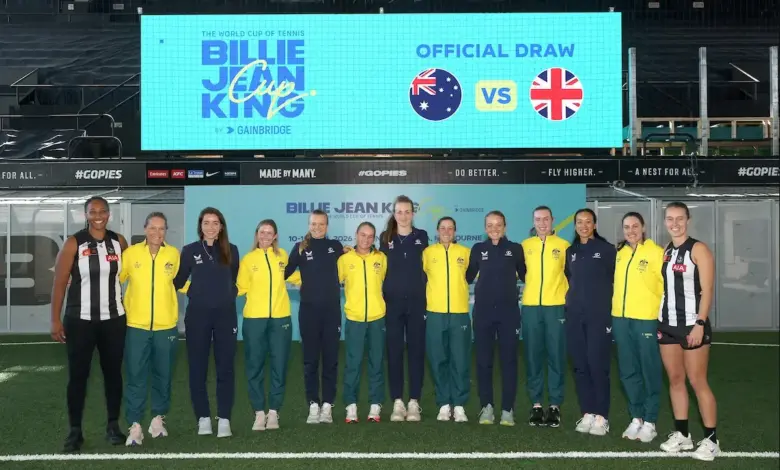
Talia Gibson’s first Billie Jean King Cup appearance arrives with unusual weight: Australia has handed the 21-year-old the No. 1 singles role for Friday’s Qualifier tie against Great Britain. That decision reflects both recent form and a wider selection puzzle for captain Sam Stosur, who must turn practice-court rhythm into points on match day. Australia missed the Finals in 2025 after finishing second in its Qualifiers group in April, so the immediate task is clear: start well, stay composed, and keep the Billie Jean King Cup return path alive.
Why the selection matters now
Australia’s lineup for the tie shows a team balancing momentum with experience. Gibson will open against 17-year-old Mika Stojsavljevic in a first-time Billie Jean King Cup matchup for both players, while Kimberly Birrell is set to face Harriet Dart in the second singles rubber. Storm Hunter and Ellen Perez have again been chosen for doubles, carrying a 5-1 record as a pairing into Saturday’s match. The structure matters because the tie is not only about who plays, but when form can be converted into control of the contest.
Stosur has described the squad as one of the hardest to pick, and that assessment fits the available evidence. The team’s recent practice sessions have been strong enough that Stosur said she could have selected at least four singles players for the first day. That kind of depth is useful, but it also creates pressure: in the Billie Jean King Cup, selection decisions can shape the entire tone of a tie before the first ball is struck.
Gibson’s rise and the pressure of being Australia’s No. 1
Gibson’s appointment as Australia’s No. 1 singles player follows what the squad describes as a breakout Sunshine Swing, and she enters the tie for her second Billie Jean King Cup appearance. Her own reaction suggests the role still feels new. She said it was “a little bit of a shock” to find herself in this position after the last month in the United States, but also stressed that she wants to draw confidence from what she has earned.
That combination of surprise and self-belief is central to the story. Australia is not just asking Gibson to participate; it is asking her to anchor the opening day. In a Billie Jean King Cup tie, the No. 1 singles player often carries symbolic as well as competitive value, and Gibson’s debut in that slot signals trust in recent results rather than seniority alone. It also shows how quickly the team’s hierarchy can shift when one player’s form accelerates.
For Australia, the calculation is straightforward: if Gibson can settle quickly, the rest of the lineup can operate with more freedom. If she struggles, the tie may become harder to manage. That is why her first match is more than a debut; it is a test of whether her recent rise can withstand the demands of team tennis.
Experience, doubles strength and the margin for error
The doubles rubber offers Australia one of its clearest advantages on paper. Hunter and Perez have repeatedly shown they can function effectively together, and Perez emphasized that their experience in big matches could matter against Dart and Jodie Burrage, who will be forming a new partnership. In a Billie Jean King Cup setting, a proven doubles team can be decisive because it reduces uncertainty when the tie reaches its later stages.
That depth gives Stosur flexibility, but it does not remove the need for precision. The selection dilemma she described is partly a sign of healthy competition, yet it also highlights how narrow the margins are for a team trying to reach the Finals after missing out in 2025. Every rubber, especially the opening singles matches, carries extra weight because the tie is being framed by a desire to return to the season-ending stage.
What the tie could mean beyond one weekend
The broader significance extends beyond Friday and Saturday. A strong result would validate Australia’s current blend of youth, experience and recent form, while also strengthening the case for Gibson’s expanded role. A difficult result, by contrast, would reinforce how demanding this Billie Jean King Cup pathway can be, even for a squad with obvious depth.
There is also a wider lesson in Stosur’s remarks: practice form is valuable, but selection decisions must still be made under pressure. Australia enters the tie prepared and motivated, yet the outcome will depend on whether that preparation can translate into match-day execution. The team has the pieces to compete, but the question now is whether this group can turn a promising setup into a direct route back to the Finals.
For Australia, and for Gibson in particular, the Billie Jean King Cup now becomes less about potential and more about proving whether that potential can hold up when the tie begins.