The new Elizabeth ii exhibition at Buckingham Palace does more than display clothing; it reframes how a monarch used style as a public language. Opening at the King’s Gallery on April 10 to mark the centenary of her birth, the show places eveningwear at the center of a broader story about identity, diplomacy, and presentation. More than 300 items from the late Queen’s wardrobe are included, and over half are being shown for the first time. The result is less a fashion retrospective than a carefully staged portrait of power.
Opening Buckingham Palace’s Style Archive
The exhibition explores every aspect of the late Queen’s style, from a wall of more than 50 hats to headscarves, handbags, daywear, and ceremonial garments. Among the most visible pieces are her wedding dress, christening gown, and Coronation dress, each carrying a different layer of royal meaning. But the evening gowns create the most immediate impact, especially because they are positioned as part of a wider visual argument: Elizabeth ii understood fashion not as decoration, but as a disciplined part of public life.
Caroline de Guitaut, the exhibition curator, describes that balance clearly. She says the late Queen had “a definite sense of what suited her” and “absolutely knew how she wanted to appear, ” while also wanting to embrace “whatever the prevailing style of the time was. ” That tension between continuity and adaptation is one of the show’s central themes. It explains why the display feels historically dense without becoming static. The clothing is not presented as costume; it is presented as evidence.
Why the Ballgowns Matter Now
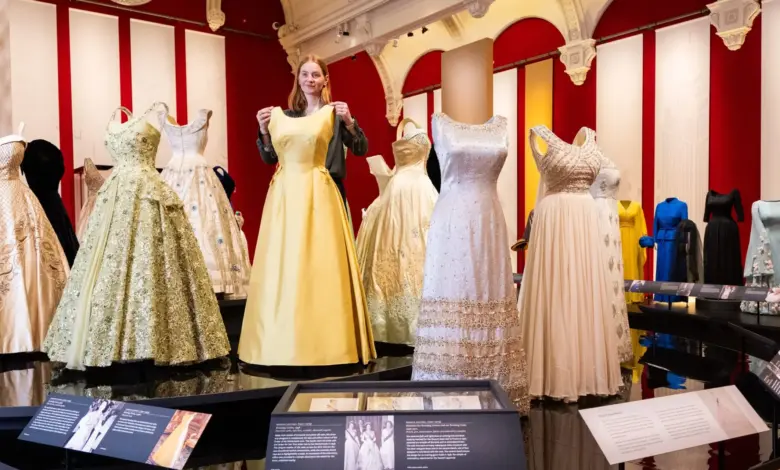
The strongest thread running through the exhibit is the way formal dress helped shape the public image of Elizabeth ii across decades. The gold lamé Norman Hartnell ballgown from her first Commonwealth tour as monarch in 1953-54 opens the eveningwear section with unmistakable force. Nearby, a blue gown tailored to allow for pregnancy in 1948-50 shows how design choices were also practical responses to life events. Together, they reveal a wardrobe built around appearance, function, and symbolic continuity.
That point becomes sharper in the central podium of evening dresses, where full 1950s silhouettes sit beside the slimmer outlines of later decades. The display includes the Hartnell “cherry blossom” dress worn in Japan in 1975 and an Angela Kelly gown worn for the 2011 Ireland visit, embellished with shamrocks. The black gown worn to greet Marilyn Monroe in 1956 and the Hartnell gown chosen for a meeting with President Eisenhower in 1957 underline how often garments became part of diplomatic memory. In this sense, Elizabeth ii was not simply wearing fashion; she was helping define how state appearances were remembered.
A Royal Wardrobe Built as a Public Record
The exhibit also traces the roots of that visual strategy back to childhood. A display of princess party dresses includes a 1935 bridesmaid’s dress, the first couture piece designed for her by Norman Hartnell, who later created both her wedding and Coronation dresses. That continuity matters because it shows how early the relationship between royal image and dress was formed. The presence of a dress designed for the Queen’s stunt double in the London 2012 Olympics opening ceremony, shown beside the identical version the Queen wore for filming, adds a different kind of insight: fashion was also used to manage spectacle, precision, and narrative control.
Just as important is what the exhibition leaves visible through scale. More than 300 items, with over half shown publicly for the first time, turn the wardrobe into a substantial historical record. The Royal Collection’s stewardship after Queen Elizabeth’s death in 2022 gives the display a museum-like authority, but the emotional effect comes from the specificity of the objects. A hat, a handbag, a pair of riding clothes, or a single evening gown becomes part of a larger argument about how monarchy communicates through form, repetition, and detail.
Expert Perspective on Fashion and Power
Caroline de Guitaut’s comments provide the clearest interpretive frame for the exhibition: Elizabeth ii knew what suited her, and she also knew when to reflect the style of her era. That duality helps explain why the wardrobe feels both personal and institutional. It was not random elegance. It was an ongoing visual system built around consistency, selective modernity, and carefully managed symbolism.
Seen that way, the exhibit does not merely celebrate glamour. It shows how formal dress can function as a diplomatic tool, a historical marker, and a form of public memory all at once. The statement gowns are the most dazzling objects, but the larger message comes from their placement alongside daywear, hats, and personal accessories. The late Queen’s wardrobe reads less like a closet than an archive of carefully calibrated appearances.
Global Reach of a Royal Image
The international references inside the exhibition help explain why the display has broader resonance. Gowns linked to Japan, Ireland, the Commonwealth, the Olympics, and presidential meetings show how Elizabeth ii’s style traveled across borders while staying unmistakably hers. That combination of recognition and adaptability is rare in any public figure, let alone a monarch whose image was watched across generations.
For visitors, the question is not simply what she wore, but what those choices accomplished. The exhibition suggests that royal fashion was never separated from diplomacy, ceremony, or legacy. As the galleries open the wardrobe to public view, they also raise a larger question: if clothing can shape history so visibly, what else has been hidden in plain sight?