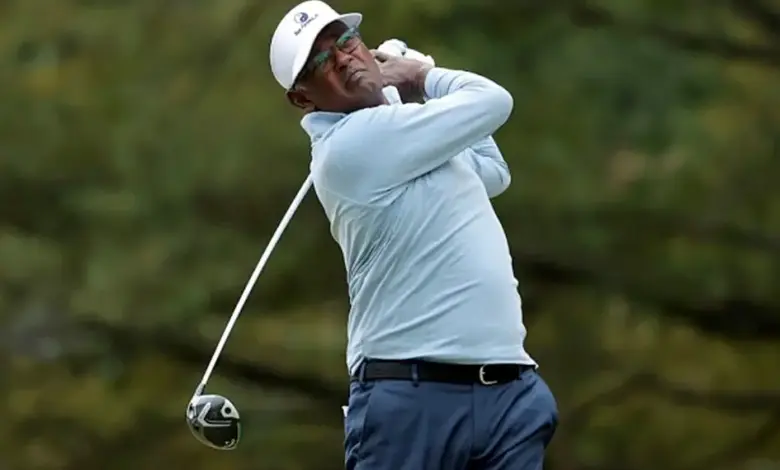
Vijay Singh is back in the Masters conversation for reasons that go beyond scorecards. The 63-year-old Fijian arrives at Augusta National Golf Club for his 32nd appearance, with his Masters legacy drawing fresh attention at a time when his career has often been defined as much by understatement as by achievement. This week, the focus is not on ceremony or nostalgia, but on what his record still says about durability, discipline and a champion who has rarely fit the sport’s preferred script.
Why Vijay Singh’s Augusta return matters now
The timing is significant because Singh’s past at Augusta is no small footnote. He won the Green Jacket in 2000, finished among the top eight five years in a row after that, and remains one of the few players whose Masters history spans multiple eras of the tournament. He is also returning after a season in which he finished tied for eighth at the Senior PGA Championship in 2025, showing that his competitive presence still extends beyond ceremonial appearances.
That matters because the Masters often turns older champions into symbolic figures. Singh is different. His identity has always been tied to work, repetition and resistance to the spotlight rather than to sentiment. His 25th anniversary of his Masters victory passed with little fanfare in 2025, and he made clear on Monday that he did not expect any celebration. In that sense, Vijay Singh remains an outlier in a sport that often rewards visibility as much as performance.
Masters legacy shaped by results, not image
Singh’s record helps explain why this return carries weight. He has 34 PGA Tour victories, including nine in 2004, and he spent 32 weeks at No. 1 in the world ranking. His career earnings on the PGA Tour place him eighth on the all-time money list at $71, 312, 738 million. Those numbers are not the profile of a forgotten player, yet his public image has often lagged behind his results.
That disconnect has several roots. He has long been one of the least media-friendly golfers of his generation, and he has often declined interview requests even while leading tournaments. He answered a question about his relationship with the media on Monday with a simple “no comment. ” That line may sound curt, but it also fits the larger pattern: Vijay Singh has never relied on charm to build his legacy. He has relied on output.
His contrarian streak has also shaped perceptions. In 2024, he suggested that Augusta National’s famous 155-yard 12th hole should be lengthened. That view, along with an earlier dustup with Phil Mickelson over golf spikes, reinforced an image of a player willing to challenge the grain rather than follow it. For supporters, that made him authentic. For others, it made him easier to overlook.
What the numbers say about Vijay Singh
The competitive case for Singh is strong. He won the PGA Championship in 1998 and again in 2004, and his victory at Augusta in 2000 remains the centerpiece of his Masters record. In the early 2000s, his Augusta results were remarkably steady. He tied for 18th in 2001, then finished in the top eight for five straight years, with notable chances in 2002 and 2006. In 2002, he entered the final round two shots behind Tiger Woods and finished seventh. In 2006, he led after a first-round 67 before settling into a tie for eighth.
Ben Crenshaw, a two-time Masters champion, summed up that talent simply: “What a talent. He sees things other people don’t. ” Larry Mize, the 1987 champion, offered a similarly concise assessment: “Vijay is a great player; a great champion. ” Those judgments matter because they come from fellow winners who understand how thin the line is between a very good player and a lasting one.
Singh himself has never rejected the possibility of another run. “We all think we can win again, ” he said. “If you play the right shots and don’t make mistakes at the right moment things can change just like that on a golf course like this. ” That is the essence of Masters golf, but it also captures the logic of his career: patience, precision and a refusal to be defined by expectation.
Regional pride, global impact and the wider field
His return also carries meaning beyond Augusta. He continues to represent Fiji on one of golf’s biggest stages, and his presence remains a source of pride at home. He qualifies through his lifetime exemption as a former champion, a reminder of how a single major victory can echo for decades when backed by sustained performance. In a field of 91 players that includes defending champion Rory McIlroy and world No. 1 Scottie Scheffler, Singh’s start is not just symbolic; it is earned.
There is also a broader lesson in how longevity works in elite sport. Singh is the second-oldest player in this year’s Masters field, and his 32nd start underlines how rare it is for a former champion to remain relevant across generations. In that context, Vijay Singh is not merely returning to Augusta. He is testing whether a legacy built on resilience can still command attention in a sport that quickly moves on.
As this Masters week unfolds, one question remains open: if a champion has already proven his place in history, how much more does he need to do before the game finally stops calling him overlooked?