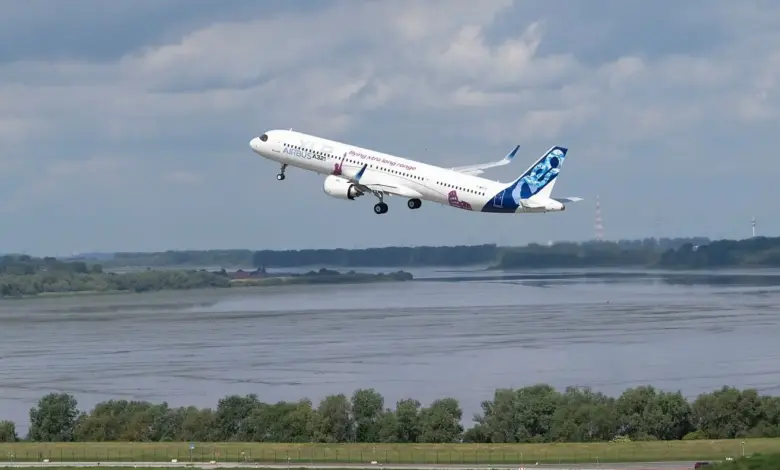
At an airline desk where every aircraft order can reshape a route map, sky is the word now tied to a new long-term plan. BOC Aviation has signed an agreement to purchase and lease-back three Airbus A321XLR aircraft to SKY Airline, a move that links a new customer, a newer jet, and a longer runway for growth.
The aircraft are set to arrive in 2026 and 2027, and all three will be powered by Pratt & Whitney GTF engines. For both companies, the deal is framed not just as a fleet transaction but as a step toward more efficient flying and a broader network across the Americas.
What does the A321XLR deal mean for SKY?
For SKY Airline, the agreement is built around expansion. Daniel Belaunde, chief executive officer of SKY Airline, said the deal supports the carrier’s continued growth and its commitment to operating one of the youngest and most fuel-efficient fleets in the region. He added that the A321XLR will enable further network expansion, offer more direct and affordable travel options, while maintaining a focus on efficiency, sustainability and a high-quality customer experience.
That message reflects where SKY already stands. The Chilean low-cost carrier has a 24-year history, operates in seven countries across the Americas, and has bases in Chile and Peru. Since its inaugural flight in 2001, the airline has carried more than 70 million passengers. It is currently the only airline in South America operating a fleet composed entirely of Airbus A320neo and A321neo aircraft, a setup that has helped it reduce emissions per seat by approximately 30% since 2018.
Why is BOC Aviation adding SKY as a new customer?
BOC Aviation says the agreement brings SKY in as a new customer while it continues to build a fleet of latest-generation, highly fuel-efficient aircraft. Steven Townend, chief executive officer and managing director of BOC Aviation, said the Airbus A321XLR exemplifies that strategy, and noted that the aircraft marks the first of its type currently scheduled for delivery into BOC Aviation’s fleet.
The leasing structure also matters. By combining purchase and lease-back under long-term operating leases, the arrangement gives SKY access to aircraft while allowing BOC Aviation to deepen its position in newer-generation narrowbody jets. In practical terms, the deal ties asset strategy on one side to route ambition on the other, with the aircraft arriving into service over a two-year window.
For passengers, that kind of deal is usually invisible until schedules change or new destinations appear. For airlines, it can determine whether growth is measured in incremental seats or in entirely new links between cities.
How does this fit into SKY’s broader fleet story?
The new lease deal sits within a fleet identity SKY has already built over time. Its current all-Airbus A320neo and A321neo lineup has already become a defining feature of the carrier’s operations in South America. Adding the A321XLR continues that pattern and extends it.
The airline’s comments point to a model that blends expansion with restraint: more direct travel options, but with a continued emphasis on operating efficiency and sustainability. That balance matters in a market where growth is not just about adding aircraft, but about using them in ways that keep costs and emissions under control.
For communities across the airline’s seven-country network, the practical effect may be found in routes that are easier to connect, and in flights that are designed to be more affordable without moving away from a fuel-conscious fleet plan.
What happens next for the aircraft and the people waiting for them?
The immediate next step is delivery. The three Airbus A321XLR aircraft are scheduled to reach BOC Aviation’s fleet in 2026 and 2027, before moving into long-term operating lease service with SKY Airline. That timeline gives both companies time to prepare for a handover that is as much about planning as it is about hardware.
For the airline’s customers, the significance may be felt later, when the aircraft begin to shape what SKY can offer on its network. For BOC Aviation, the deal is another signal of confidence in latest-generation aircraft that are designed to be highly fuel-efficient.
And for SKY, the agreement reinforces a direction it has already chosen: growth built on a young fleet, lower emissions per seat, and a promise of more direct and affordable travel. In the end, the word sky here is more than a name. It is the space where both companies are placing their bets, one aircraft at a time.