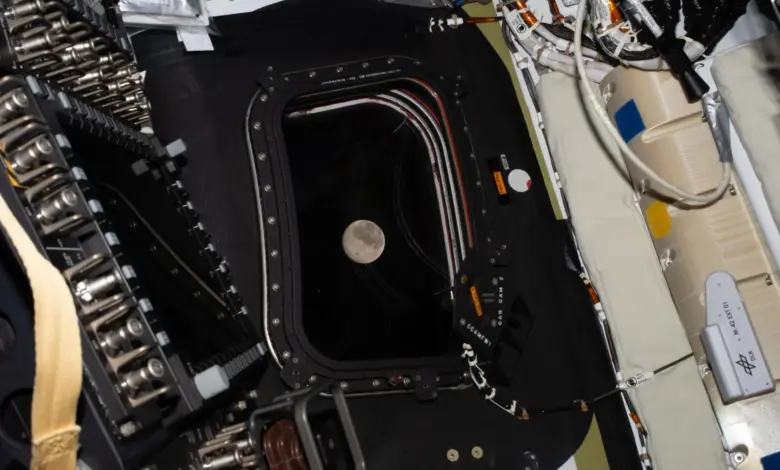
reid wiseman is part of a mission that has now pushed humans farther from Earth than anyone before, but the headline number is only the surface. The Artemis II crew has broken the Apollo 13 distance record, and the larger story is what the flight is trying to prove: that a crewed lunar flyby can deliver science, test deep-space operations, and prepare the way for future missions.
What does this record actually show?
Verified fact: Artemis II has surpassed the previous human distance record of 248, 655 miles from Earth, set by Apollo 13 in 1970. The spacecraft is expected to reach a maximum distance of 252, 760 miles from Earth at 7: 07 p. m. ET, exceeding the old mark by roughly 4, 100 miles. At about 1: 56 p. m. ET, the mission crossed the point where it became the farthest any human has traveled from Earth.
Verified fact: The crew is spending about 10 days in space, and this is the first time in more than half a century that humans have left Earth orbit. The spacecraft will not land on the Moon. Instead, Orion will loop around the Moon’s far side and return.
Analysis: The record matters, but not because it is a trophy on its own. The mission is proving that crewed spaceflight can operate at a distance where the margin for error is smaller, communication is delayed, and observation must be disciplined. The Apollo 13 comparison is unavoidable, yet Artemis II is framed as a controlled test, not a rescue.
Why is the lunar flyby being treated as more than a scenic pass?
Verified fact: The lunar observation begins at about 2: 45 p. m. ET and is expected to last roughly seven hours. During that time, the crew will make detailed observations of geologic features on the lunar surface. The astronauts will also take turns capturing the views from Orion’s windows and making annotations, audio recordings, and situation reports.
Those reports are meant to cover how the crew is positioned, anything unexpected they see, lunar target descriptions, and their emotions and reactions as they fly by the Moon. Kelsey Young, NASA’s Artemis II lunar science geologist, said the crew should be able to make out definite chunks of the far side that have never been seen by humans.
Verified fact: At about 8: 35 p. m. ET, the crew will witness a solar eclipse from space as Orion, the Moon, and the Sun align. The Sun will disappear behind the Moon for nearly an hour, allowing the astronauts to view a mostly darkened Moon and analyze the solar corona.
Analysis: This is the hidden value of the mission: it blends symbolism with measurement. The Moon is not just a destination in this flight; it is a platform for observing what Apollo could not fully document. The eclipse, the far side views, and the crew’s recordings all point to a mission built to expand both technical knowledge and human perspective.
What is being revealed during the communications blackout?
Verified fact: When Orion passes behind the Moon at about 6: 44 p. m. ET, the mission will enter a planned communications blackout lasting about 40 minutes. The Moon blocks the radio signals needed for the Deep Space Network to maintain contact with the spacecraft. Shortly after signal is lost, Orion is expected to make its closest approach at about 7: 02 p. m. ET, when it will be just 4, 070 miles above the Moon’s surface.
This blackout is not an accident or a problem to solve in real time. It is part of the mission design. NASA is relying on the Deep Space Network to communicate with the crew, and the break in contact is a deliberate test of how the spacecraft and mission teams handle a predictable deep-space condition.
Analysis: The blackout is one of the clearest reminders that Artemis II is not a routine orbital flight. It is an operational rehearsal for the conditions that matter most in future deep-space travel: limited contact, delayed response, and dependence on systems that must work without constant oversight. The public sees a flyby; the mission planners are also watching how the architecture behaves when the spacecraft disappears behind the Moon.
Who benefits from the mission, and what does it imply for the future?
Verified fact: The crew consists of Reid Wiseman, Victor Glover, and Christina Koch of NASA, along with Canadian Space Agency astronaut Jeremy Hansen. Jared Isaacman, NASA’s administrator, said the astronauts have observation responsibilities and are gathering data from several cameras to help future missions, including one aimed at returning to the lunar surface.
Verified fact: The crew has trained for three and a half years for this mission. Jim Lovell, an Apollo 8 and Apollo 13 astronaut, recorded a message for the crew before his passing in 2025.
The benefit is not only scientific. It is institutional. A successful Artemis II flight supports the case that crewed lunar travel can move beyond memory and into repeatable practice. That is why the mission is being described as a step that merges the past with the present and points toward the future.
At the same time, the mission’s emotional dimension is impossible to ignore. During the flight, the crew spoke of naming a Moon crater after commander Reid Wiseman’s late wife, Carroll. That moment underlines how personal this mission has become even as it is being used to measure technical progress.
Accountability conclusion: The public should view Artemis II as more than a celebration of distance. It is a test of whether deep-space travel can produce reliable science, disciplined crew reporting, and safe operations under pressure. The record is real, but the more important question is whether the mission’s data, procedures, and communication systems will justify the next step. In that sense, reid wiseman is not only part of a historic crew; he is part of a proving ground for what human travel beyond Earth may become.