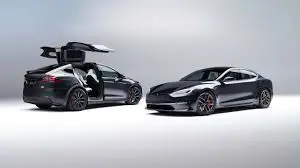
The Tesla Model S and X have moved from flagship status to a quieter ending: custom orders are over, and only inventory remains. That shift matters because it is not just a product decision. It signals how Tesla is choosing to allocate attention, production, and long-term ambition. Elon Musk marked the change in an early-hours post on X, calling for an official ceremony and saying he loved those cars. The message was clear: a chapter that began 14 years ago is closing, even as Tesla pivots toward what comes next.
Tesla Model S and X move from custom orders to inventory-only sales
Musk said custom orders of the Tesla Model S and X have come to an end, while noting that some units remain in inventory. Tesla’s website still shows available vehicles, including All-Wheel Drive trims offered with the Luxe package, which includes free access to Supercharger use and a free Supervised Full-Self-Driving subscription. Many of the listed cars are demo vehicles and are being offered at reduced prices. In practical terms, the Tesla Model S is no longer a build-to-order product in the way buyers may have expected, and the same now applies to the Model X.
The change is notable because it shifts the buying experience from personalization to selection from existing stock. That may seem like a small operational adjustment, but it is also a sign of product life-cycle management. Tesla is not presenting the move as a sudden break. Instead, Musk framed it as an ending-of-an-era moment, with a ceremony planned for the outgoing models.
Why the Tesla Model S mattered in Tesla’s rise
The Tesla Model S and Model X were early pillars of Tesla’s lineup after the original Roadster. Deliveries of the Model S began in 2012, including the first 1, 000 vehicles in a Signature limited-edition trim. Model X deliveries started in 2015, bringing Falcon wing doors to rear passengers. Those details matter because they show why the two models carried symbolic weight well beyond their sales figures.
For Tesla, the Tesla Model S once represented the company’s ability to challenge established expectations for premium electric vehicles. The Model X carried that role into a different segment. Ending custom orders now suggests that Tesla sees greater strategic value in moving resources away from legacy premium models and toward newer priorities. That interpretation is reinforced by Musk’s earlier remarks during Tesla’s fourth-quarter earnings call, when he said the company was sunsetting the Model S and X and focusing the Fremont, California, facility on Optimus humanoid robot production.
Strategic shift toward AI, autonomy and future platforms
The wider context makes the decision more than a product update. Tesla’s current lineup includes the Model 3, Model Y and Cybertruck, while Musk has also discussed the Cybercab, which is expected to launch without a steering wheel or pedals and to retail for around $30, 000. He has also pointed to the Terafab AI Chip project, aimed at producing AI5 chips for Tesla cars. Taken together, these moves show a company pulling capital and engineering energy toward AI, autonomy and platform development.
That is where the Tesla Model S becomes a strategic marker. If inventory-only sales hold, the model’s role may be reduced to a limited bridge between Tesla’s past and its future. The downside is that Tesla could narrow its appeal among higher-end buyers who value customization. The upside, from Tesla’s perspective, is simpler production and less configuration complexity. For a company facing poor sales for more than a year, the calculus appears to be that attention should follow future technologies rather than aging premium offerings.
Expert perspectives and what investors are watching
Industry observers have framed the shift as a planned wind-down rather than an abrupt discontinuation. One analysis from EV Co suggested that removing custom factory orders and directing buyers toward inventory could help Tesla manage pricing and inventory more tightly. It also noted that the move may free capital and engineering resources for next-generation vehicle programs. That is an important distinction: this is not just about selling fewer cars, but about changing which cars matter most inside Tesla’s business model.
Investors are likely to focus on three things: whether unit sales weaken further, whether average selling prices change, and whether Tesla can keep redirecting investment toward AI and autonomous capabilities. The Tesla Model S may still attract buyers through remaining inventory, but the larger question is whether Tesla is using the model’s quiet exit to sharpen its narrative around future growth.
Regional and global impact of Tesla’s premium retreat
The effect is broader than one company’s product list. In the premium EV segment, fewer configuration options from Tesla may open room for rivals seeking customers who still want personalization. In the U. S. market, the shift also reflects a wider transition in which legacy electric models are being weighed against software-led and autonomy-led platforms. Globally, Tesla’s decision sends a message that even its early prestige products can be retired when corporate priorities change.
That makes the Tesla Model S a useful symbol of Tesla’s current crossroads. It once stood for premium ambition; now it reflects a company leaning harder into robots, AI chips and autonomous vehicle experiments. If this is the ending Musk described, the next question is how quickly Tesla can turn that ending into a new growth story, and whether the market will reward the move.