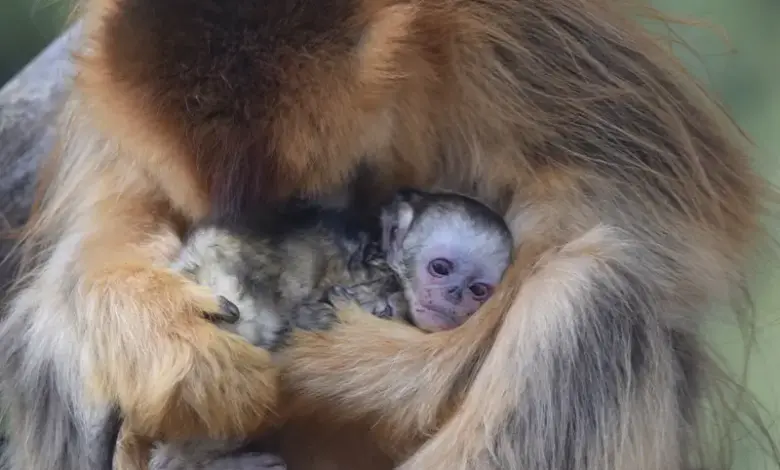
On the morning of 11 March, visitors at the ZooParc de Beauval watched as a new singe was gently pressed to its mother’s chest, tiny and protected. The scene unfolded in the park’s Hauteurs de Chine area, where keepers had been monitoring a pregnancy that had been carefully managed since the animals’ arrival the previous year.
Why is this Singe birth exceptional?
The newborn represents a first: it is the first golden monkey born in a zoological park outside Asia. The arrival follows the April 2025 transfer of three golden monkeys to the site — two females named Jindou and Jinhua and one male named Jinbao — carried out as part of an international conservation and research project in cooperation with China. Under the direction of experts from the Shanghai Wild Animal Park, the group adapted quickly to their new environment and exhibited mating behaviour that made a captive birth possible.
What happened on the day, and how are caretakers responding?
The mother, Jindou, who was born on 29 March 2018, gave birth on the morning of 11 March 2026. Keepers report that the infant is in very good health and was immediately cradled against its mother’s chest. Staff are overseeing intensive monitoring of the newborn’s development, mindful that the earliest days for primates are critical, particularly because Jindou is primiparous. Experts from the Shanghai Wild Animal Park are actively guiding care routines, and keepers are observing both maternal behaviour and any allonursing within the group.
“The team has been closely monitoring the gestation and prepared for this moment, ” said representatives of the ZooParc de Beauval. “With guidance from our international partners, we are focused on attentive care and careful observation during these first weeks. ” Keepers have placed the family group within the Hauteurs de Chine territory, visible to some visitors and situated near the park’s twin giant pandas, Yuandudu and Huanlili.
How does this birth fit into broader conservation and biological realities?
The birth is framed by a structured conservation effort: the transfer and subsequent birth are part of an international conservation and research project carried out in cooperation with Chinese partners. The species’ reproductive biology documented by park records notes a polygynous mating system in harems, sexual maturity arriving for females at four to five years and for males around seven, and a breeding season generally between August and October with births typically from March to June. Gestation lasts about six to seven months, females commonly produce a single infant every two years, and juveniles often display lighter-coloured fur. The parks’ records also note practices of allonursing and an expected captive lifespan of about 25 to 30 years.
These compiled facts shape the care strategy: keepers watch for typical milestones such as protective paternal grooming and the weaning timeline, while researchers document behaviour that may inform future conservation planning.
What next — for the animal, the park, and conservation partners?
Staff continue to monitor the newborn closely within the group. The ZooParc’s public-facing materials invite visitors to see the golden monkeys and the infant born on 11 March. At the same time, the international cooperation with experts from the Shanghai Wild Animal Park remains central: specialists are supporting husbandry practices and behavioural observation aimed at maximizing the infant’s survival and contributing data to the conservation program. The park’s caretakers emphasize patient, attentive care during the critical early period.
Back in the Hauteurs de Chine, the same enclosure that hosted the animals’ cautious acclimation now holds the tiny figure that has captured attention. Visitors who witnessed the birth that morning saw more than an event: they saw a moment engineered by months of cross-border cooperation, veterinary preparedness, and daily care. Whether the infant’s progress will alter long-term conservation trajectories remains for scientists and partners to record, but for now the scene retains a quiet urgency — the fragile promise of a species whose presence in a European park is itself historic.