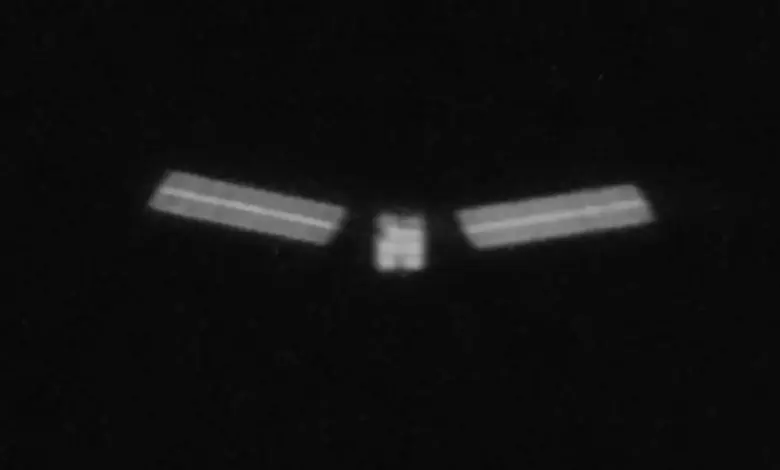
A SpaceX starlink satellite experienced an on-orbit anomaly that produced trackable debris at roughly 560 km above Earth, prompting fresh scrutiny of repeated fragmentation events and how rapidly operators and trackers characterize them.
What happened to Starlink satellite 34343?
Verified facts: On March 29, 2026, SpaceX wrote that Starlink satellite 34343 experienced an anomaly on orbit and lost communications while operating near 560 km altitude. SpaceX wrote that the latest analysis shows the event poses no new risk to the International Space Station or to NASA’s Artemis II crewed lunar mission, and that teams will continue to monitor the satellite and any trackable debris while coordinating with NASA and the US Space Force. SpaceX also noted the event posed no new risk to the Transporter-16 rideshare mission because payload deployments for that mission were conducted well above or well below the Starlink constellation.
Imaging and tracking: HEO Robotics captured an image of the spacecraft on Feb. 14, 2026, and is working toward imaging the current state of the unit after fragmentation. Orbital tracker LeoLabs detected a fragment-generation event tied to satellite 34343 and characterized it as a fragment creation event.
What do the tracking data and prior incidents show?
Verified facts: LeoLabs’ analysis noted similarities between the 34343 event and an earlier anomaly involving Starlink satellite 35956 on Dec. 17–18, 2025. For that prior satellite, the company acknowledged the unit vented a propulsion tank and released a small number of trackable objects; it remained largely intact and was expected to re-enter the atmosphere within weeks. LeoLabs characterized the 34343 fragment-generation event as likely caused by an internal energetic source rather than a collision with another object, and it assessed that debris from the 34343 event would likely de-orbit within the next few weeks due to the event’s low altitude.
Verified fact: SpaceX has stated its teams are actively working to determine root cause and will implement any necessary corrective actions.
What does this mean, who is accountable and what should change?
Analysis (labeled): When the verified facts above are viewed together, a pattern emerges: two recent Starlink satellites experienced on-orbit anomalies that produced trackable fragments, and independent trackers linked both events to internal energetic sources rather than collisions. The combination of imagery from HEO Robotics, fragmentation detection by LeoLabs, and SpaceX’s public notices establishes a contemporaneous chain of observation, technical assessment and operator acknowledgement.
Accountability (labeled): Verified facts show SpaceX, tracking firms and national space agencies are involved in monitoring and coordination—SpaceX has stated it will coordinate with NASA and the US Space Force. The evidence supports a call for more rapid, standardized characterization of anomalous events so operators and orbital-traffic managers can assess collision risk and communicate mitigation steps promptly.
Recommendation (analysis): Given the repeated nature of these fragment-generation events and the involvement of propulsion or internal energetic sources in at least one prior case, the public record in these verified statements points to the need for clearer disclosure timelines and interoperable tracking updates among operators, imaging teams and authoritative orbital services.
Final verified note: The event that affected starlink satellite 34343 produced trackable debris at about 560 km, is under active monitoring, and has been linked by trackers to a fragment-generation process that resembles a previous anomaly.