Fifa Rankings reveal real-time volatility as Japan climbs and South Korea tumbles after 0-4 defeat

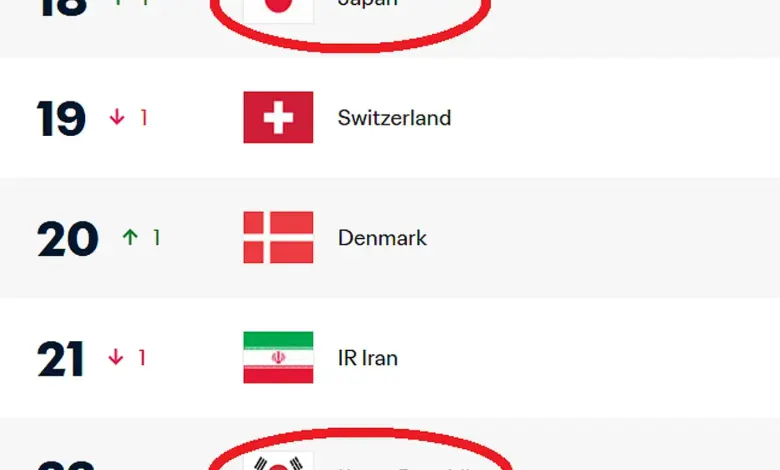
The latest fifa rankings update, applied in real time to reflect friendly results, has widened performance gaps across Asia: Japan moved from 19th to 18th after a 1-0 victory in Scotland, while South Korea endured a 0-4 defeat that trimmed 5. 73 ranking points and left the team 22nd with 1, 593. 71 points.
How have the Fifa Rankings shifted in March?
Verified fact: FIFA began reflecting changes to rankings in real time for international friendly weeks. Japan rose one place from 19th to 18th after a 1-0 win in Scotland; Junya Ito scored the goal that produced the result. Iran dropped from 20th to 21st after a 1-2 loss to Nigeria. France moved ahead of Argentina into second place following wins over Brazil (2-1) and Colombia (3-1); Argentina remained in the top five after a win over Mauritania. England were held to a 1-1 draw with Uruguay and remained fourth. Portugal climbed to fifth while Brazil fell two places to seventh.
Analysis: The switch to real-time processing of match results magnifies the immediate effects of single friendly fixtures. Small-margin outcomes such as Japan’s narrow win now produce instant positional shifts that alter continental pecking order and the visible narrative around teams preparing for major competitions.
Why did South Korea’s 0-4 defeat cut its standing?
Verified fact: South Korea suffered a 0-4 loss to Ivory Coast in a warm-up match at Stadium MK in Milton Keynes. The result reduced South Korea’s ranking score by 5. 73 points and left the team in 22nd place with 1, 593. 71 points. South Korea, led by head coach Hong Myung-bo, is scheduled to play Austria in Vienna at 3: 45 a. m. ET on April 1. If defeated again, the team could fall to 25th place.
Analysis: A four-goal margin in a friendly had an outsized impact under the real-time system, illustrating how defensive collapses in single fixtures now translate quickly into quantifiable ranking losses. For teams like South Korea that sit near the upper tier of Asian squads, one heavy defeat can jeopardize seeding, perceptions of form, and short-term planning ahead of higher-stakes matches.
What do Azerbaijan’s rise and Kyrgyzstan’s drop reveal about volatility?
Verified fact: Azerbaijan moved up one place in the rankings from 125th to 124th and is recorded at 1, 136. 67 points after winning the final of the “FIFA Series-2026” international tournament against Sierra Leone. Kyrgyzstan fell to 108th place after two friendly defeats in Turkey: a 0-1 loss to Equatorial Guinea followed by a 2-5 loss to Madagascar; the team had been 103rd in January.
Analysis: The movements of Azerbaijan and Kyrgyzstan underscore that the real-time framework affects teams across the entire ranking spectrum. Tournament wins at lower tiers can lift national positions incrementally, while back-to-back friendly losses can cause marked drops. For federations and coaches, the practical consequence is clearer: match outcomes in friendlies now carry immediate ranking consequences that can influence scheduling, opponent selection, and short-term strategic priorities.
Verified fact: In Asia, the top three order remained Japan, Iran, and South Korea following these updates.
Accountability and next steps: Verified facts show that real-time fifa rankings are producing rapid shifts based on isolated friendly results. Stakeholders—national federations, head coaches, and tournament organizers—face decisions about whether to treat friendlies as low-risk preparation or as contestable events with meaningful ranking impact. Greater transparency about how specific match weightings and goal margins affect point calculations would help federations manage scheduling and selection. For now, the recent updates make clear that single results can immediately reshape continental hierarchies and global perceptions, as Japan’s narrow win and South Korea’s heavy defeat demonstrate in starkly different ways.