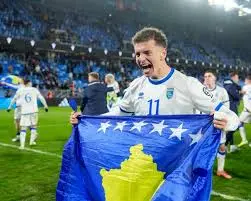
The kosovo vs turkey play-off at Pristina’s Fadil Vokrri Stadium places a Balkan nation 90 minutes away from the World Cup — a sporting milestone that, on the surface, reads like pure triumph. Beneath it are institutional milestones, wartime scars and logistical limits that matter as much as the result on the scoreboard.
Kosovo Vs Turkey — what are the verifiable facts?
Verified facts: Kosovo are unbeaten in their past six World Cup qualification matches. Ten years ago the national team had never played a World Cup qualifier. Kosovo declared independence in 2008 and were admitted by UEFA and FIFA in 2016. The play-off final is scheduled to be held at Fadil Vokrri Stadium in Pristina, a venue with a capacity listed at under 14, 000 spectators; Kosovo coach Franco Foda called it “a stadium only for 13, 000 spectators” and warned of emotional fans that must be managed.
Further match facts in the qualifying campaign: after a 4-0 opening defeat to Switzerland, Kosovo avoided defeat in the remaining group fixtures, including home and away victories over Sweden and results against Slovenia that carried them into the play-offs. Kosovo won the play-off semi-final 4-3 away in Bratislava against Slovakia to reach the final. In the current world rankings cited for this stage, Kosovo stood at 78th while Turkey stood at 23rd — 55 places higher. If Kosovo qualify, they would be placed in Group D of the finals and be scheduled to face Australia in Vancouver, Paraguay in San Francisco and the United States in Los Angeles.
Named witnesses and officials in the public record include Franco Foda, Kosovo coach; Samir Ujkani, former Palermo goalkeeper and Albania international, who described early squad-building struggles; Eroll Salihu, former General Secretary of the Football Federation of Kosovo, who recounted the federation’s diplomatic campaign; and Fadil Vokrri, the former federation president and striker whose name now adorns the stadium.
How did Kosovo reach this stage despite the odds?
Analysis (informed): The sequence of results — an opening heavy defeat followed by sustained unbeaten form, victories over established European teams and a decisive 4-3 away semi-final — maps to a team that has learned to absorb setbacks and convert home advantage into momentum. Samir Ujkani’s recollection of the squad’s early, improvised days and Eroll Salihu’s account of the federation’s political campaign supply institutional context: the national programme’s rapid maturation is both sporting and diplomatic.
Verified fact: UEFA and FIFA acceptance in 2016 changed Kosovo’s competitive horizon. Verified fact: the stadium capacity and the coach’s public caution about emotionally charged fans are immediate logistical constraints that frame the home fixture.
What must officials, players and the public demand from the moment?
Accountability conclusion (grounded): The moment requires three concrete priorities grounded in the facts on record. First, match governance and crowd control must match the scale of expectation inside a venue built for fewer than 14, 000 spectators; Franco Foda’s warning about emotional fans is not ceremonial, it is operational. Second, football authorities — the Football Federation of Kosovo together with UEFA and FIFA as the governing organisations that admitted Kosovo in 2016 — must ensure that sudden international exposure is accompanied by infrastructure and welfare planning for players and supporters. Third, historical context matters: statements by Eroll Salihu and testimony from veteran players such as Samir Ujkani underline that sport has been used as an instrument of national rehabilitation; that investment should be transparent and accountable, not episodic.
Verified fact: If Kosovo prevail in the play-off, the team’s World Cup itinerary would include matches in Vancouver, San Francisco and Los Angeles — a schedule that places travel, recovery and logistics at the forefront of any credible plan.
Final assessment (separating fact from analysis): Verified facts establish a remarkable competitive run, constrained stadium capacity and a federation that rose to secure global recognition in 2016. Informed analysis shows those elements combine into an eleventh-hour governance test: can infrastructure, crowd management and institutional transparency scale to a World Cup reality? The kosovo vs turkey fixture will decide qualification in sporting terms; it should also trigger a public reckoning about whether the rapid rise has been matched by durable capacity off the pitch.