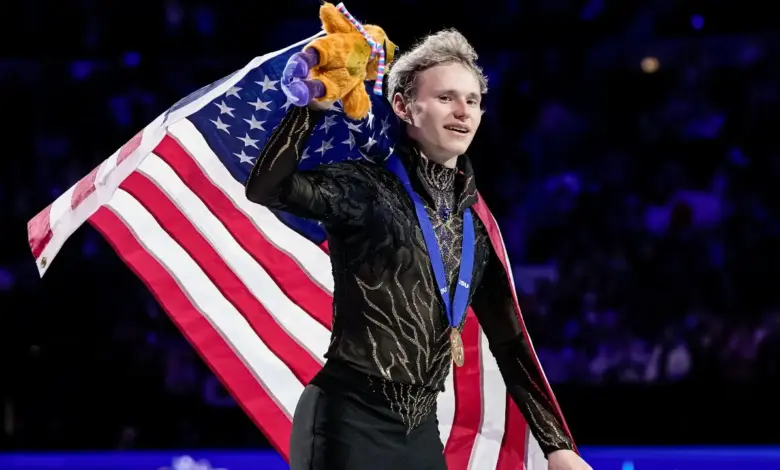
Ilia Malinin completed a swift and emphatic redemption on Saturday afternoon ET, claiming a third straight world figure skating crown with a commanding free skate that erased the memory of an Olympic collapse a month earlier. The 21-year-old American headed into the final with a sizable short-program lead and converted it into a decisive victory, a performance framed by difficult jumps, a late backflip, and noticeably few costly errors.
Background: from Olympic shock to Prague dominance
Malinin arrived in Prague off the back of a high-profile Olympic disappointment, where two falls had dropped him from favorite to an eighth-place finish. In the short program at the World Championships he posted a personal-best 111. 29, more than nine points clear of the field, and skating last in the free program he produced 218. 11 to finish on 329. 40 overall. Those marks put distance between him and his nearest competitors: Yuma Kagiyama finished second on 306. 67 and Shun Sato took bronze with 288. 54. The absence of the Olympic champion focused attention on Malinin’s recovery and the broader question of how elite skaters respond to major setbacks.
Ilia Malinin: redemption, technique and composure
The technical content of Malinin’s free skate was unmistakable. He packed the program with difficulty, landing five quadruple jumps and executing a quad toe–triple toe combination followed by a backflip late in the routine. Beyond the raw numbers, what distinguished the performance was composure: errors that had undone him in Milan were largely absent in Prague, and he finished nearly 23 points clear of the next best free-skate score. He later described feeling pushed and supported by the crowd and said his primary aim was to leave the long program “in one piece. ” Malinin’s visible relief—shouting and punching the air after the skate—underscored how much settling a performance like this meant to him personally.
That composure coexisted with imperfection. Reporting from the event noted that not all planned elements were fully clean across the competition; some difficult jumps were under-rotated or altered from original intention. Even so, the combination of difficulty and fewer decisive mistakes allowed Malinin to reclaim the sport’s top podium in Prague and extend a run of world titles not seen in men’s skating since Nathan Chen achieved three straight wins across 2018, 2019 and 2021.
Regional and global impact: ripple effects for the sport
The podium spread and scoring here have implications beyond a single medal. Japan’s Yuma Kagiyama improved his personal-best free-skate mark yet again to finish second, while Shun Sato repeated a previous Olympic-bronze program to secure third. Other contenders shuffled positions: Canada’s Stephen Gogolev finished fourth on 281. 04, and France’s Adam Siao Him Fa slipped from second after the short to fifth overall with 271. 56 after a fall. The results illustrate how depth in men’s skating can shift rapidly when top contenders are inconsistent or absent; the Olympic champion did not compete at worlds, concentrating spotlight and expectations on those who did skate.
For national programs and event organizers, the spectacle produced by Malinin—both his jumping arsenal and his rebound narrative—will shape commercial, selection and training discussions. Skaters and federations will study the balance he found between high-difficulty content and mental steadiness, while audiences and broadcasters will once again be reminded of the thin margin that separates triumph from collapse at the highest level.
Expert voices within the event echoed the emotional tenor. Ilia Malinin, the Virginia-born American skater, said the crowd’s support was central to his ability to complete the program. Yuma Kagiyama, the Japanese skater who took silver, emphasized relief at delivering what he described as a satisfying performance after his own recent struggles, and the two embraced on the ice in a moment that illustrated sportsmanship alongside competition.
The win leaves open strategic questions for the coming seasons: how Malinin will manage expectations after reclaiming the world crown, whether rivals will narrow the technical gap, and how the sport’s conversation about risk versus consistency will evolve. Will this third straight championship mark a consolidation of a new dominant era, or will it intensify pressure that shapes the next Olympic cycle? Ilia Malinin’s Prague victory answered one chapter of his career—but it also set the terms for the next.