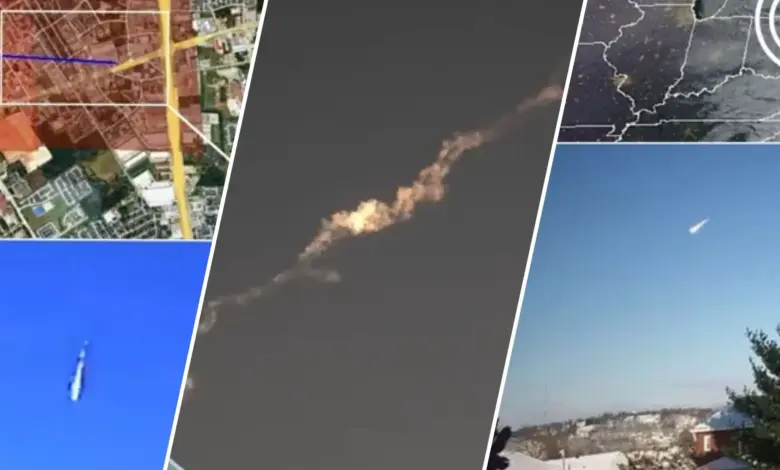
On a spring night north of Houston, a bedroom was left strewn with plaster and dust after a cannonball-sized fragment punched through a roof — one dramatic moment amid a recent string of bright streaks across the sky that is raising new questions about meteor showers and public sightings. Neighbors stepped into the street beneath a baffled, bruise-colored sky; elsewhere in Ohio, California, Michigan and Georgia people watched long, bright meteors carve arcs overhead.
Are Meteor Showers linked to the recent fireball surge?
Scientists and monitoring groups point to a complex mix of seasonality and clustering. NASA has noted that in the northern hemisphere February through April is peak “fireball season, ” when appearance rates of very bright meteors can rise by 10% to 30%, with particularly elevated activity around the March equinox. That seasonal context sits alongside a week in March when observers in multiple states saw unusually large, widely witnessed events: Ohio on March 17, California on March 19, Michigan and Georgia on March 20, and a striking explosion over Texas on March 21 in which a 1-ton, 3-foot-wide meteor traveled at 35, 000 mph and produced a sonic boom; a fragment from that event crashed through a roof in Bammel, near Cypress Station north of Houston and landed in a bedroom.
Why are people seeing more fireballs?
Part of the explanation is human and part is statistical. The American Meteor Society’s fireball reporting database recorded 1, 587 reports in the U. S. in January, 1, 425 in February and more than 2, 369 in March, a pattern that reflects both clustering of large events and heightened witness rates. Mike Hankey, who led the American Meteor Society analysis, noted that while total fireball counts are only slightly higher than recent years, events that draw 50 or more reports have more than doubled and events with over 100 reports have also doubled compared with recent averages. Hankey also pointed out that several meteorite recoveries happened in a short span, a departure from the typical pace: “We might see 10 meteorite recoveries a year worldwide, ” he said, “We had three recoveries in a week or ten days. “
Technology is an added factor. NASA highlights that the proliferation of cameras — from smartphones to doorbell and dashboard cameras — makes it far more likely that bright, brief events will be captured and shared, turning otherwise isolated streaks into widely witnessed phenomena.
What are scientists and communities doing in response?
Monitoring, reporting and recovery efforts have intensified. The American Meteor Society maintains the fireball reporting database that researchers use to identify clustered events and prioritize searches. NASA continues to watch the skies with a network of specialized telescopes and a planetary defense network tasked with finding and tracking much larger objects; its role and instruments help place bright meteors in context even though most meteoroids are far too small to be tracked before atmospheric entry.
Planetary scientist Nick Moskovitz of Lowell Observatory in Flagstaff, Arizona, framed the question plainly: “This is the question everybody wants answered, ” he said. “I think we are looking at slightly elevated meteor activity, though still well within statistical expectations, and increased awareness and reporting, which happens whenever big events occur. ” Public reporting to the monitoring database and coordinated recoveries are already producing results: several meteorites were recovered in quick succession during the recent cluster of events.
Back in the neighborhood where the fragment struck a bedroom, the ruined ceiling and the stunned family are small, immediate evidence of a broader phenomenon: seasonal peaks, clustered large events and an environment that now records and amplifies every bright streak. As scientists continue to analyze counts and patterns, the public is being asked to keep reporting sightings and preserve any footage — an uncertain but active partnership between skywatchers and researchers as meteor showers and their fireballs continue to remind communities how close and unpredictable the night sky can feel.