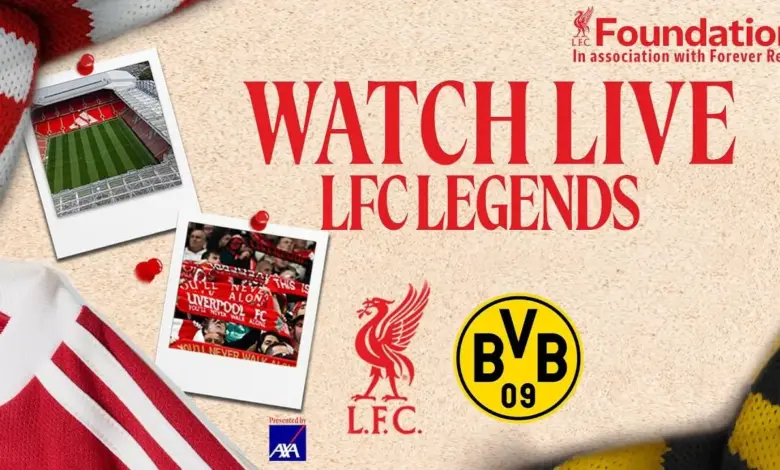
Anfield this weekend staged a liverpool legends match that combined celebrity returns with a fundraising push for community programmes. The fixture, a charity event supporting the LFC Foundation and Forever Reds, brought former first-team figures back to Merseyside in a fixture managed by Sir Kenny Dalglish alongside Jürgen Klopp. High-profile participants and foundation targets made the occasion more than a nostalgic exhibition — it was a calibrated effort to convert matchday attention into sustained local impact.
Background and context
The match was announced as a charitable fixture with proceeds directed to the LFC Foundation and Forever Reds to support employability programmes and long-term ambitions. Organisers emphasised that funds raised would support mentoring, training and efforts to help people find work and gain qualifications. The fixture’s purpose framed a night of football that mixed competitive nostalgia with social responsibility: the liverpool legends match was explicitly tied to concrete community outcomes rather than charity theatre alone.
Liverpool Legends Match: squads and star returns
The line-ups assembled included well-known names across Liverpool and Borussia Dortmund alumni. On the Liverpool side, former internationals and club stalwarts were listed among participants — Steven Gerrard, Thiago Alcantara, Pepe Reina and Peter Crouch were all named, with the management team led by Sir Kenny Dalglish and assisted by Ian Rush and John Aldridge. Thiago, described in the roster notes as a 34-year-old Spaniard who made 98 appearances for the club and has since moved into coaching, was highlighted as a notable return to Merseyside for the occasion.
Defensive and goalkeeping experience was visible in the squad makeup, with names such as Sami Hyypia, Martin Skrtel, Jerzy Dudek, Sander Westerveld and Pepe Reina listed among former players taking part. Additional former players — including Jay Spearing, Ryan Babel, Albert Riera and Peter Crouch — reinforced the sense of a star-studded reunion. The match narrative leaned on familiar faces to draw attention and ticket revenue that would be channelled into the foundation’s employability work.
Organisers also emphasised the fixture’s continuity with prior charity efforts: all proceeds from the event will go directly to the LFC Foundation and Forever Reds, the same bodies named as beneficiaries for previous fixtures. That operational detail positioned the liverpool legends match as a repeatable model of matchday philanthropy rather than a one-off spectacle.
Expert perspectives and charity impact
Voices from the event framed both the emotional and practical stakes. Jürgen Klopp, serving in a managerial role for the legends side and named as an LFC Foundation honorary ambassador, reflected on his personal ties to the club and community in a remark that underscored why the fixture matters beyond football: “The most important contract I signed in my life was the one with Ulla, ” he said, a comment that linked private commitment to public service. Sir Kenny Dalglish’s managerial involvement added gravitas and continuity with the club’s past leadership traditions, while Ian Rush and John Aldridge contributed ambassadorial support tied directly to Forever Reds.
On-pitch reactions also reinforced the fixture’s tone. Peter Crouch, identified in event material as a TNT Sports pundit and participant in past charity fixtures, captured the atmosphere in simple terms when reflecting on recent legends games: he “couldn’t keep the smile off his face, ” a sentiment that managers and organisers pointed to when describing crowd engagement and player willingness to participate.
Beyond anecdotes, the match was explicitly linked to measurable targets: organisers outlined a strategy tied to the LFC Foundation’s ambition to scale programmes to support 500, 000 people a season by 2030. The funds from this fixture were described as contributing to employability initiatives that aim to turn matchday goodwill into practical training, mentoring and job-placement activity.
As the crowd dispersed and former players departed Anfield, the liverpool legends match left behind both a short-term fundraiser and a longer-term framing for how clubs and alumni can marshal attention for community outcomes. Will this model of repeat fixtures and high-profile returns translate into measurable steps toward the foundation’s 2030 ambitions? The answer will depend on sustained engagement from participants, transparent allocation of proceeds and the capacity of employability programmes to absorb and scale the resources raised.