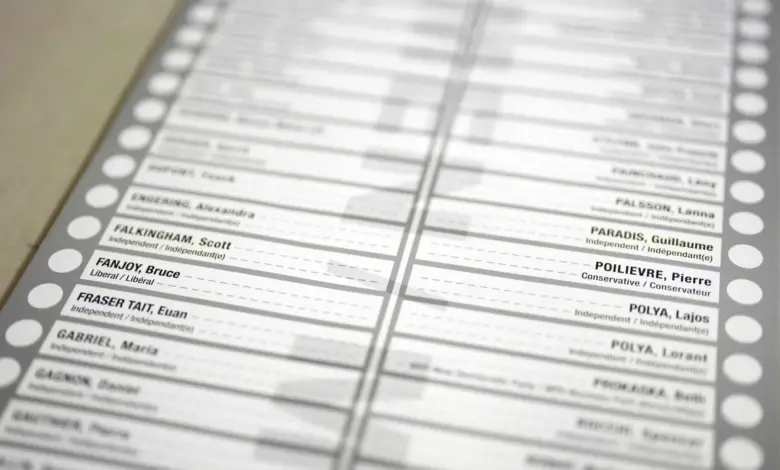
Voters in the Terrebonne byelection will use a write-in ballot after the Longest Ballot Committee signed up an unusually high number of candidates, forcing Elections Canada to alter how ballots will be cast and counted.
What is driving the move to a write-in ballot?
Verified facts: Elections Canada announced that a write-in ballot will be used in the Terrebonne byelection because of the high number of candidates assembled by the Longest Ballot Committee. The advisory committee of political parties at Elections Canada confirmed voters will write the first name, or initials, and last name of their chosen candidate, and that a list of candidates will be provided at polling stations during advance voting and on election day. The Longest Ballot Committee has targeted multiple byelections dating back to 2022 and has said it is signing up candidates in the Montreal-area riding of Terrebonne. In at least one prior case, the same write-in ballot approach followed when the protest group recruited nearly 200 people to run in a byelection, creating a ballot so long that Elections Canada instituted the write-in format to avoid delays in voting and counting.
Analysis: The immediate trigger is administrative: a ballot with an exceptionally high candidate count creates printing, counting and accessibility challenges. The write-in option reduces the complexity of a printed ballot but shifts the burden to voters to recall or record candidate names precisely, and to election officials to validate write-ins against a candidate list provided at polling places. That trade-off addresses one operational risk while introducing others related to voter experience and counting accuracy.
Who is behind the protest and what are they demanding?
Verified facts: The Longest Ballot Committee has said its actions aim to call attention to the need for electoral reform and, more recently, to put pressure on lawmakers to appoint an independent citizens’ body to set election rules. Chief electoral officer Stéphane Perrault has identified procedural patterns in the Longest Ballot Committee’s filings: nomination papers for multiple candidates often listed the same official agent and were signed by the same individuals. Candidates are required to collect signatures from 100 residents in a riding on nomination papers.
Analysis: The Committee’s tactic leverages existing nomination rules to create a political statement that also has tangible operational consequences. The pattern noted by Stéphane Perrault—that common agents and repeat nominators appear across many candidacies—suggests coordination that falls within the mechanics of current law but challenges its intent. That distinction frames the debate: is this lawful protest an exploitation of loopholes, or simply an extreme exercise of the rules as written?
What changes are being proposed and who will enforce them?
Verified facts: The House procedure and affairs committee is recommending legislative changes to make it harder for protest groups to sign up dozens of candidates in a single riding. Proposed measures in the committee’s report include limiting the number of candidates one person can nominate in a riding; ensuring candidates in the same riding have different official agents; penalties for individuals who sign more than one candidate’s nomination paper; a rule preventing an agent from representing more than one candidate per riding; a new penalty for collecting signatures on nomination papers before a candidate has been identified; and penalties for conspiring to violate the Elections Act or encouraging others to do so. Government House leader Steven MacKinnon is scheduled to hold a press conference to announce proposed amendments to the Elections Act, which the committee frames as steps to “strengthen and protect Canada’s democratic institutions and processes. ” Chief electoral officer Stéphane Perrault has called for legislative changes to reduce the risk of repeat occurrences.
Analysis: The package of proposed reforms targets the procedural levers exploited by coordinated nomination drives: nominators, agents and the timing of signature collection. If enacted, these changes would reduce the ease with which a single organized group can populate an entire ballot. Enforcement will rest with Elections Canada under amended statutory authority and with penalties set by Parliament; the effectiveness of such changes will depend on clarity in drafting and on the capacity of election administrators to detect and prosecute coordinated violations.
Verified fact & forward look: The shift to a write-in ballot in Terrebonne has prompted the House committee’s recommendations and a pending ministerial announcement. Ballot integrity and voter accessibility are now the central questions for lawmakers and election administrators as they move from crisis response to proposed statutory reform.