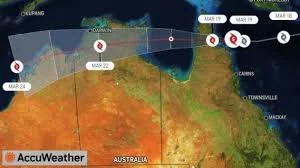
Ex-tropical Cyclone Narelle reveals rare cross‑continent sweep and the risk of reforming off WA coast


More than 100mm of rain fell across a wide area on Sunday, yet ex-tropical cyclone narelle weakened to a tropical low as it moved across the Northern Territory — raising questions about how a system that lost strength inland can later reform into a severe cyclone off Western Australia.
Ex-tropical Cyclone Narelle: Verified facts
- It weakened to a tropical low after bringing heavy rain to already-saturated parts of the Northern Territory; this shift in status occurred while the system continued a westward track.
- More than 100mm of rain fell across a wide area on Sunday, prompting minor to major flood warnings for communities including Daly River, Adelaide River and Katherine, and contributing to river rises and road closures including the Stuart Highway near Adelaide River. Lia Finocchiaro, Northern Territory chief minister, noted the system had moved across the NT faster than expected and that communities were relieved as it neared the West Australian border.
- Forecasts from the Bureau of Meteorology project the system will move into the Indian Ocean on Tuesday evening, travel south parallel to the Western Australia coastline and spend significant time over water in an environment favourable for re-intensification.
- Ilana Cherny, a meteorologist at the Bureau of Meteorology, stated the system would move into the northern Kimberley region, bring damaging gale-force winds and gusts up to 100km/h, and carry the risk of riverine and flash flooding. Cherny outlined a scenario in which the system could re-intensify into a tropical cyclone by Wednesday evening and become a major category four system offshore by Thursday, with potential coastal impacts from strong and damaging winds.
- Forecast confidence declines beyond Friday and across the weekend; Cherny noted a range of scenarios for tracks through central and southern parts of Western Australia and that it is too early to know if a crossing back to the coast will occur while the system is a tropical cyclone.
What is not being told?
Public briefings and the forecast narrative set out clear possibilities, but key uncertainties remain explicit in official statements: the probability of each scenario and the specific coastal locations at greatest risk become less certain after Friday. The Bureau of Meteorology models provide a range of outcomes, and the meteorologist Ilana Cherny emphasised that once forecasts move into the end of the week and weekend, the system starts to track closer to the coast with multiple potential crossing locations. Those planning responses — emergency services, local government and communities — must therefore work from a moving forecast envelope rather than a single predicted landfall point.
Call for accountability and next steps
Verified fact: the system produced heavy inland rain and road closures in the Northern Territory, and official forecasts identify a credible pathway for re-intensification offshore of Western Australia. Analysis: when a system crosses a continent and spends significant time over warm ocean, the odds of re-strengthening rise; combined with model divergence after several days, this creates both opportunity for beneficial rainfall north of Perth and risk of damaging winds should a severe cyclone track closer to shore.
Authorities should therefore make two concrete moves grounded in the verified facts on record: first, communicate forecast uncertainty clearly to affected communities and local authorities, emphasising the range of model outcomes and the timing windows articulated by the Bureau of Meteorology; second, prepare contingency plans for flood response and wind damage in the Kimberley, Pilbara and for agricultural districts north of Perth that may receive heavy rain. Lia Finocchiaro’s statement that communities were relieved as the system moved on underscores the immediate relief in the north, but it does not remove the duty to plan for re-intensification offshore.
The public and responsible agencies should track official updates closely over the coming days and align resources to a scenario-based response rather than a single forecasted track. The event now hinges on an unfolding ocean phase — whether ex-tropical cyclone narelle spends sufficient time over favourable waters to regain strength and, if it does, where along Western Australia’s coast that renewed energy will be directed.