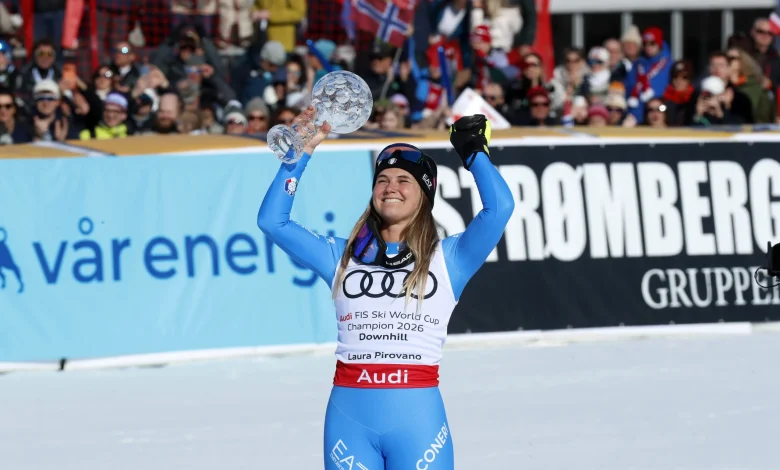
In a dramatic late-season twist, Laura Pirovano completed a remarkable run to claim the women’s downhill crown, turning a career without podiums until this month into three successive victories. The Italian’s decisive downhill triumph—earned by a 0. 15-second margin over Breezy Johnson—secured the discipline crystal globe and left Emma Aicher closing on Mikaela Shiffrin’s overall lead by 95 points, reshaping the title fight heading into the final races.
Downhill context and implications
Pirovano’s surge reframes a season that had shown little indication of such dominance. Less than a month earlier she stood fourth in the standings and had never finished on a World Cup podium; she now leaves the downhill campaign 83 points clear of nearest challenger Emma Aicher. The three straight wins—bookended by a double victory at Val di Fassa and capped by a final triumph—deliver the Audi FIS World Cup Downhill Crystal Globe to an athlete whose form peaked at the decisive moment.
On the same weekend, Aicher’s performance had broader consequences for the overall title race. The 22-year-old German gained 45 points on five-time overall champion Mikaela Shiffrin in one event block, trimming the overall deficit to 95 points and ensuring that the final rounds will carry amplified significance for the big crystal globe.
Deep analysis: how the result unfolded and why it matters
Factually, the margin of victory was razor-thin: Pirovano beat Breezy Johnson by 0. 15 seconds, with Kira Weidle-Winkelmann completing the podium on the day. Pirovano’s run was marked by precise execution on key features of the course, combined with a top speed that reached 127. 15 km/h on the final straight in the decisive performance. Those technical elements translated into a crushing late-season conversion of form—where earlier consistency in top-10 finishes became outright winning speed when it mattered most.
Strategically, this result alters incentives for the remaining races. Pirovano’s 83-point cushion in the downhill standings removes the immediate pressure in that discipline, while Aicher’s accrual of 45 overall points over Shiffrin creates a tactical dilemma for contenders: whether to concentrate on discipline points or chase the overall leaderboard. For Breezy Johnson, the runner-up finish moved her upward in the season-long standings and preserved momentum into the closing events.
Analysis note: the preceding lines separate verifiable race outcomes and numerical margins from interpretation about strategy and incentives. The latter are offered as editorial analysis based on the standings movements already recorded.
Expert perspective and regional impact
Laura Pirovano, World Cup Downhill Crystal Globe winner (ITA/Head), captured the mood of her breakthrough succinctly: “It’s unbelievable. ” She described a mix of disbelief and composure at the finish line, noting that she had not expected to review her time immediately and had to wait before accepting the result.
The season’s dynamics also reflect wider shifts within women’s speed events. The absence of a previous dominant presence due to injury factors was acknowledged in the season narrative, and Pirovano’s late flourish produced a golden month for her national team when combined with strong performances elsewhere. At the same time, Aicher’s all-round capabilities—capable of racing multiple disciplines in the final rounds—kept the overall chase alive and injected cross-discipline stakes into the Norwegian finale.
Regionally, the outcomes concentrate attention on the final races in Norway, where national teams and athletes must now balance preservation of discipline advantages against opportunistic bids for the overall crown. The condensed margin movements mean national programs will likely recalibrate athlete entries and risk profiles for the remaining events.
Looking ahead, Pirovano’s confirmation as downhill champion and Aicher’s tightening of the overall standings set up a riveting conclusion to the season: will Pirovano translate late sprint form into sustained success across other events, and can Aicher’s gains overturn Shiffrin’s advantage in the remaining races?
How will the interplay between discipline security and overall ambition reshape tactics in the finale, and which athlete will rise to meet that challenge in the remaining downhill contests?