Rei Sakamoto: Miami breakthrough exposes a contradiction — training to improve, playing to win

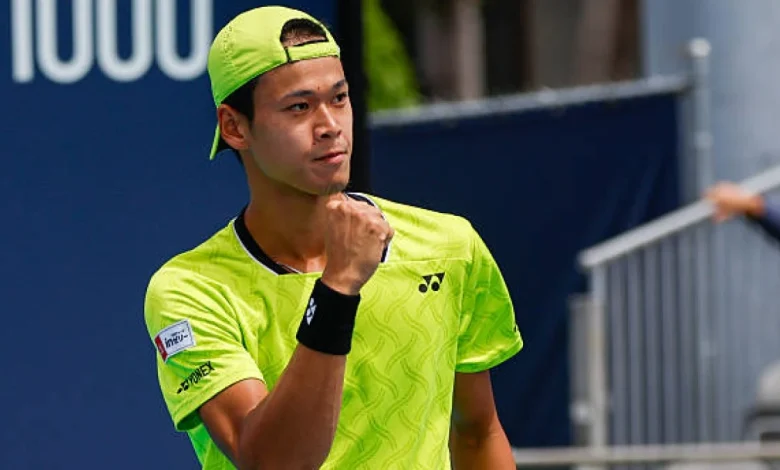
In a match decided on his fifth match point, 19-year-old rei sakamoto claimed his first ATP victory at the Miami Open, defeating Aleksandar Kovacevic 6-4, 3-6, 7-6. The result both confirms a competitive debut at ATP level and underlines a paradox he described after a recent practice with Jannik Sinner: train to improve, but play to win.
How did Rei Sakamoto convert a practice lesson into a match breakthrough?
Verified fact: Rei Sakamoto won his Miami Open main-draw match in three sets, closing the decider in a tiebreak on his fifth match point. He moved past Aleksandar Kovacevic by the scoreline 6-4, 3-6, 7-6. The victory was identified as his first at ATP level in Miami and follows prior success on the Challenger circuit, where he has already won two titles.
Verified fact: Sakamoto is the 2024 Australian Open junior champion and is 19 years old. He currently sits outside the top 150, yet his Miami performance and Challenger titles mark clear forward movement on the professional circuit.
Analysis: The match score and the way it finished signal an ability to handle tight pressure moments. That trait—closing on match point in a deciding-set tiebreak—gives measurable evidence that lessons being learned in practice are transferring into competition.
What did the Miami scoreline and training with Jannik Sinner reveal?
Verified fact: Sakamoto described a training session with Jannik Sinner in which they warmed up and played almost two sets, with a practice score reported at 6-4, 3-5. He said Sinner was focused on working on his game rather than trying to win the practice, and that the rallies were intense and purposeful.
Verified fact: Sakamoto said the session changed his view of daily work: training is not about winning points but about improving strokes and patterns. He noted that Sinner’s forehand commitment and the absence of frivolous drop shots during rallies were particularly instructive, and he highlighted that his second serve performed well in competition.
Analysis: The juxtaposition—practice aimed at improvement versus matches aimed at victory—helps explain a seeming contradiction in Sakamoto’s rapid advancement. The practice approach he observed emphasizes process over outcome; the Miami result shows he can convert that process into results under match pressure. This suggests a developmental trajectory in which technical and tactical adjustments made in practice start to bear out in high-stakes moments.
Who is in his cohort and what is the next test?
Verified fact: Sakamoto is one of five teenagers to reach the second round in Miami, joining Moise Kouamé, Darwin Blanch, Rafael Jódar, and Joao Fonseca—the first time that many teenagers have advanced that far in Miami since 2007. The immediate next opponent for Sakamoto is Daniil Medvedev, described in the Miami coverage as an extremely demanding test that will gauge his level against a top ATP player.
Analysis: The company Sakamoto keeps—five teenagers advancing together—signals a generational cohort making inroads at tour events. Facing Daniil Medvedev next creates a clear litmus test: success there would move beyond promising results and toward demonstrable competitiveness against established elite opposition; falling short would still provide a benchmark and developmental data for future work.
Verified fact: Sakamoto himself framed training and match play as distinct but complementary exercises: in training the goal is to improve, while in matches the goal is to win. In the immediate term, the evidence from Miami—the first ATP victory, his performance on pressure points, and lessons drawn from a training session with Jannik Sinner—points to a young player whose daily work is shifting into measurable match outcomes. Uncertainties remain about how that conversion will hold against higher-ranked opponents, and the scheduled match with Daniil Medvedev will be a decisive next indicator for rei sakamoto.