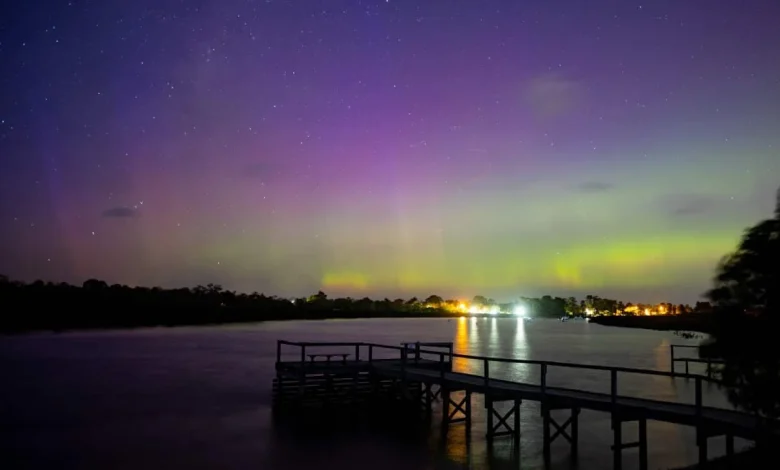
aurora australis tonight is now possible after the Bureau of Meteorology’s Space Weather Forecasting Centre issued an alert that a coronal mass ejection could impact Earth and spark geomagnetic activity across parts of Australia. The event is expected during night hours and may be visible in southern states, with activity highlighted for March 19. The alert explains that solar material and charged particles striking Earth’s magnetic field can push auroras farther from the poles than normal.
Aurora Australis Tonight: Where to look
Authorities have flagged southern Tasmania and southern Victoria as more likely viewing zones, with warnings covering parts of Tasmania, Victoria, South Australia, Western Australia and southern New South Wales for the next 48 hours from March 19. For observers in New South Wales — where sightings are usually rare — dark locations named for their open skies include Echo Point lookout in the Blue Mountains, Kangaroo Valley, Jervis Bay and Coonabarabran’s Warrumbungle National Park. For a clear sighting, minimal light pollution and clear weather are essential; photographers have been advised to use long exposures and high ISO settings on a tripod to capture faint colour.
Why this is happening: the science and colours
The Space Weather Forecasting Centre issued its alert because a coronal mass ejection — a burst of solar material — is expected to interact with Earth’s magnetic field and increase geomagnetic activity. Jonti Horner, Professor of Astrophysics at the University of Southern Queensland, explains: “But occasionally the sun is more active than normal. It has these things called coronal mass ejections and solar flares, and they’re like the sun having a big burp into space. It throws out more material … and the more materials coming in, the more our magnetic field can be overloaded. ” That overload pushes auroral displays farther from the poles and raises the chance of visible lights across southern populated areas.
National Aeronautics and Space Administration identifies how different gases produce colour: charged oxygen between 100 and 200 km creates green light; charged oxygen above 200 km produces red; charged nitrogen below 100 km can create pink; and charged nitrogen at 100–200 km can appear blue. Forecasts in the alert note that red and green are the most commonly seen colours in Australia during these events.
Immediate reactions and what to expect next
The Bureau of Meteorology’s Space Weather Forecasting Centre will issue further alerts if geomagnetic activity develops. Observers should watch sky conditions overnight and into the hours before dawn, when the event may be strongest. Forecasting agencies in other nations have indicated the coronal mass ejection is expected to reach Earth around March 19 and that geomagnetic activity could persist through the subsequent 48-hour window.
What happens next depends on the CME’s exact path and local weather; forecasts will become more specific as the interaction unfolds. As of March 19 (ET), crews monitoring space weather will update alerts if activity increases. If you plan to head out, pick a dark, open site well away from city lights, bring warm clothing and allow time for your camera to record long exposures — and keep watching the skies: aurora australis tonight could offer a rare, shifting show for southern Australia.