The season four premiere of invincible arrives with a sharper, more mature narrative that leans into an all-out war and a heavy, feels-bad-man tone — and yet the show’s animation quality has become an increasingly visible constraint on that ambition.
Is Invincible’s storytelling outpacing its animation?
Verified fact: The season four opening spans three episodes that push the series toward a darker, more introspective setup for a looming war, adapting Robert Kirkman’s Image Comics material into a grimmer, more grounded television arc. The narrative concentrates on Mark Grayson’s moral uncertainty — the fear that he will become another Viltrumite warmonger like Omni-Man/Nolan Grayson — while other principal players brace for escalating conflict, and Lee Pace’s Thragg is identified as a looming menace.
Analysis: Those story choices raise expectations for visual clarity and kinetic impact. When a plot escalates in scale and consequence, every beat of animation is required to carry emotional weight. The series’ strengths in performance casting — Steven Yeun and J. K. Simmons as the polar opposites of Mark and Omni-Man/Nolan Grayson, Sandra Oh and Gillian Jacobs in roles that balance strength and vulnerability, Walton Goggins as Cecil — now compete with moments where visual shortcuts blunt the intended force of scenes.
What specific animation shortcuts are visible?
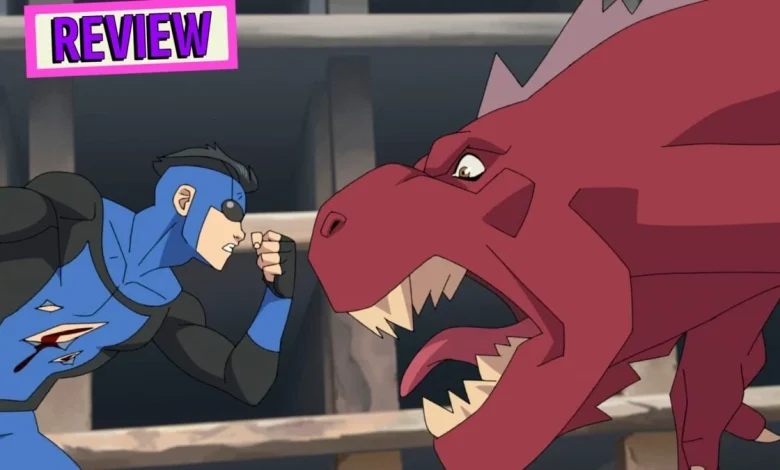
Verified fact: Observed production choices include slow-motion staging intended to suggest impact, the use of freeze-framed PNGs dragged across the screen to simulate motion, and a reduction in the effectiveness of impact-frame flourishes that once lent fights extra punch — for example, the anime-esque frames that enhanced the Mark–Conquest confrontation in prior episodes have lost some of their weight. The series’ near-annual release pace is cited as a factor that has strained Skybound Animation’s output.
Analysis: When animation relies on static assets moved mechanically rather than fluidly animated action, audience immersion can drop. Slow-motion can heighten drama, but when it replaces fully animated motion it reads as a production workaround rather than a stylistic choice. The cumulative effect is a mismatch between story ambition — intimate moral crises and the prelude to large-scale warfare — and the on-screen execution that is meant to carry that drama.
Who benefits, who is accountable, and what must change?
Verified fact: The adaptation continues to draw acclaim for its writing choices and its cast’s performances. The creative team’s decision to push characters into deeper moral terrain is explicit, and the three-episode opening leans into that maturity even as animation techniques show strain.
Analysis: Stakeholders here include the creative authorship embodied in Robert Kirkman’s Image Comics source material and the animation studio executing the vision. Performers deliver material that often outperforms the visuals tasked with carrying it. This dynamic benefits the performers and the narrative profile of the series while placing production pressure on the animation studio and the broader production pipeline. The visible shortcuts suggest a misalignment between release cadence and the time-intensive demands of high-quality animation.
Accountability and next steps: Transparency about production timelines and resourcing would clarify whether the near-annual schedule driving the series is sustainable without recurring visual concessions. A candid assessment grounded in the documented presence of static-frame tactics, diminished impact-frame effects, and explicit strain on Skybound Animation would allow creators and viewers to weigh trade-offs between cadence and craft.
Final verified observation: The season four premiere demonstrates that the invincible narrative engine — stronger characters, deeper moral stakes, and a cast delivering complex work — remains intact even as visual execution weakens. The public record of visible animation shortcuts and the adaptation’s mounting ambitions point to a single policy choice behind the scenes: match the production timeline to the demands of the storytelling or accept that important emotional beats will continue to lose force on screen.