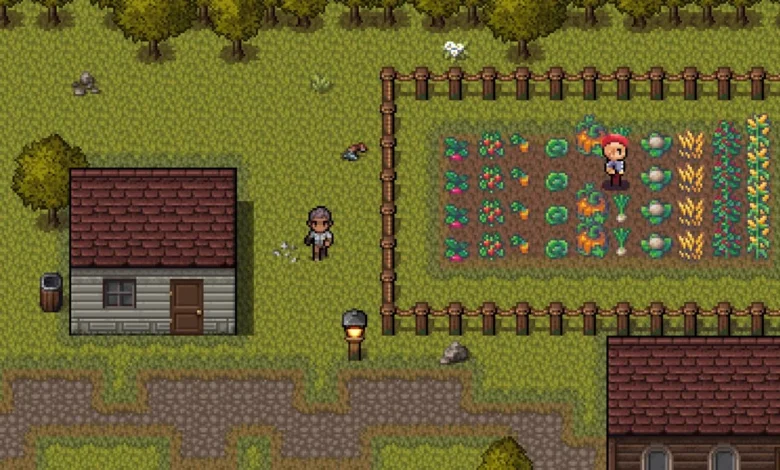
A new indie RPG on Steam wears its inspirations visibly, blending survival combat and settlement drama with pastoral life-sim loops — explicitly nodding to the last of us and Stardew Valley within its opening minutes. Ashfield Hollow, developed by BitQuest Studio, offers a free demo that mixes 2D pixel art farming and relationship systems alongside real-time fights against the infected, inviting players to test a hybrid that aims to honor two distinct design legacies.
Background & Context: What Ashfield Hollow Borrows
Ashfield Hollow is described as an open-world survival RPG shooter set in a post-apocalyptic world overtaken by the infected after a deadly outbreak. The developer BitQuest Studio frames the player as a survivor in one of humanity’s remaining settlements, responsible for defending the camp from hordes of infected through real-time combat while maintaining daily life. The game operates in 2D pixel art and integrates life-sim mechanics — farming, crafting, scavenging, and fishing — elements explicitly linked to the influence of Stardew Valley and its creator, ConcernedApe.
Players can expand and customize households with furniture and workstations and develop meaningful relationships with other survivors, progressing missions that can evolve friendships into romance. While Ashfield Hollow will be a paid product on release, a free demo is currently available on the Steam platform without developer permissions or fees. The development timeline in published materials contains two different cues about launch timing: the title is described both as set to arrive later this year and as scheduled for release on Steam in 2026.
Deep Analysis: The Last Of Us Influence Meets Farming Sim Mechanics
The pairing of the last of us–style infected narrative with Stardew Valley–inspired life-sim mechanics is noteworthy because it recombines high-stakes survival with low-stakes domestic routines. The infectious-threat conceit borrowed from Naughty Dog’s hit title supplies an emotional and mechanical pressure — defending a fragile human settlement against a persistent external danger — while the farming and fishing loops offer rhythm and player agency that reward patience and planning.
Mechanically, the demo’s real-time combat against hordes of infected creates tension that contrasts with slower tasks like tending crops and crafting workstations. This contrast can broaden appeal: players drawn to social progression and customization may stay for the defensive action, and vice versa. The demo’s 2D pixel presentation channels classic indie aesthetics, positioning the title alongside other contemporary experiments that fuse genres; another example cited in community discourse is HumanitZ, itself noted for heavy influence from the last of us.
Design risks are evident. Merging two distinct pacing profiles demands careful balancing so that farming does not undercut threat, and combat does not render life-sim progress incidental. The decision to include relationship arcs and household customization signals a deliberate attempt to create narrative anchors within settlement management, shifting some survival stakes from resource scarcity to interpersonal dynamics.
Regional and Global Impact and Forward Look
On the platform front, Steam’s distribution of a no-request demo gives Ashfield Hollow immediate global visibility among PC players who test hybrid titles. The demo’s free access model could serve as a market probe, allowing BitQuest Studio to collect play patterns and adjust balance before the paid release. The game’s explicit nods to established properties — both Naughty Dog’s infected-driven drama and ConcernedApe’s life-sim loops — position it to attract fans across communities, including those who admire survival staples like Project Zomboid that prioritize emergent camp management under threat.
What remains open is how BitQuest Studio will reconcile the two different public timelines cited for release; materials reference both an arrival later this year and a scheduling on Steam in 2026. That discrepancy leaves the production window and post-demo roadmap unclear, but the demo itself offers a concrete basis for assessing whether the hybrid concept lands.
Ultimately, Ashfield Hollow’s demo asks whether players want their quiet moments to be constantly endangered or whether steady domestic progress can coexist with episodic violence. If the balance is struck, the title could broaden how narrative survival and cozy life-sim mechanics interoperate; if not, it will illustrate the friction inherent in marrying opposing tempo drivers. Will this fusion redefine expectations for post-apocalyptic sims, or will it remain a niche experiment? That question will guide attention as the demo’s community feedback and BitQuest Studio’s development choices unfold, and it will shape whether fans of the last of us and Stardew Valley find a genuine middle ground.