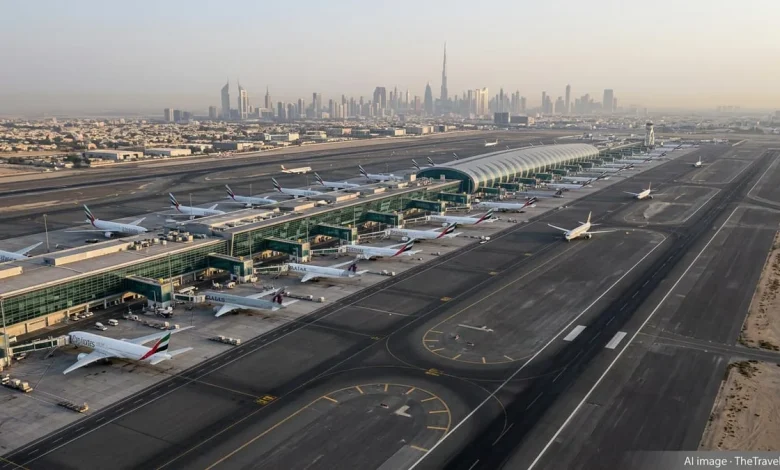
In a dimmed departure lounge at Dubai’s terminal, rows of lie-flat seats sit unused on a widebody jet bound for Europe — a quiet emblem of how emirates airlines transit flows have thinned. The sight of once-packed business cabins with empty premium rows is now a familiar scene on some long-haul services as airspace closures and security concerns ripple through global aviation.
Emirates Airlines: What operational changes are visible?
Airspace closures across the United Arab Emirates, Qatar, Iran and Israel, together with constraints in neighboring states, have forced airlines to reroute or suspend flights and to trim schedules. Emergency security controls in the UAE have limited civilian corridors and reduced the number of flights able to use the region’s usual hub links. Carriers associated with the Gulf super-connector model have sharply reduced services from Dubai, Abu Dhabi and Doha, and some long-haul departures that once carried heavy transit traffic now show unusually light premium cabins.
Why are premium cabins unusually sparse?
Three dynamics combine to hollow out first and business-class sections. First, coordinated airspace restrictions and the specter of missile and drone attacks have created longer routings and last-minute schedule volatility. Second, the collapse of predictable through-traffic has removed a core source of premium passengers who historically connected between Europe, North America and Asia Gulf hubs. Third, traveler anxiety and corporate travel decisions have changed demand: many companies and travelers have reduced or restricted routes that relied on fast, predictable Gulf connections. Publicly available analytics and industry commentary indicate that premium cabins on overnight sectors have been hit harder than economy in certain markets, producing an uneven pattern of load across classes.
How might global route shifts reshape airline brands and who is responding?
The operational squeeze on Gulf hubs is prompting questions about the long-term brand value built by carriers that marketed themselves as safe, reliable superconnectors. Regional carriers that once leveraged short layovers through the Persian Gulf now face a test of that brand promise. At the same time, the narrowing of usable corridors — with the Caucasus route increasingly critical — opens opportunity for carriers based outside the Gulf. Asian and Eurasian airlines have stepped into altered networks in past disruptions, and some state-owned Chinese carriers have offered fee-free refunds and rescheduling on cancelled routes, presenting themselves as responsive alternatives during the uncertainty. Industry recognitions and safety claims that once underpinned Gulf branding remain on record for certain carriers, but the crisis has made the connection between perceived safety and operational geography a central concern.
The broader picture is of an air-transport ecosystem forced into rapid adaptation: flight planners are redrawing routings to avoid constrained zones, schedules are being pruned, and the premium product mix that supported high-yield connecting traffic is being reevaluated. Uncertainties remain about how long the current pattern will persist and whether passenger behaviour will revert or shift permanently toward different hubs.
Back in the terminal, the empty lie-flat seats are more than a statistic: they are a quiet sign of disrupted livelihoods and altered travel plans, affecting crews, airport workers and corporate itineraries alike. As carriers and states navigate security controls and rerouting, the question lingers for passengers, planners and the airlines themselves — will the rebuilt networks restore the premium flows that once defined emirates airlines transit dominance, or has a deeper rebalancing already begun?