Hawaii Flooding Reveals How Power Restorations, Road Closures and Shelters Clash During the Kona Storm

Hawaii flooding has left a paradox: utilities restored electricity to 217, 000 customers while tens of thousands remain in the dark because high winds, downpours and flood-damaged roads make repairs unsafe. The scale of concurrent outages, rescues and sheltering exposes how emergency priorities clash when access and weather dictate the pace of response.
What is not being told?
Where are the published priorities and timelines that explain which neighborhoods will be reconnected first, and how road closures and flooding are being factored into those plans? What assessment has been shared publicly that links transmission-line damage, shelter capacity, and water-system advisories so residents can make informed choices about travel, evacuation, and conservation?
Verified facts: Hawaii Flooding and infrastructure strain
Hawaiian Electric stated its crews and contractors repaired most major transmission lines and restored power to 217, 000 customers across Oahu, Maui and Hawaii Island, while about 86, 000 customers remained without power as of 9 p. m. ET because unsafe weather, flooding or inaccessible roads prevented damage assessments and repairs. The company identified vegetation — fallen trees and broken branches blown into lines — and some lightning strikes as primary causes of outages, and said rain and flooding make field work difficult. Hawaiian Electric spokesman Darren Pai described vegetation and lightning as key contributors to outages; Jim Alberts, senior vice president and chief operations officer at Hawaiian Electric, said the utility is prioritizing transmission equipment that will bring the most customers back online and emergency facilities such as hospitals and water companies.
The utility recorded localized restorations after crews cleared large trees and repaired poles in Mililani that returned roughly 10, 000 customers to service. On Oahu, two high-voltage transmission lines crossing the Koolau ridgeline into East Honolulu were damaged; one remaining line was damaged later, and a helicopter was cleared to fly at around 11 a. m. ET Saturday to inspect storm-damaged lines. Hawaiian Electric warned that repairing mountainous transmission damage could take hours to days or longer.
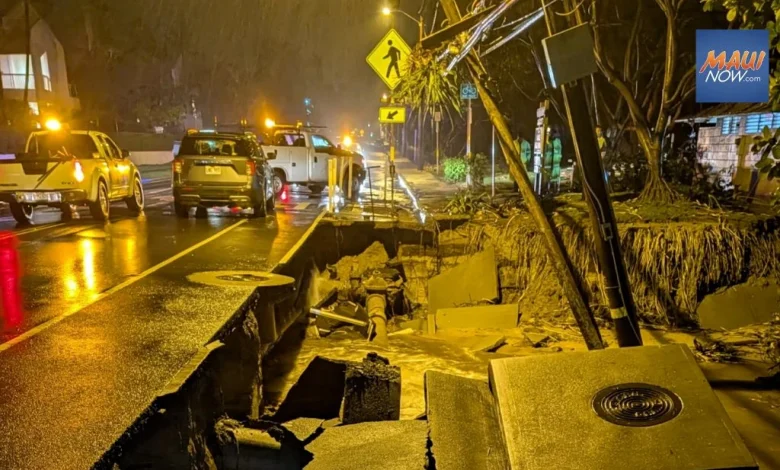
On Maui, roughly 7, 300 customers — about 10% in certain areas — remained without power in several locations after crews restored more than half of the roughly 20, 000 customers initially impacted across the county. Damage assessments and repairs were hindered by flash flooding and road closures, including a massive sinkhole in South Maui. Separate counts showed about 20, 400 customers, or 22% of local customers in some areas, without service where strong winds and heavy rain were concentrated.
Emergency agencies documented multi-pronged impacts: the Maui Fire Department conducted floodwater rescues overnight in South Maui; dozens of people cut off in Hāna were placed in a shelter after road washouts; more than 100 people were using shelters opened by the Maui Emergency Management Agency and the American Red Cross. The National Weather Service reported localized rainfall totals exceeding 20 inches in parts of Kula and wind gusts beyond 70 mph in parts of Kaunakakai. County officials closed parks, facilities and offices on March 14, and Mayor Richard Bissen signed an emergency proclamation on March 10 enabling access to state and federal assistance. The Department of Water Supply advised conservation because potential power and electronic system disruptions could affect water systems.
Who benefits, who must answer — analysis and accountability
Verified facts: Hawaiian Electric is directing resources to restore large transmission lines first and to prioritize hospitals and water companies. Emergency managers opened shelters and urged residents to avoid travel; road closures and sinkholes are blocking access for repair crews. The National Weather Service issued flood watches, flash flood warnings and high-wind warnings covering the storm period.
Informed analysis: The intersection of damaged transmission corridors, blocked roadways and active flood rescues means technical restoration is not solely an electrical problem; it is a logistics and access problem. Prioritizing transmission lines returns power to the greatest number of customers faster, but that strategy can leave isolated neighborhoods waiting while crews lack safe access. Simultaneous advisories — do not drive through pooling water, conserve water because systems may lose power, and treat out traffic lights as four-way stops — place day-to-day decisions on residents who may lack clear timelines for reconnection.
Accountability requires transparent, synchronized reporting: verified, regularly updated maps of outage clusters tied to road closure maps and shelter locations; published criteria for how transmission versus neighborhood restorations are sequenced; and public timelines for when aerial inspections and ground crews can resume work safely. Hawaiian Electric’s stated priorities and the county emergency actions demonstrate intent, but the public lacks a single consolidated picture that connects damage, access and service restoration.
For now, residents must be empowered with clear, time-stamped updates and unified operational maps from utilities and emergency agencies so scarce resources align with the greatest safety need. That imperative is the central public reckoning emerging from this Kona storm and ongoing hawaii flooding.