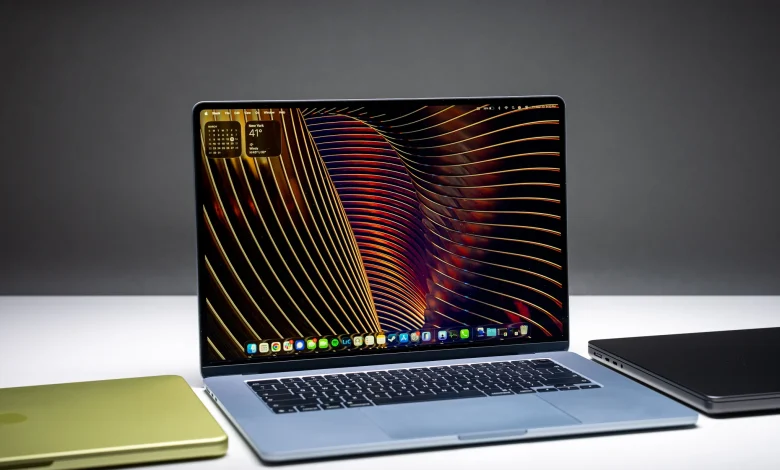
The new m5 macbook air arrives as a cautious, evolutionary upgrade that tightens performance margins without changing the product’s identity. With the M5 chip, Wi‑Fi 7, and faster storage now standard at 512GB, the machine refines what users already liked — yet higher price positioning and cheaper alternatives beneath it force a fresh assessment of value.
Background & context
The latest iteration keeps the Air’s essential formula intact: thin profile, strong battery life, a 12‑megapixel Center Stage webcam, and an improved speaker setup on larger models. The m5 macbook air brings a 10‑core CPU coupled with a 10‑core GPU, faster NVMe storage that benchmarks at roughly double the read/write speeds of the previous generation, and Wi‑Fi 7 connectivity. Base storage now starts at 512GB rather than 256GB, and the entry price sits approximately $100 higher than the prior model while delivering that larger storage baseline.
Market signals around the Air are shifting in three directions at once. First, the device itself is a modest internal update that boosts GPU and multicore performance over the M4 generation and narrows the gap with higher‑end models. Second, a new lower‑priced laptop positioned beneath the Air introduces a clear value alternative, sitting several hundred dollars below the base Air and recasting the Air as a step‑up option. Third, heavier discounts on both prior‑generation Air units and M5 MacBook Pro machines are compressing the choices consumers face.
M5 Macbook Air: Deep analysis
Technically, the M5 upgrade focuses on areas that matter to real users: storage speed, graphics performance, and connectivity. Storage gains bring the Air in line with more expensive models, meaning day‑to‑day tasks and file transfers feel snappier; benchmark testing cited for the platform shows read/write rates more than twice those of the M4 Air. The 10‑core CPU and GPU show modest generational uplift, with the largest wins in GPU tasks and certain multicore workloads like 3D rendering. Thermal design remains a tradeoff: without an active fan, the Air trails a fan‑cooled 14‑inch model with the same chip in sustained heavy workloads, but it preserves the silence and thinness that define the family.
Battery performance remains a standout. In extended mixed‑use testing that combined web browsing, messaging, and streaming, the Air sustained a full work‑day and beyond — testing logged roughly 13 to 14 hours on a single charge under typical usage and moderate screen brightness. Audio and webcam capabilities continue to outpace rivals in class: the 12MP Center Stage camera and multi‑speaker arrangements contribute to a confident multimedia experience for video calls and content consumption.
Where the Air’s positioning becomes strategic rather than purely technical is price and lineup placement. The device is now a deliberate middle ground: more capable and sleeker than the new budget alternative beneath it, yet not as powerful as the Pro family. That middle position may be ideal for many shoppers, but it also invites comparison with two very different offers — a lower‑cost model designed to capture budget buyers and discounted higher‑end machines that close the premium gap.
Expert perspectives and market signals
Gabriela, a tech writer with a dozen years covering consumer technology, called the marketplace shift predictable but consequential: “Now that the M5 is here, we expected to see sales on the M4, but the price moves have been sharper than anticipated, ” she said, noting that prior‑generation Air inventory has seen unusually deep discounts. Independent price movements add another dimension: a high‑end laptop with the same M5 chip has been discounted by a major retailer to a notably lower price point, and earlier Air models have been offered at steep reductions through online promotions.
Those market dynamics frame how buyers evaluate the m5 macbook air: is the marginal boost in speed, doubled storage performance, and upgraded wireless worth the premium over cheaper alternatives? Or do aggressive discounts on both older Airs and Pro‑class machines tilt buying decisions the other way? Expert commentary highlights that the answer depends on intended workloads, preference for silence and thinness, and tolerance for paying for a mid‑tier position within a broader family.
Product features promoted elsewhere in the ecosystem matter to that calculation. Higher‑brightness displays, expanded port arrays, and additional RAM in discounted Pro models can sway creative professionals, while budget‑oriented laptops emphasize value and similar day‑to‑day responsiveness for mainstream users.
Conclusion
The m5 macbook air is a careful, well‑executed refinement: faster storage, incremental CPU/GPU gains, better connectivity, and long battery life preserve its place in the lineup. Yet the broader device market is exerting pressure from below and above, creating a new buying calculus that will determine whether the Air is the perfect middle ground or an awkward middle child. As inventory rotations and promotional pricing continue, will consumers pay a modest premium for the tuned Air experience or follow the bargains to other machines?