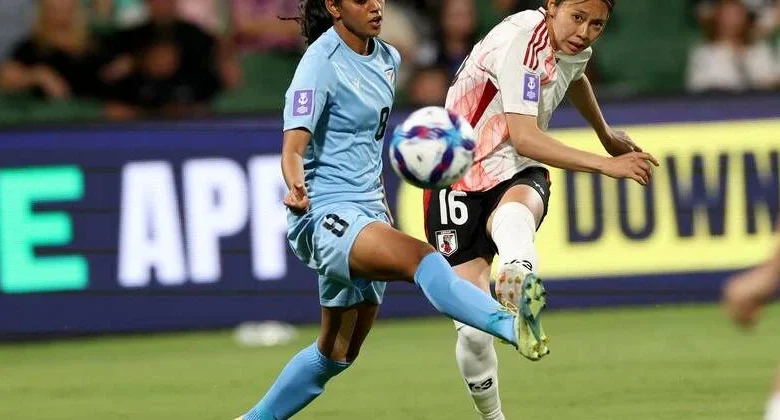
Perth Oval under lights felt less like a contest and more like a lesson: Japan hammered 11 goals past India in the opening lines of this afc women’s asian cup match, racing into an unsurpassable position in the group and announcing title intent.
Afc Women’s Asian Cup: How the score unfolded and why it mattered
Japan struck early and often. Yuzuki Yamamoto’s first international goal came in the fourth minute when she cut in, eluded Sanju Yadav and Pyari Xaxa, and curled a left-footed finish into the top corner. That opener set the tone; Yui Hasegawa followed inside the first half, and Hinata Miyazawa added goals as Japan ran away with the game.
The margin was emphatic: five goals in the first half and six in the second. Two players finished with hat-tricks — Hinata Miyazawa, forward, Manchester United, and Riko Ueki, forward, West Ham United — while Kiko Seike added a brace and Maya Hijikata, Mina Tanaka, and Yuzuki Yamamoto also found the net. Japan’s head coach, Nils Nielsen, made tactical changes at halftime that produced immediate results as substitutes combined for quick-fire goals early in the second half.
Numbers that explain a rout
The statistical picture was stark. Japan produced 35 shots to India’s zero, with 16 of those on target. Possession tilted overwhelmingly in Japan’s favour at around 80%, and passing volume highlighted the gulf: 613 passes for Japan against 161 for India. The action sat predominantly in India’s defensive third — roughly 65% of the match — while Japan’s defensive third saw only about 3. 6% of the play. Those figures underline more than finishing; they reveal control across the field.
Individual moments reinforced the statistics. A Kiko Seike penalty on the stroke of halftime made it five before Nils Nielsen introduced changes that paid immediate dividends. Maya Hijikata’s left-sided delivery and clever movement from Riko Ueki resulted in quick second-half goals that removed any doubt. India goalkeeper Panthoi Chanu faced repeated pressure and costly positional overloads as Japan continued to pile on the scoring.
What this result means for the teams and the group
The result leaves Japan with an unsurpassable six points in two games and a goal difference sitting markedly in their favour. For India, the loss dramatically worsened a goal difference that now stands deep in negative figures, leaving their path to the knockout phase precarious. Chinese Taipei and Vietnam occupy the chasing positions on three points each, with progression scenarios hinging on head-to-head comparisons and goal differentials.
Beyond immediate qualification arithmetic, the match exposed structural gaps on the pitch: Japan’s resources and cohesion translated into relentless possession, high shot volume and clinical finishing. India were able to create little sustained threat, facing a level of opposition that highlighted disparities in build-up, pressing and defensive recovery.
Voices and the technical view
The players who scored carry the headlines. Hinata Miyazawa and Riko Ueki provided clinical finishes at different moments; Kiko Seike’s composed penalty and Maya Hijikata’s incisive crosses added variety to the attack. Nils Nielsen’s halftime adjustments — three substitutions early in the second half — yielded immediate returns and demonstrated a coach managing not just for victory but for message: Japan would not ease up.
Institutional context lends perspective: the teams occupy very different positions within the broader competitive landscape, reflected in ranking and development disparities highlighted during the match. That gap, illustrated by shot counts, passing numbers and territorial control, shaped both the result and its implications for tournament progression.
What is being done in response is already procedural: Japan progress to the quarterfinals with momentum, while India must regroup and prepare for a must-win test against Chinese Taipei to keep any hopes alive of qualifying as one of the better third-placed teams. Tactical fixes for India will need to address defensive compactness and transitional play; Japan will face pressure to maintain focus and convert dominance into continued consistent performances.
Back at Perth Oval, the final whistle left Japanese players celebrating an emphatic night and Indian players grappling with the scale of the defeat. The afc women’s asian cup, as the tournament unfolds, will test whether this result is an outlier or a defining moment for both teams: a stepping stone toward Japan’s title campaign and a stark prompt for India to adjust quickly if they wish to remain in contention.