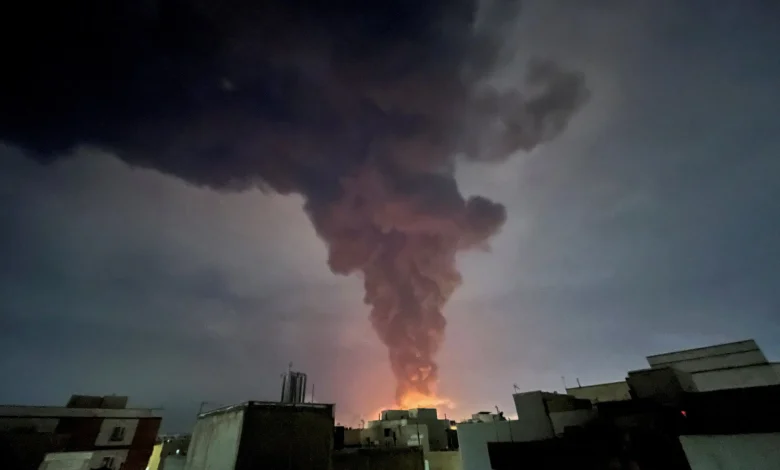
In a rare public apology, tehran’s president acknowledged attacks on neighbouring countries even as ballistic missiles and drones continued to strike Gulf states — a contrast that raises urgent questions about who controls Iran’s military response while the US president presses for harder action.
What is not being told about control of the strikes?
Verified facts: President Masoud Pezeshkian apologised for attacks on neighbouring countries and said Iran’s three‑man leadership council had been in touch with the armed forces. Pezeshkian also rejected the US president’s repeated calls for unconditional surrender. General Abolfazl Shekarchi, Iran’s armed forces spokesman, followed Pezeshkian with a statement saying Tehran has “not hit countries that did not provide space for America to invade our country. ” President Donald Trump, in a social media post, warned that more Iranian officials would become targets and wrote that Iran would be “hit very hard. ”
Analysis: Those three closely timed statements — an apology from the civilian president, a guarded clarification from the armed forces spokesman, and an escalatory message from the US president — together show a fracture between political messaging and military action. The apology signals political leaders trying to limit regional escalation; the armed forces response suggests competing operational narratives; and the US president’s posture amplifies pressure on Iran’s decision‑makers. These are distinct verified facts and not conjecture.
Documented strikes, interceptions and regional responses
Verified facts: Qatar’s Ministry of Defence said 10 ballistic missiles and two cruise missiles were fired towards Qatar and that Qatar’s armed forces intercepted six of the ballistic missiles and both cruise missiles; two ballistic missiles fell in Qatar’s territorial waters and two landed in an uninhabited area without causing casualties. Saudi Arabia’s Ministry of Defence said eight drones were intercepted and destroyed after entering the country’s airspace and that Saudi air defences shot down the drones. Saudi Arabian Defence Minister Prince Khalid bin Salman spoke with Jordan’s prime minister and defence minister, Jaafar Hassan; both officials condemned what they described as Iranian attacks and affirmed support for measures aimed at preserving security and stability.
Analysis: The pattern of multiple missile and drone launches — and the matching pattern of interceptions and cross‑government condemnations — documents a region already operating under kinetic duress. The named Gulf defence ministries reporting interceptions and the bilateral exchanges between Prince Khalid bin Salman and Jaafar Hassan establish that neighbouring states are treating these events as a coordinated security threat rather than isolated incidents.
Tehran: Who speaks for Iran’s use of force?
Verified facts: Pezeshkian apologised and said attacks on neighbouring countries should stop unless those countries attack Iran; he urged a diplomatic approach. Gen. Abolfazl Shekarchi’s later statement introduced divergent language about which countries had been targeted and why. Ayatollah Nasser Makarem Shirazi urged the Assembly of Experts to act quickly to name a new supreme leader following disruptions to Iran’s leadership.
Analysis: The juxtaposition of Pezeshkian’s apology and Shekarchi’s subsequent remarks is a clear, documented sign of competing authorities. Pezeshkian’s call for restraint and diplomacy and the armed forces spokesman’s framing of targeting rationale cannot both be read as a single coherent command approach; they indicate operational autonomy within Iran’s security architecture. That autonomy matters because it shapes the risk calculus for neighbouring states and for the US president’s stated intention to escalate forceful responses.
Accountability and next steps — verified facts only: The US president has refused to disclose the conditions for sending ground troops into Iran. Qatar’s Ministry of Defence, Qatar’s armed forces, Saudi Arabia’s Ministry of Defence, Prince Khalid bin Salman, Jaafar Hassan, President Masoud Pezeshkian, Gen. Abolfazl Shekarchi and Ayatollah Nasser Makarem Shirazi are the named actors tied directly to the verified developments described above.
Analysis and call for transparency: The documented divergence between political apology and military messaging requires clearer public accounting. Regional governments that have recorded missile and drone activity and Iran’s own named officials have presented facts that, when combined, point to a power gap with real consequences. For the public and policymakers to weigh options responsibly, the named institutions and individuals must provide transparent explanations about command structures, target selection, and steps to de‑escalate — only then will tehran’s public statements match the operational reality observed across the Gulf.