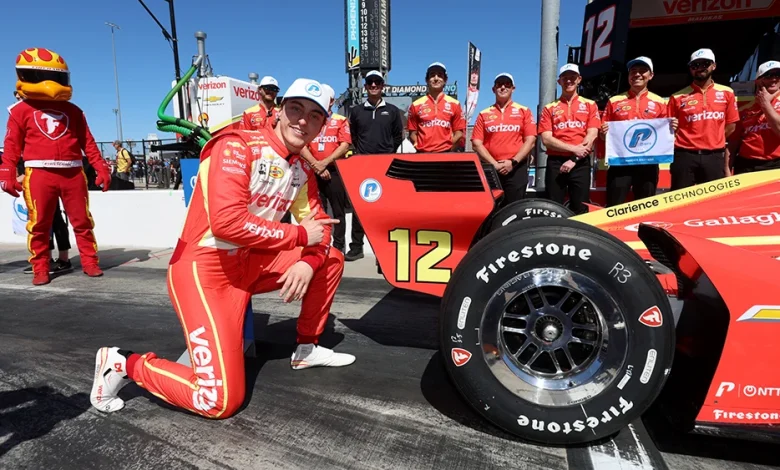
David Malukas’ pole for the Good Ranchers 250 at Phoenix Raceway exposed a rare moment of reordering in the indycar pecking order: the 24-year-old Penske rookie took the NTT P1 Award with a two-lap average of 175. 383 mph in the No. 12 Verizon Team Penske Chevrolet, delivering both an individual breakthrough and a symbolic shift for a team with a long-established lineup.
Indycar Context at Phoenix Raceway
Pole position at this one-mile desert oval puts Malukas alongside teammate Josef Newgarden on the front row for the 250-lap race set to start at 3 p. m. ET. Malukas’ qualifying effort followed a practice lead at 175. 605 mph and made him the 13th of 24 drivers to make an attempt. Team Penske completed a front-row sweep with Newgarden clocking 174. 548 mph; Scott McLaughlin also placed a Penske car in the top five. The qualifying sheet shows a compressed set of speeds across the short oval: Graham Rahal managed 173. 993 mph in third, Mick Schumacher posted 173. 667 mph in fourth, and Scott McLaughlin recorded 173. 448 mph in fifth, illustrating how little separates the front-running groups on this circuit.
What the Pole Reveals: Deep Analysis and Team Dynamics
Malukas’ ascent to pole carries layered implications. He enters Team Penske after a path that included stints with Dale Coyne, a signing and subsequent firing from Arrow McLaren without completing a race for them, drives for Meyer Shank, and time at AJ Foyt Racing, before being named to the iconic No. 12 Verizon Dallara/Chevrolet. The performance in Phoenix converts accumulated experience into a clear, measurable output: the fastest qualifying average and the NTT P1 Award, a milestone that has tangible race implications on a tight, traffic-heavy oval where starting position governs early strategy.
Malukas framed his development as cumulative: “From all these different teams that I’ve had and different experiences from IndyCar, if it’s from Honda, if that be from Andretti, and all these things, I think I can bring a perspective of how is Team Penske compared to to all these other cars, ” said David Malukas, Team Penske driver. He also emphasized temperament: “From my side, it’s trying to control the youth in me, right? Not getting too anxious or making these aggressive, exciting moves, keeping things under control so we can have that consistency. ” That combination of institutional learning and personal restraint is central to evaluating whether a single qualifying performance will translate into sustained results.
Expert Perspectives and Immediate Stakes
Mick Schumacher, Rahal Letterman Lanigan Racing driver and Formula One veteran, underscored the difference between qualifying and race conditions: “I’m excited to run the race. It’s going to be a whole different situation in the race with traffic and everything, so it’s going to be tough. ” Schumacher’s observation highlights a core tension at Phoenix: qualifying speed can be neutralized by race traffic and strategy, particularly for drivers making an oval debut.
The significance of Malukas’ pole is amplified by what it means for Team Penske’s internal balance. He replaces Will Power in the No. 12 car, inheriting a seat that Power occupied since 2009. Team Penske’s lineup had been stable for multiple seasons, and Malukas’ arrival and immediate qualifying success point to both a generational shift and a new distribution of roles within a team that has historically run as a cohesive unit.
Regional and Championship Implications
On a broader level, Phoenix presents a moment of reset for teams chasing Alex Palou, the season opener winner and a four-time series champion who remains the benchmark. The oval’s relative unfamiliarity for many entrants — with a limited number of drivers having prior laps at the track in top-level competition — levels one aspect of the playing field, but it also rewards teams that can synthesize data rapidly. Malukas’ qualifying pace demonstrates Team Penske’s ability to convert limited learning into performance gains, a capability that could reverberate through short ovals and beyond.
As the Good Ranchers 250 approaches, the immediate questions are both tactical and developmental: can Malukas turn pole into his first career victory over 250 laps, and will Team Penske’s freshly adjusted lineup sustain the momentum that showed in qualifying? The answers will hinge on race-day execution, traffic management, and how effectively experience from multiple prior teams has been institutionalized within the No. 12 program.
With a rare shake-up on the front row and a championship standard in Alex Palou still the target, Phoenix poses a test of whether a single breakthrough can become a lasting chapter in indycar — and whether Malukas can transform this P1 into the legacy he is aiming to build.