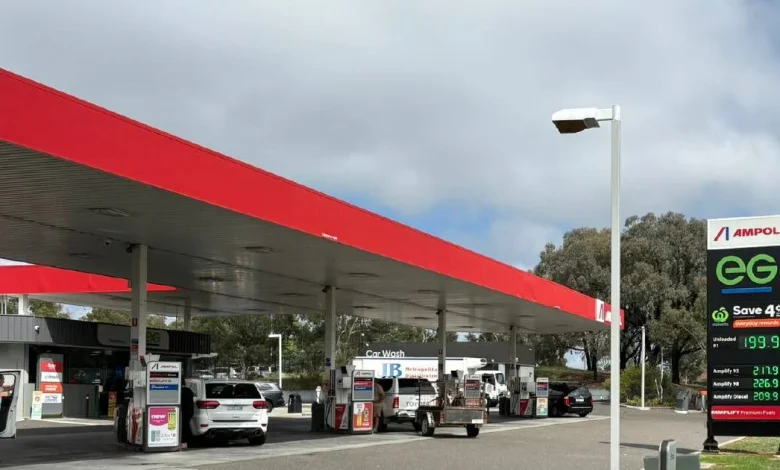
At a fluorescent-lit Ampol forecourt in Belconnen, a handwritten price board read $1. 99 and a small queue formed as shoppers wrestled with a simple calculation: fill up now or risk higher costs later. The rise in petrol has become a daily headache for families and drivers across the capital.
What has driven recent Petrol price rises in the capital?
The immediate trigger cited by local motoring groups was a jump in wholesale oil costs after military strikes in the Middle East. The motoring organisation NRMA tracked an increase in the average price for a litre of unleaded from $1. 81 to $1. 88 in the period described, and real-time tracking showed Unleaded 91 averaging around $1. 90 in Canberra. Some forecourts later touched $1. 99 per litre while Sydney faced even higher averages.
NRMA spokesman Peter Khoury said, “We are monitoring price movements carefully. Canberra’s price of $1. 88 is by no means the most expensive. ” He also noted that the events in the Middle East had affected prices almost immediately and that the wholesale price of oil jumped by 10 cents per litre following the bombing of Iran.
Who feels the impact and how serious is it?
For households the effect is immediate and concrete. Grace Mills, 69, from Nicholls, described swapping taxis for driving her husband to medical appointments and warned that “the fuel price rise is going to increase the price of fruit and vegetables. ” “I chose to drive him around in my car instead, but this fuel price rise will really pinch us, ” she said.
For drivers who earn by the hour, margins are tightening fast. Uber driver Ash Ahmed, who moved from Sydney to Queanbeyan, laid out the arithmetic: “I spend $150 on fuel to drive customers for a week and make $1, 000. Today, the price in Macquarie is $1. 97 for 91. I fear I’ll be spending more and earning less. I might have to leave this profession and look for alternatives. “
Not all service stations priced the same. The Ampol in Majura recorded a low of $1. 64 for Unleaded 91 on the date cited, while a warehouse seller listed $1. 78 and other forecourts ranged from $1. 92 to $1. 99. Some suburbs reported temporary shortages, though availability returned within days.
Are officials and economists warning of broader effects?
Reserve Bank governor Michele Bullock warned that “things can change quickly” and highlighted a possible “supply shock” — specifically the closure of the Strait of Hormuz, a waterway through which a fifth of the world’s crude normally travels. That supply shock was named as a risk that could add to inflationary pressures.
Belinda Allen, head of Australian economics at the Commonwealth Bank, said the jump in international oil prices, if sustained, “would add 0. 1 percentage points to inflation per quarter. “
What responses have emerged and who is watching prices?
Motoring groups NRMA and RACQ have accused some retailers of using the conflict as an excuse to lift prices and urged scrutiny of retail behaviour. An Australian Competition and Consumer Commission spokesperson said that fuel prices were “determined by the market” and warned that making false or misleading statements to consumers about price rises would breach consumer law.
Retail variation was visible across the city: some motorists lined up for the lower-priced forecourts while others encountered pumps charging near $1. 99. The pattern of sharp local differences, combined with rapid movement in wholesale costs, has prompted public frustration and calls for closer oversight.
Back at the Ampol in Belconnen, the queue thinned as shoppers left with filled tanks and a new calculation about weekly budgets. The price numbers remain in flux, the supply risks untouched, and for many like Grace Mills and Ash Ahmed the question is practical: what trade-offs will they make next? The forecourt, for now, keeps providing an answer in cents and litres.