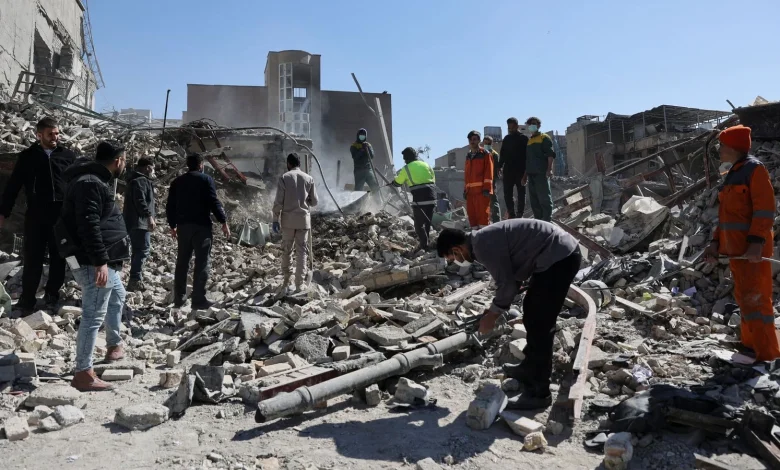
As Israel and the US ramp up strikes on Iran and regional exchanges intensify, trump declared it “Too Late!” for negotiations even while embassies in Gulf capitals were struck and air defenses intercepted waves of missiles and drones. The violence has opened new fronts, seen evacuations around major airports and produced figures that highlight a stark financial imbalance between offensive drone campaigns and costly regional missile defenses.
Trump’s Public Posture and Strategic Claims
The political signal from the US presidency has been stark: trump wrote that it was “Too Late!” to restart talks with Tehran and has suggested the United States is prepared for a longer operation than initially described. That public posture coincides with a stepped-up kinetic campaign in which Israel launched a fresh wave of strikes against targets in Iran and issued evacuation orders for areas around an airport in Karaj. Ground forces movements have also been acknowledged on at least one front, with troops reported to have entered southern Lebanon as part of measures described as precautions for residents of northern Israel.
Military and Civilian Toll: Embassies, Casualties and New Fronts
The conflict has reached diplomatic compounds: Iranian drones struck the US embassy in Riyadh, starting a minor fire and prompting guidance for Americans to avoid the compound, and there has been a separate attack on a US embassy in Kuwait. Another diplomatic facility was reported hit in Dubai. Front-line escalation has produced civilian casualties and displacements: Israeli strikes have targeted areas in and around Beirut and other Lebanese towns, with the Lebanese Ministry of Health confirming multiple fatalities and injuries in several strikes. One city near Jerusalem experienced falling shrapnel after interceptions, following an earlier strike that killed nine Israelis.
On the US military side, four US troops killed since the conflict began have been named, underscoring the human cost that US officials and lawmakers warn will continue if ground operations expand. The battlefield has also broadened to include missile salvoes toward northern Israel and shelling that prompted evacuations across southern Lebanon and the southern suburbs of Beirut.
Economic and Strategic Costs of Missile-Drone Exchanges
Analyses of recent defensive campaigns expose a sharp financial asymmetry. Kirsty Grieco at the Stimson Centre in Washington, DC, has found that one country in the Gulf shot down roughly 92% of incoming Iranian missiles and drones. Estimated unit costs show a single interceptor capable of downing ballistic missiles can cost $4–5 million, while an Iranian ballistic missile costs $1–2 million. Grieco calculates Iran spent between $11 million and $27 million to launch 541 drones in one wave, while interceptors averaged $500, 000–$1. 5 million to shoot down 506 of them. That puts the defending state’s expenditure in that episode between $253 million and $759 million—20 to 30 times what it cost Iran to launch the assault.
Regional interceptions have continued: Saudi Arabia’s defence ministry said two cruise missiles and nine drones were intercepted and destroyed over an area south of Riyadh. At the same time, analysts estimate the US could deploy up to 400 Tomahawk cruise missiles—about 10% of an estimated 4, 000 Tomahawks available—and the US has previously used a substantial share of its missile defense inventories in prior strikes.
Expert Perspectives and Political Warnings
General David Petraeus, former director of the Central Intelligence Agency, warned that Iran had made a “big mistake” by extending attacks beyond military targets to civilian infrastructure and assets in Gulf states, arguing this widened the conflict. Kirsty Grieco (Stimson Centre, Washington, DC) emphasized the cost imbalance between cheap offensive drones and expensive interceptors, illustrating how defense expenditures can be rapidly exhausted. US Senator Chris Murphy (United States Senate) cautioned that the current approach looks like an “open-ended engagement with no end in sight, ” warning that policy choices in Washington leave the prospect of more American casualties and the potential insertion of ground forces on the table.
These expert observations map onto operational realities: air defenses are being tested by wide salvos that can overwhelm interception capacity, while offensive nodes have struck ports, airports and bases, further complicating civilian protection and regional stability.
Regional Ripple Effects and Global Stakes
The fighting has already spread across multiple countries and actors, disrupting oil flows and prompting evacuations in populated areas. Hezbollah-aligned groups have declared escalatory responses, launching missile salvoes toward northern Israel and engaging in cross-border shelling. The combination of diplomatic strikes, infrastructure targeting and high-cost defense responses creates a feedback loop that threatens to entrench a prolonged regional confrontation rather than a brief punitive operation.
With key capitals sustaining hits to diplomatic facilities and with defense budgets absorbing steep, immediate costs to protect civilian populations and critical infrastructure, the conflict’s trajectory will hinge on whether political leaders sustain rhetoric favoring extended operations or move toward de-escalatory channels.
As battlefield exchanges continue and the financial burden of defense accumulates, one central political question remains: will the posture signaled by trump and echoed by allied militaries translate into a finite campaign, or will the region face a longer, more costly phase of conflict that reshapes strategic balances and civilian exposures?