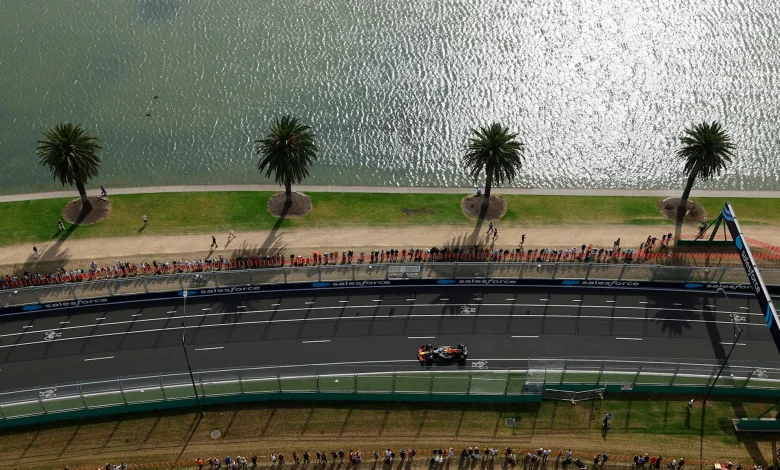
cars arrive at the Australian Grand Prix this weekend as the 2026 season opens against a backdrop of clear weather at Albert Park and a sweeping rule overhaul that reshapes power delivery and strategy. The combination of predictable track conditions and far-reaching technical change makes this more than an opening round — it is an early test of which teams have mastered the new balance between internal combustion and electrical power.
What Happens When Cars Run under the 2026 Power-unit Rules?
The 2026 regulations reset the balance between internal combustion and electrical systems toward a roughly 50/50 split between sustainable fuels and electric power. The motor generator unit – kinetic (MGU-K) maximum deployment has risen nearly threefold from 120 kW to 350 kW, while the internal combustion engine (ICE) potency has been constrained from upwards of 550 kW to roughly 400 kW through limits on fuel flow and compression ratio. Battery capacity remains capped at 4 megajoules, which means a fully charged battery can be depleted about three times faster than before. To replenish that charge around a lap, the MGU-K can recover energy at a higher maximum rate of 350 kW and teams can harvest roughly 8 MJ to 9 MJ of electrical energy depending on the circuit.
These rule shifts create a technical landscape that drivers and engineers describe as materially more complex. Seven-time world champion Lewis Hamilton called the new framework “ridiculously complex, ” and former Red Bull team principal Christian Horner warned the new cars could look like “Frankenstein” creations. For this weekend, teams will be balancing the higher instant electrical power available against tighter ICE constraints and the practical limits of a 4 MJ battery cap.
What If Weather Steers the Opening Weekend?
The weather forecast for the Australian Grand Prix at Albert Park points to generally dry, clear conditions across practice, qualifying and the race, reducing one axis of uncertainty for teams adapting to the new rules. Below is the event forecast as provided for the weekend:
| Session | Temperatures (air) | Track Temperature | Winds | Chance of Rain |
|---|---|---|---|---|
| Friday, March 6 — FP1 & FP2 | 15°C to 22°C (max expected 21. 81°C, min 15. 12°C) | ≈40°C | Light to moderate, peaking at 12 km/h | 5% |
| Saturday, March 7 — FP3 & Qualifying | 12. 8°C to 19. 1°C (max expected 19. 09°C, min 12. 81°C) | ≈29. 9°C | Moderate, avg 11. 9 km/h, gusts to 40. 3 km/h | 5% |
| Sunday, March 8 — Race | 12. 8°C to 24°C (max expected 24. 04°C, min 12. 81°C) | ≈45. 4°C | Light to moderate, avg 6. 8 km/h, gusts to 41 km/h | 0% |
Clear skies and low precipitation probabilities should allow teams to focus on extracting performance from the new power architecture rather than responding to rain-related variability. Track temperatures that warm significantly during the race day will also influence tire and thermal management strategies under the altered power split.
What If Outcomes Break Down into Three Plausible Scenarios?
Best case: Teams adapt quickly to the higher MGU-K deployment and the 4 MJ battery cap, using improved electrical deployment and harvest strategies to generate consistent lap-time gains. With dry, stable conditions at Albert Park, the weekend becomes a clean technical baseline by which comparative progress can be judged.
Most likely: The greater complexity advantages teams that integrated the new power-unit philosophy early in winter development. Engineers who optimize the interplay between faster electrical deployment and limited battery capacity will win qualifying and race-day strategy battles, while gusty moments remain a tactical variable but not a dominant one.
Most challenging: Mismanagement of battery depletion or recovery under race conditions yields inconsistent performance across stints; in combination with occasional strong gusts, that could amplify strategic divergence and create an unpredictable race order despite the benign precipitation outlook.
As the season opener, the Australian Grand Prix will be the first empirical test of how the 2026 rules translate on track. The clear weather at Albert Park narrows one set of variables, but the technical transformation — higher MGU-K limits, a reduced ICE output, and a strict 4 MJ battery cap — ensures that the weekend is a decisive early indicator of which teams and drivers have aligned their operations to the new electrical-and-fuel balance. Fans and competitors should watch both lap times and energy-management patterns to understand who has gained the upper hand as the new era of cars begins.