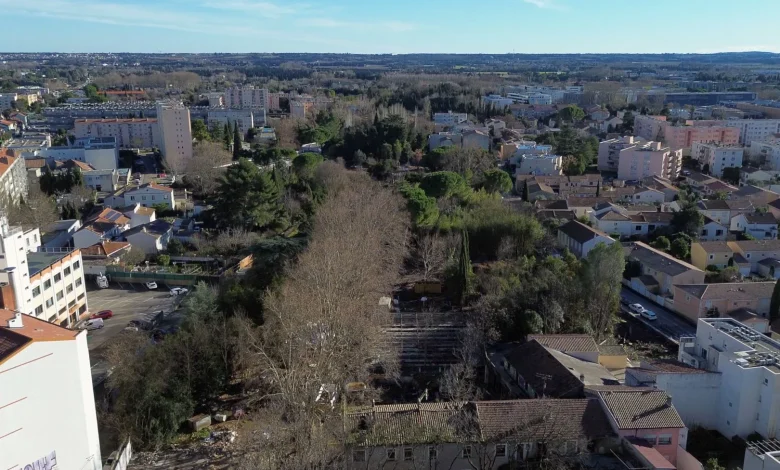
On a bright morning a drone hovers above spades and tree crowns: earth has been moved, pathways are being traced and the dense, arboretum-like foliage of the former pépinières Pichon folds back into the city. The parc Jacques Chirac, set south of Nîmes’s centre and stretching for more than 1. 5 kilometres, is being remade into roughly ten hectares of public green intended to open in autumn 2027.
What is the parc Jacques-Chirac and where will it run?
The parc Jacques Chirac occupies the historic site of the pépinières Pichon, a horticultural estate south of the centre that will link the Triangle de la Gare to the voie urbaine sud. The project extends a Diagonale Verte through the city, prolonging the landscape and ecological continuity between the Bois des Espeisses, the Jardins de la Fontaine and the allées Feuchères, and completing a chain to the Terres de Rouvières and the Bois des Noyers. At over 1. 5 kilometres in length and about ten hectares of developed parkland, planners say it will offer promenades, relaxation and leisure spaces accessible to all, with a target public opening in September or the broader autumn of 2027.
How is the project balancing nature, history and public use?
The site carries a layered horticultural history. After more than 25 years of fallow growth, the grounds still host significant specimens: chestnuts, centenary plane trees, cedars, umbrella pines, Osage orange and stands of giant bamboo that resemble an in-town arboretum. Philippe Deliau, landscape architect for the agency Alep, notes the challenge was to work with what was already there: he described discovering an “incredible forest” and a very rich plant heritage that the design seeks to preserve as much as possible while opening the site to visitors.
That balance has practical consequences. Some trees have been felled where they were dead, hazardous or overly dense; report figures for the chantier note 178 trees removed, with plans to plant 1, 650 trees and 14, 000 shrubs. A preserved alignment of centennial plane trees, a 150-year-old Lebanon cedar and a poplar grove are among the historic elements saved within a new layout of promenades and varied landscape sequences.
What are the practical steps and who is making them happen?
The city of Nîmes is driving the conversion of the former nurseries into a public park, with technical work already under way. Works began in November and have included night operations to prepare a traffic deviation, and interventions to ensure the park will be safely connected across a busy ring road. A passage illuminated day and night, roughly twenty metres long, has been imagined to link the park to the Vistre riverbanks beyond the boulevard; parts of the boulevard Allende will be raised by around eighty centimetres to create a secure, vegetated pedestrian crossing that can be closed at night for safety.
Jean-Paul Fournier, mayor of Nîmes, frames the project as a major transformation of a strategic southern sector: he describes it as an opportunity to offer residents an accessible, calming and environmentally respectful park while preserving the site’s identity. Practically, the plan deploys a central route with varied landscape sequences—resting pergolas, restored greenhouse halls, rain and mist gardens, themed plantings, clearings and play areas—alongside around three kilometres of soft pathways to ensure fluid movement for pedestrians and cyclists within the park.
Designers are also thinking of wildlife. The preserved tree stands and undergrowth aim to support local biodiversity, and planners have sought ways for fauna to cross the infrastructure boundaries that once hemmed in the site.
Back under the hovering camera, the chantier reads as layered work: conservation of notable specimens, removal and replacement where necessary, engineered crossings and a new program of public sequences. Philippe Deliau calls the future park a “place of freshness and sociability, ” while the mayor positions it as a fertilizing link between city and territory.
When the opening day arrives in autumn 2027, the same drone will show a different scene: pathways where machines now grind, play areas where construction material sits and, between them, the retained trees and new plantings knitting the former pépinières into a living diagonal. For residents who watched the site fall into wilderness over decades, the parc Jacques Chirac promises both a recovered natural heritage and a newly staged public commons—an intervention that is at once a tribute and a transformation.