Holi Festival Reveals a Fractured Tradition: Bonfires of Renewal, Playful Beatings and Martial Pageantry

Millions of people are celebrating the holi festival, the festival of colours, in India and across the world — a spring ritual that proclaims the triumph of good over evil while accommodating traditions that range from communal bonfires to organised stick-beating and martial displays. That contrast reframes what many outside the region assume is a single, uniformly joyous event.
Holi Festival: Ritual at the centre — what is not being told?
Verified fact — The holi festival marks the end of winter and celebrates the victory of good over evil: participants light bonfires on the eve of the main event to symbolise the burning of the demoness Holika, a ritual commonly known as Holika Dahan. Devotional threads connect the festival to the divine love of Radha and Krishna; Mathura and Vrindavan are among the northern cities most closely associated with those celebrations.
Verified fact — Celebratory behaviour includes smearing bright pigments on family and friends, throwing colours in the streets, dancing to traditional and film music, and consuming customary foods and a milk-based drink called thandai. Children engage with toy pistols and water dispensers during the festivities. Holi is also observed beyond India, including in Nepal.
Central question — What should the public know that often gets compressed out of tourist-friendly descriptions: that the rituals and local customs tied to the festival vary dramatically and sometimes include forceful, confrontational elements?
How regional rites, tourism framing and public safety collide
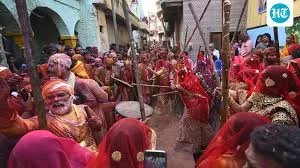
Verified fact — Regional expressions of the holi festival differ sharply. In Barsana and Nandgaon, a tradition known widely for its ritualised retaliation involves women using large wooden sticks (lathis) while men accept blows with shields as part of a performative sequence connected to Krishna legends. In Anandpur Sahib, Hola Mohalla — started by Guru Gobind Singh — emphasises martial arts, mock battles and horsemanship rather than only the play of powders. Other regional forms include Dhulandi in Haryana, Basanta Utsav in West Bengal where students wear yellow, Rang Panchami in Maharashtra, Shigmo in Goa and Yaosang in Manipur featuring the Thabal Chongba moonlight dance.
Verified fact — The festival’s evening bonfires, powder-throwing and water fights remain the common denominator, but the execution can feel like a different event from one district to the next: playful, mischievous, sombre, or martial.
Analysis — The packaging of the holi festival as a short “colour-coded getaway” for long weekends flattens these distinctions. When promotional narratives emphasise photogenic powders and communal merriment, they can obscure practices that are ritualised, potentially hazardous, or rooted in local historical meanings. That estrangement may leave both visitors and casual observers with an incomplete understanding of safety considerations, consent norms and the cultural logic behind apparently confrontational customs.
Accountability and a forward look: transparency, context and community leadership
Verified fact — The common practice of lighting bonfires on the eve of the festival functions as a symbolic communal reset; regional customs then reshape how the next day is lived. Verified fact — Multiple distinct festivals and names coexist under the broad seasonal observance, and some communities prize martial readiness or ritualised roughness as central components.
Analysis — Preserving the holi festival’s cultural integrity while safeguarding participants requires clearer communication from organisers and community leaders about what each local tradition entails and what risks, if any, are involved. Promoters and travellers should distinguish between visual spectacle and ritual practice to avoid normalising behaviours that are not universally practiced or consented to. Local custodians of ritual — from temple authorities to community committees and historical custodians of Hola Mohalla — are positioned to lead that dialogue.
Call for transparency — Where the holi festival is presented as an attractive short-break experience, organisers and hosts should make regional specificities explicit: the nature of local rites, expectations of participants, and any safety measures in place. That public reckoning is grounded in the festival’s own emphasis on renewal: if Holika Dahan symbolically burns away the bad, communities and organisers can use the moment to renew commitments to clarity and consent rather than to erase the complexities that make the observance culturally meaningful.