The most striking fact in the juha miettinen case is not only that a 66-year-old Finnish driver died in a seven-car crash, but that viewers watching the live coverage did not see the incident itself. Instead, the broadcast moved to red flags, an ambulance on track, and a prolonged period of uncertainty before the scale of the tragedy became clear.
What happened at Nürburgring?
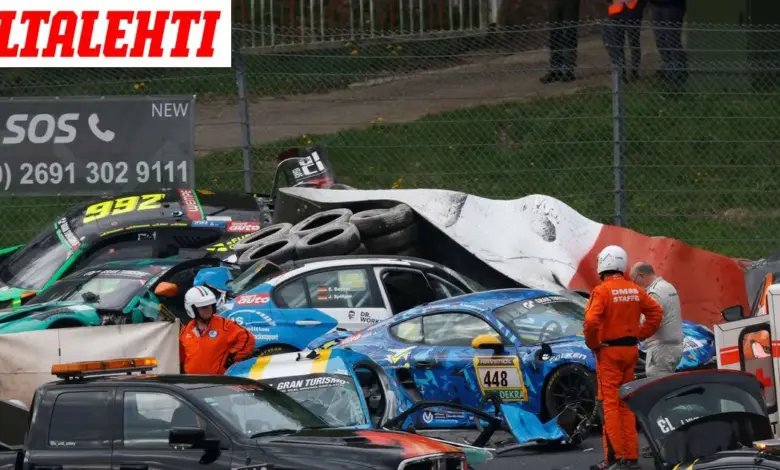
Verified fact: The accident took place during the qualifying session for the ADAC 24h event at Nürburgring, on the third lap, in the Klostertal corner. Seven cars were involved. The session was stopped immediately after the crash, and the race control response was described as urgent, with major rescue and medical measures beginning at once. Juha Miettinen later died at the medical center after attempts to save him failed.
Informed analysis: The structure of the incident matters. This was not a brief interruption in a quiet race; it was a chain reaction at speed, on a demanding track, during a session tied to a major endurance weekend. The fact that the crash unfolded in a multi-car sequence suggests a problem that extended beyond one driver and into the density and risk of the racing environment itself.
Why did the broadcast reveal so little at first?
The live Nürburgring YouTube feed did not show the crash when it happened. Cameras were focused on another part of the circuit, and only the red flags became visible near the finish line. The commentator then stated that the qualifying was being stopped and said he had never seen anything like it before. He also noted that an ambulance had been seen on track, while the audience still did not know exactly what had happened.
That gap between the visible broadcast and the real emergency is important. It shows how motorsport audiences can be left with fragments: a flag, a medical vehicle, and a commentator trying to assemble events in real time. In this case, the absence of the crash itself delayed public understanding of the seriousness of the situation. The juha miettinen name only became central later, after organizers confirmed the fatal outcome.
Who was affected, and what did organizers say?
Verified fact: Organizers said that rescue and medical work began immediately after the collision. They also stated that six other drivers were taken either to the track medical center or to nearby hospitals for further checks, and that none of them were known to have life-threatening injuries. The competition was stopped and would not continue on Saturday. Later, organizers said Sunday’s four-hour race would go ahead, and that a minute of silence would be held before the start in memory of Miettinen.
The public response from the racing world also reflected the seriousness of the loss. The International Automobile Federation and Max Verstappen both expressed condolences. Verstappen described the moment as a reminder that motorsport, while loved by those who follow it, remains dangerous. His reaction underscores a central tension in this story: the event was part of a celebrated racing weekend, yet it ended in a fatal crash that immediately shifted attention from competition to mortality.
What does this tell us about risk, response, and responsibility?
Informed analysis: Taken together, the facts point to three truths. First, the Nürburgring session moved from routine competition to tragedy in seconds. Second, the public saw only the aftermath at first, which left uncertainty to fill the space before confirmation. Third, the official response focused on rescue, suspension, and memorialization, while the broader risk inherent in the setting remained unmistakable.
This is where the juha miettinen case becomes more than a single fatality. It exposes how quickly a prestigious race weekend can become a crisis, and how dependent the public is on timely, precise communication from organizers when lives are at stake. The facts available show immediate rescue efforts and a formal acknowledgment of the loss. They also show how much was hidden from the audience in real time, not by design alone, but by the nature of the coverage and the speed of the unfolding event.
For motorsport, that combination should prompt a sober reckoning. The question is not whether racing carries risk; that is already clear. The question is whether the systems around it — on-track safety, broadcast transparency, and crisis communication — are sufficient when the risk becomes real. On the evidence available here, the answer is not fully settled. What is settled is the outcome: Juha Miettinen died after a seven-car crash at Nürburgring, and the race weekend was forced to confront the cost of that reality. The lesson of juha miettinen is that speed, spectacle, and silence can collide faster than the audience can process them.