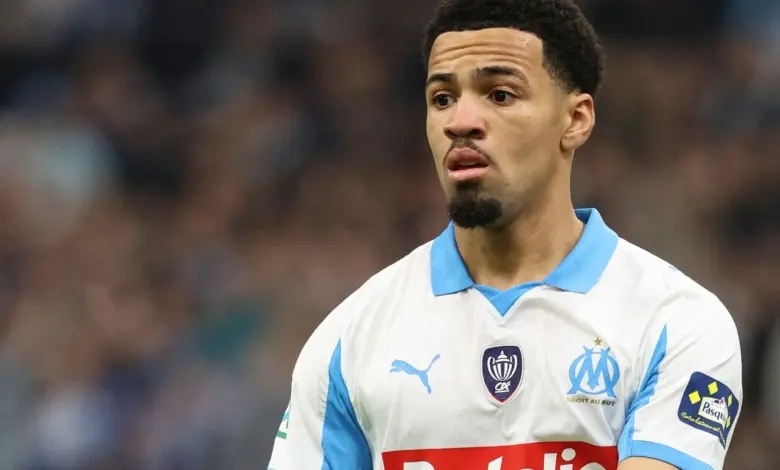
The Marseille manager has turned Ethan Nwaneri’s loan into a test of more than talent. The 19-year-old, sent from Arsenal in January, arrived with the promise of regular football and a fast reset. Instead, his most recent run in France has been defined by reduced minutes, a bench role, and now a pointed public warning from Habib Beye. In a move that shifts the discussion from selection to standards, the message was clear: ability is not enough if daily commitment is questioned.
Why the Marseille manager’s message matters now
The timing is significant. Nwaneri has not started a match since being substituted at half-time against Paris Saint-Germain on February 8, and he was left unused in Marseille’s 1-1 draw with Nice on Sunday, the fourth time he has remained on the bench without coming on. That is a sharp change from the early optimism around the move, when he scored 13 minutes into his debut in a 3-1 win over Lens on January 24. For a loan designed to build momentum, the drop in involvement matters as much as any tactical choice.
The Marseille manager’s comments also land in a period when the club is not enjoying stability. Marseille have won just one of their last five matches and sit sixth in Ligue 1. In that setting, each squad decision carries added weight, especially when minutes are scarce and pressure on the dressing room is increasing.
What lies beneath the commitment warning
Beye’s public line was unusually direct. “He’s a quality player, ” he said on Sunday, “but he has to show us a lot more in his everyday commitment. Other players have shown a lot more. ” That framing suggests the issue is not simply form or fitness, but how the player is being judged day to day. For a young footballer on loan, that distinction is crucial, because trust is often built in training before it appears in a matchday squad.
There is another layer to the story. Nwaneri joined Marseille on a short-term deal from Arsenal in January, and the move was shaped in part by the prospect of working under Roberto De Zerbi, who has since left and taken charge at Tottenham Hotspur. The managerial change means the original plan has already shifted once, and the latest criticism from the Marseille manager creates a second reset, this time around selection and attitude. In that sense, the loan is no longer only about development; it is now about whether the player can adapt to a new standard fast enough to stay involved.
The Marseille manager’s stance also sends a wider signal inside the squad. When a player is benched despite recent attacking absences around him, the message is that hierarchy alone does not guarantee opportunity. The club’s decision-making appears to be rewarding perceived intensity, not reputation.
Marseille manager Habib Beye and the pressure on a young loanee
From an analytical perspective, this is where the loan becomes fragile. Nwaneri’s brief at Marseille included a bright start, but his recent record shows how quickly momentum can fade when starts are unavailable. The context matters: he is still 19, still adapting, and still operating in a new environment. Yet the club’s public criticism suggests patience may be limited if the staff believe the training ground effort does not match the talent.
That creates an uncomfortable balance for both sides. Marseille need players who can contribute immediately in a tense league run-in. Arsenal, meanwhile, will be monitoring the situation with interest because the loan includes financial provisions tied to appearances, including a fee linked to how much he plays and a development fee if he does not receive enough minutes in France. The structure makes his role more than symbolic; it has direct practical consequences.
Expert perspective and wider club implications
Beye’s remarks are not backed in the context by outside commentary, but the club’s own position is unmistakable: standards are being emphasized publicly. For Marseille, that may help reinforce discipline during a difficult spell. For Nwaneri, it means every selection decision now carries added scrutiny. His early goal against Lens showed why the move attracted attention in the first place, but the current situation shows how quickly a loan can become restrictive when trust slips.
That is why the marseille manager storyline has become more than a single quote. It now shapes the interpretation of the whole spell: a promising arrival, an early high point, then a stretch of reduced involvement and a direct challenge from the head coach. The question is not whether Nwaneri has quality; Beye has already answered that. The real issue is whether he can translate that quality into the daily application the staff want to see.
Regional stakes and what comes next
Marseille’s position in Ligue 1 adds urgency, because sixth place and a narrow recent run leave little room for passengers. With Nantes next on Saturday, the squad’s internal competition is likely to remain intense. For a player on loan, that means the path back into the picture depends not just on one good performance, but on rebuilding confidence in every training session and every squad decision.
There is a broader lesson here as well. Loans are often sold as opportunities, but they can become tests of fit, discipline, and timing just as quickly. In Nwaneri’s case, the early promise is still there, yet the latest comments have made the margin for error much smaller. If the situation does not improve, the season could end with the same question it now poses: what happens when a move designed for growth starts to look like a waiting room?
The marseille manager has already made his position clear. The next response belongs to Nwaneri.